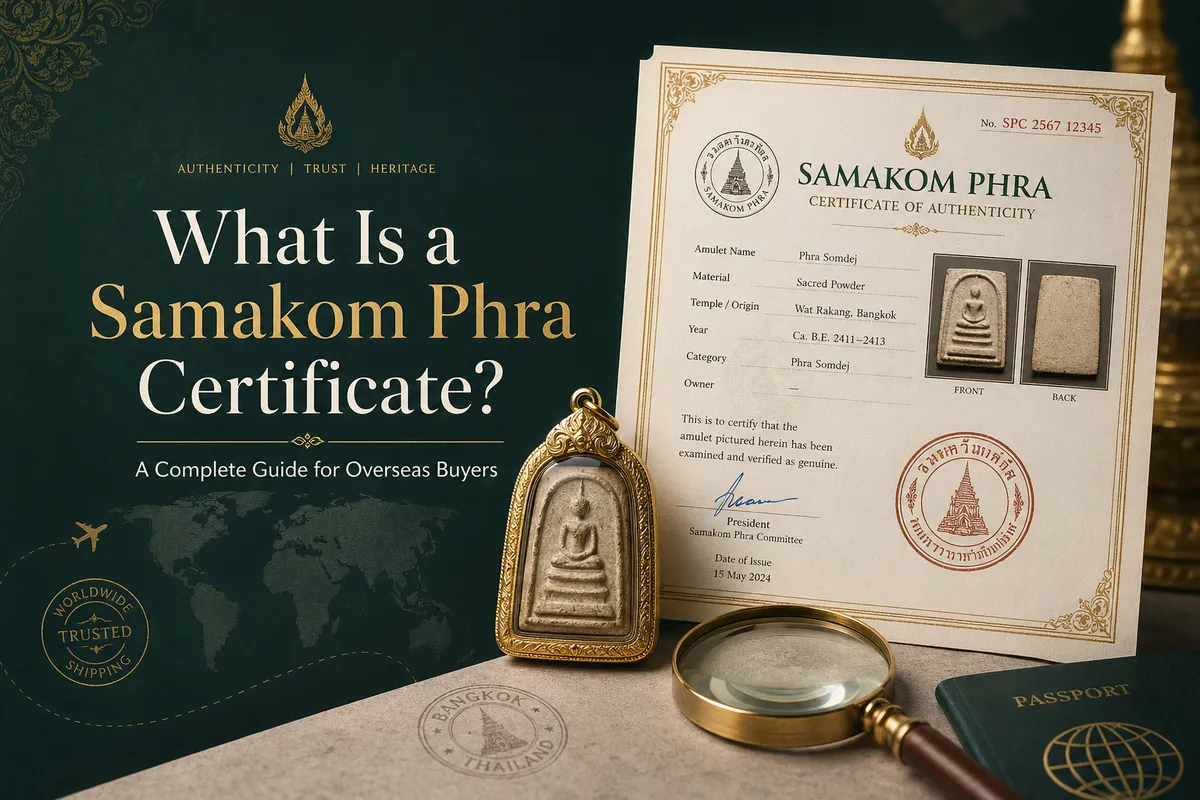
If you've ever tried to buy a Thai amulet online and wondered how to know whether it's real, the answer is usually three words: Samakom Phra certificate. This document is the closest thing the Thai amulet market has to an official passport for an amulet.
1. What Is Samakom Phra?
Samakom Phra Krueang — often shortened to just "Samakom Phra" — is Thailand's largest and most respected amulet authentication organization. Founded decades ago and headquartered in Bangkok, it brings together senior collectors, temple scholars, and certified appraisers who evaluate amulets for authenticity and historical significance.
When an amulet passes their review, Samakom Phra issues a formal certificate that travels with the piece as permanent documentation. Think of it the way a major auction house issues a certificate of authenticity for fine art: it doesn't guarantee spiritual power (that's a matter of personal belief), but it does guarantee that the physical object is what the seller claims it to be.
Key Facts
- Samakom Phra is a non-government, member-run organization — independent from any single temple or seller
- Assessments are conducted in person; the physical amulet must be examined, not just a photo
- Certificates are numbered and recorded, making them traceable
2. What Does the Certificate Actually Look Like?
A genuine Samakom Phra certificate is a printed document, typically in Thai, attached to or stored alongside the amulet.
Key Facts
- Certificate number: A unique ID printed on the document — this is what you use to verify authenticity independently
- Amulet description: The name of the amulet, the monk or master who blessed it, the temple of origin, and the approximate year of creation (Buddhist Era calendar)
- Organization seal and signatures: Official stamps and the signatures of the appraisers who reviewed the piece
If a seller claims a piece has a Samakom Phra certificate but cannot show you a photo of the actual document — front and back — treat that as a red flag.
3. Why Does the Certificate Matter for Overseas Buyers?
The Thai amulet market is enormous and largely informal. Without the ability to inspect an amulet in person at a Bangkok market, overseas buyers are at a significant disadvantage. The Samakom Phra certificate shifts the balance.
Key Facts
- No physical inspection needed: The certificate represents the judgment of experts who did inspect the piece
- Resale value: Amulets with valid certificates consistently command higher prices and sell faster on the secondary market
- Cross-border trust: Thai sellers who deal seriously with overseas buyers understand that international customers rely on third-party verification
We have processed over 200 certified amulets at Merit Messenger across five years of operation, and certificate status is the single most common question we receive from customers in the US, Europe, and Southeast Asia.
4. How to Verify a Samakom Phra Certificate
Key Facts
- Ask the seller for a clear photo of both sides of the certificate before purchasing
- Cross-reference the certificate description with the amulet itself: Does the name, temple, and era match?
- Work with trusted dealers: Reputable sellers will proactively share certificate documentation and welcome verification questions
5. Common Amulets That Typically Come with Certificates
Key Facts
- Amulets blessed by deceased high-ranking monks are more likely to have certificates because the demand — and the forgery incentive — is highest
- Modern amulets from living monks are less commonly certified, though some temples issue their own documentation
- If you are buying a piece priced above ฿6,600, it is reasonable to expect — and ask for — a Samakom Phra certificate
Frequently Asked Questions
Q: Can a Samakom Phra certificate be faked?
A: Yes, forged certificates exist, which is why verification beyond the physical document matters. Legitimate sellers welcome scrutiny. If a seller resists your request to verify, walk away.
Q: Does every genuine Thai amulet have a Samakom Phra certificate?
A: No. Many authentic amulets — especially newer or lower-value pieces — have never been submitted for certification. A certificate confirms authenticity; the absence of one does not prove an amulet is fake.
Q: What language is the certificate in?
A: Thai. Most overseas buyers will need help reading it. A reputable seller should be able to translate the key fields for you: amulet name, temple, monk, year, and certificate number.
Q: Is a Samakom Phra certificate the same as a temple certificate?
A: No. Temples sometimes issue their own documentation. A Samakom Phra certificate is issued by an independent third-party organization and generally carries more weight in the collector market.
Last updated: 2026-04-27 | Author: Merit Messenger Team (Bangkok-based)
Ready to take the next step? If you want to see certified amulets currently available, or have questions about a specific piece, visit our authentication guide — it walks through every step of the verification process in plain English.