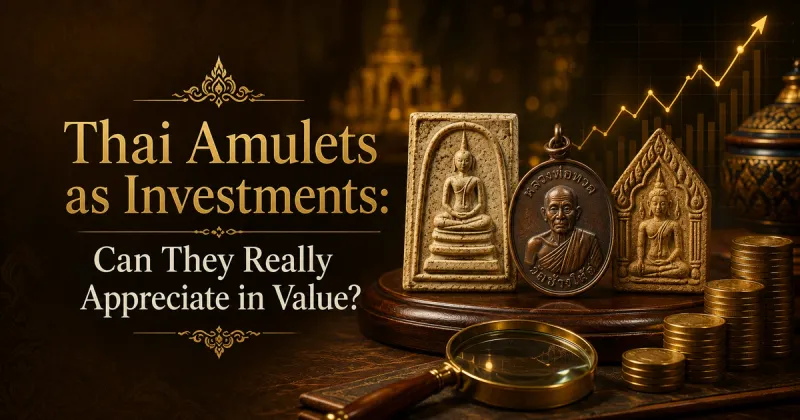
Yes, rare Thai amulets can appreciate dramatically — top specimens have sold for millions of dollars. But amulet investing requires deep specialist knowledge, carries authentication risk, and has no regulated market. It is best approached as a passion-driven hobby where appreciation is a bonus, not as a pure financial play. The amulets most likely to gain value are those from famous monks, in excellent condition, with proven provenance.
The numbers that turn heads
A single Phra Somdej Wat Rakang amulet — a small piece of sacred powder roughly the size of a thumb — has reportedly changed hands for over 100 million baht (approximately $3 million USD). That is more than a luxury Bangkok condominium.
While these are exceptional cases, they illustrate a real phenomenon: the Thai amulet market is a multi-billion baht industry with a collector base that treats certain pieces with the same reverence (and price tags) that Western collectors reserve for fine art or rare watches.
What drives amulet value
1. The monk
This is the single most important factor. Amulets from monks who are widely recognized as spiritual masters — with decades of meditation practice and documented miraculous experiences — command the highest prices. The monk's reputation is the "brand" in amulet collecting.
2. Rarity
Limited production runs naturally drive value. When a famous monk creates only 1,000 amulets in a specific ceremony, and that monk has since passed away, the supply is permanently fixed while demand continues to grow.
3. Age and condition
Older amulets from monks who are no longer alive carry a premium — the supply can only decrease as pieces are lost, damaged, or permanently housed in private collections. Condition matters enormously: an amulet with crisp details and minimal damage can be worth 10 times more than a worn specimen from the same batch.
4. Provenance
A documented chain of ownership — especially if the amulet has won awards at amulet competitions (ngan phra) — adds significant value. An authenticated, competition-graded piece removes the uncertainty that plagues the market.
5. Historical significance
Amulets connected to important events, landmark ceremonies, or turning points in Thai Buddhist history carry a narrative premium that transcends their physical characteristics.
The "Benjapakee": Thailand's blue-chip amulets
The Thai amulet collecting world has its own version of blue-chip investments — the five most revered amulet types known as the Benjapakee:
- Phra Somdej Wat Rakang: Created by Somdej Toh in the 1860s. The undisputed king of collectible amulets.
- Phra Nang Phaya: Ancient amulets from Phitsanulok, dating to the Sukhothai period (13th-15th century).
- Phra Rod: From Lamphun province, among the oldest known Thai amulets (8th-11th century).
- Phra Phong Suphan: From Suphanburi province, highly valued for their charm-enhancing properties.
- Phra Somdej Wat Bangkhunprom: Another creation associated with Somdej Toh.
Authentic Benjapakee pieces are the equivalent of Old Master paintings — extremely rare, extremely expensive, and requiring expert authentication.
More accessible investment-grade amulets
You do not need millions to collect amulets with appreciation potential. Several categories offer more accessible entry points:
- Early editions from recently deceased masters: When a respected monk passes away, his earliest and rarest editions typically jump in value as the market prices in permanent scarcity.
- Limited ceremony editions: Special amulets from one-time ceremonies (temple anniversaries, royal events) with documented small production runs.
- Rising-reputation monks: Amulets from monks who are building strong reputations but have not yet reached peak fame. This is the amulet equivalent of buying an emerging artist's work.
The risks you need to understand
Authentication risk
Counterfeiting is the biggest threat. Sophisticated fakes can fool casual collectors, and even experts sometimes disagree on authenticity. Without reliable authentication, you might be investing in a worthless reproduction. See our authentication guide.
Illiquidity
Unlike stocks or gold, amulets cannot be sold instantly at a market price. Finding the right buyer for a specific piece can take weeks, months, or longer. There is no centralized exchange or transparent pricing mechanism.
No regulation
The amulet market is entirely unregulated. There are no consumer protection laws specific to amulet transactions, no standardized grading system (though expert competitions serve a similar function), and no recourse if a private sale goes wrong.
Emotional attachment
Many collectors find it difficult to sell amulets they have worn and felt connected to for years. If you are collecting primarily for investment, this emotional dimension can complicate exit decisions.
Practical advice for collector-investors
- Start with knowledge, not money: Spend at least 6-12 months learning before making significant purchases. Join collector communities, attend amulet fairs, handle as many pieces as possible.
- Buy the best you can afford: One high-quality piece from a reputable source is better than ten questionable bargains.
- Insist on authentication: For any piece over ฿16,500, seek third-party verification from recognized experts or competition grading.
- Document everything: Keep records of provenance, purchase receipts, authentication certificates, and photographs.
- Store properly: Invest in quality cases and climate-controlled storage. Physical damage directly reduces value.
- Never invest more than you can afford to lose: Treat amulet collecting as a passion with potential financial upside, not as a retirement plan.
FAQ
Q: How do I find out what my amulet is worth?
A: Start by identifying the exact edition (monk, temple, year, batch). Then consult specialist dealers, online collector communities, or amulet competition records for comparable sales. There is no "Blue Book" for amulets — valuation requires specialist knowledge.
Q: Are modern amulets worth collecting for investment?
A: Potentially, but it is a long-term play. A modern amulet from a monk who is building a strong reputation today could appreciate significantly if that monk becomes widely revered over the coming decades. The risk is that not every promising monk achieves lasting fame.
Q: How does the amulet market compare to art or wine investing?
A: Similar in many ways — passion-driven, requires expertise, illiquid, authentication-dependent, and potentially very rewarding for knowledgeable collectors. The key difference is that amulets also carry spiritual value, which means the market is driven by both collectors and practitioners.
Last updated: June 2026 | By the Merit Messenger team, based in Bangkok
Building a collection? Browse our curated amulets — each piece comes with full provenance documentation. Contact us for advice on collectible pieces.