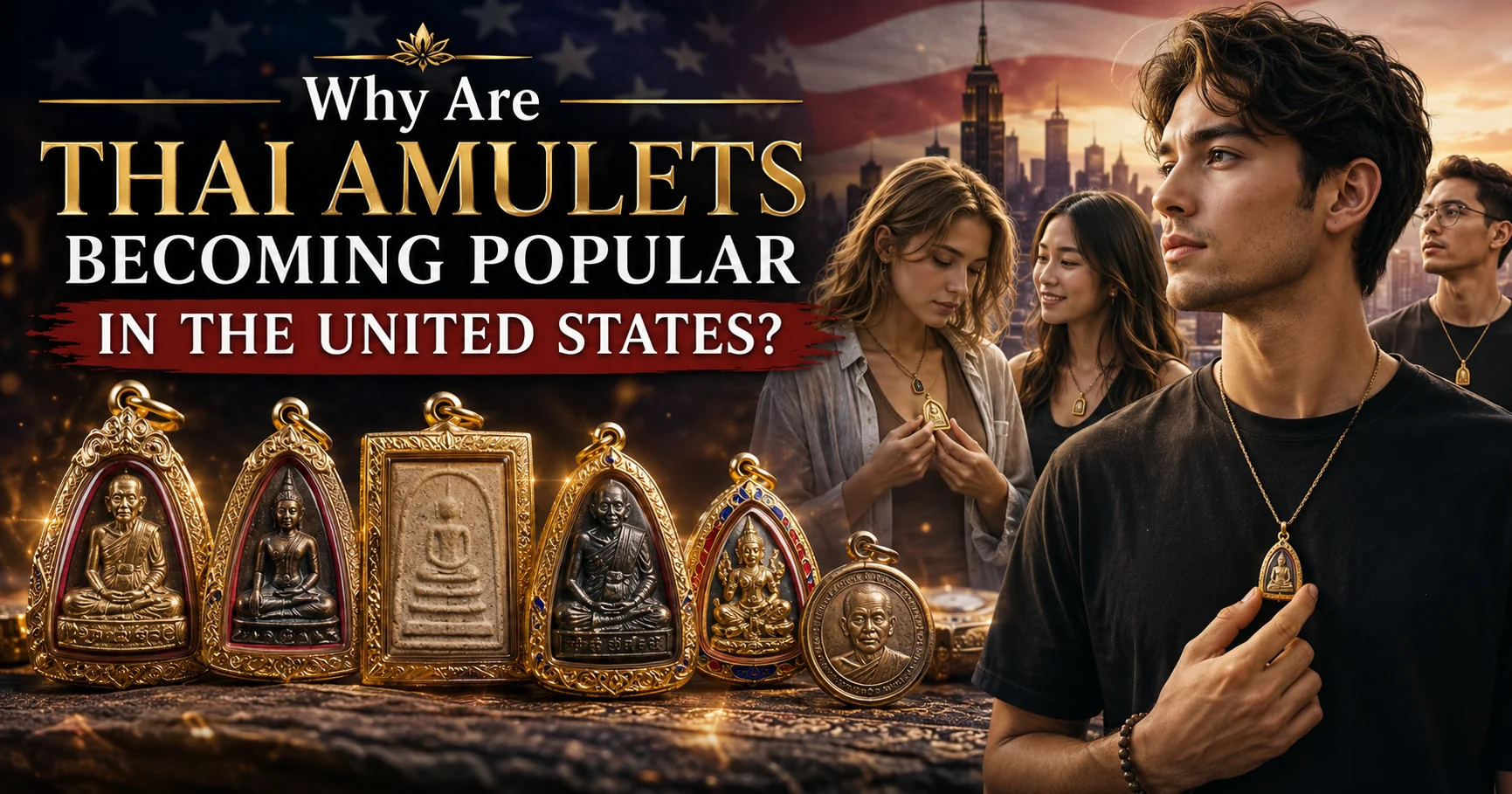
Thai amulets are trending in the US because they sit at the intersection of three things American buyers already value: spiritual meaning, wearable everyday jewellery, and objects with a genuine cultural story behind them. Rising life pressure, declining attachment to traditional religion, and social-media-driven curiosity about Eastern spiritual culture have all converged to make Thai amulets one of the most talked-about crossover collectibles in the Western market right now.
1. Americans Haven't Stopped Believing — They're Looking for Something New
It's tempting to assume that as the US grows more secular, demand for spiritual objects must be falling. The data tells a different story. Younger Americans are less likely than previous generations to identify with a formal denomination, but their interest in personal spirituality has not declined — it has diversified. Crystals, tarot, astrology, sound healing, meditation, yoga, and Buddhist philosophy have all seen measurable growth in mainstream US consumer culture over the past decade.
Thai amulets fit naturally into this landscape. They don't require joining an organisation or adopting a fixed doctrine. They carry Buddhist symbolism and a monk's blessing, but they can be appreciated by anyone drawn to mindfulness, Eastern philosophy, or simply the idea of carrying something meaningful. For a generation that builds its own spiritual practice from multiple traditions, a Thai amulet is a compelling addition.
2. Thai Amulets Have Exceptional Storytelling Power
American consumers respond strongly to provenance — the story behind an object. A standard necklace is metal and design. A Thai amulet is a specific master, a specific temple, a specific year, a specific consecration ceremony, and a specific intended blessing. That layered origin story is exactly what the US "meaningful object" market rewards.
- Specific master: Who blessed it, when they lived, what they were known for
- Specific temple: Where it was made, the tradition it comes from
- Specific blessing: Protection, love, prosperity, courage, danger evasion — each type has a defined purpose
- Specific material: Sacred powder, copper, bronze, gold-plated — each carries its own significance
When you acquire a Thai amulet, you're not just buying a pendant. You're entering a story that has been running for decades — and that's what commands attention, trust, and lasting value.
3. It's a Wearable Spiritual Object — a Category America Already Buys
One of the most underappreciated advantages of Thai amulets in the Western market is simple: you can wear them every day. Many spiritual objects — statues, altarpieces, incense burners — stay at home. Amulets go with you. In a culture where pendant necklaces, charm bracelets, and intention jewellery are already a mature consumer category, Thai amulets don't need to create new buying behaviour. They slot into an existing one.
For American wearers, a Thai amulet can carry several layers of meaning simultaneously:
- Protection: A sense of safety during commutes, travel, or difficult periods
- Identity signal: An expression of interest in Buddhist culture, mindfulness, or Eastern spirituality
- Aesthetic choice: The aged patina, temple-case craftsmanship, and iconography look unlike anything in Western jewellery
- Psychological anchor: In uncertain times, a physically present object with personal meaning provides genuine comfort
4. Social Media Has Supercharged the Mystique
TikTok, Instagram Reels, YouTube Shorts, and Pinterest are ideally suited to Thai amulet content. The visual language is compelling: aged copper patina, ornate gold-plated cases, incense smoke in a Thai temple, a revered monk's face on a medal, a collector's tray of rare pieces. These images stop the scroll.
The questions US viewers typically ask after encountering Thai amulet content are exactly the questions a good product page should answer: Which temple did this come from? Why is this monk famous? What does this amulet actually do? How do I know it's genuine? Where can I get one that's real, not a tourist copy?
A decade ago, an American interested in Thai amulets would have needed to travel to Bangkok, visit a Chinatown, or know someone in the Southeast Asian diaspora. Today a single video can spark genuine purchase intent — and a well-structured English-language product page can capture it.
5. Life Pressure Is Real — and Protective Objects Are One Response
Economic uncertainty, housing costs, career competition, healthcare anxiety, and social fragmentation are all measurably elevated in the contemporary US. In that environment, objects that offer a sense of protection, luck, or grounding find a ready audience. This isn't naive magical thinking — it reflects a well-documented human pattern: when external uncertainty rises, people seek internal stability through tangible anchors.
Thai amulets meet this need without requiring the buyer to commit to any specific belief system. The same piece can be worn as a sincere Buddhist protective charm, a mindfulness reminder, a cultural collectible, or simply a beautifully made object that feels significant to carry. That flexibility is a feature, not a weakness.
6. Thai Amulets Offer Cultural Depth That Generic Lucky Charms Don't
The US market is not short of protective symbols: crosses, saint medals, horseshoes, evil eye pendants, crystals, zodiac charms. Thai amulets occupy a different tier because of their compositional complexity. A single piece may incorporate sacred powder from ancient amulets, blessed earth from temple grounds, hand-applied lacquer, monk-chanted incantations during a multi-day consecration ceremony, and iconography drawn from centuries of Theravada Buddhist tradition.
That density of meaning is what makes serious collectors willing to pay serious prices — and what makes Thai amulets defensible at a premium alongside Western fine jewellery. The more cultural background an object carries, the more durable its long-term collecting value.
7. Thai Tourism Planted the Seed
For many American buyers, the first contact with Thai amulets happened in Thailand. Bangkok's famous amulet markets, temple precincts in Chiang Mai, the roadside stalls near major shrines — these are vivid, memorable experiences for travellers. A piece bought as a casual souvenir can become the entry point into a genuine collecting interest once the buyer is back home and starts researching what they bought.
The typical journey: encounter in Thailand → casual interest → social media research → online purchase from a trusted English-language source. Sellers who can serve buyers at the end of that journey — with clear provenance, English descriptions, and authenticated pieces — are capturing a market that tourism already warmed up.
8. US Buyers Want Transparency, Not Hype
This is arguably the most important point for anyone selling Thai amulets to an American audience. US consumers in the spirituality and collectibles space are specifically wary of exaggerated claims. They've been burned by overselling before — in crystals, in "energy" jewellery, in "rare" coins — and they research before they buy.
What US buyers actually want to know: Where does this piece come from, specifically? Who made it, and why does that matter? How old is it, and how do you know? What does it represent — in plain language? Is there a certificate or third-party authentication? What's the return policy if it turns out to be fake?
Answering these questions honestly and specifically — rather than leading with vague claims about luck and destiny — is what builds the trust that converts a curious browser into a repeat buyer. At Merit Messenger, every piece comes with a verifiable Certificate of Authenticity and a 10× refund guarantee against fakes, precisely because we know this is what the market needs.
9. The Bigger Picture: Eastern Spirituality Meets Personal Protection Meets Niche Aesthetics
Distilled to its essentials, Thai amulet appeal in the US is the product of three converging trends: a generation seeking personalised spirituality outside institutional religion; a mature market for wearable meaningful jewellery; and social media's ability to make niche cultural objects globally visible almost overnight. Thai amulets check all three boxes in a way that few other objects from any tradition can match.
A genuine Thai amulet isn't just a pendant. It's a culture, a story, a lineage, and a personal intention — carried with you wherever you go. That combination is rare in any market. In the US right now, it's exactly what a growing number of buyers are looking for.
Frequently Asked Questions
Q: Do you have to be Buddhist to wear a Thai amulet?
A: No. Many Western wearers appreciate Thai amulets as cultural objects, mindfulness tools, or meaningful jewellery without practising Buddhism. Treating the piece with basic respect — as you would any sacred object from any tradition — is generally recommended.
Q: How do I know a Thai amulet sold online is genuine?
A: Look for sellers who provide specific provenance (temple, master, approximate year), clear photographs of front and back, and a third-party Certificate of Authenticity with a verifiable serial number. Avoid sellers whose descriptions rely entirely on vague claims about "powerful energy" without any factual background.
Q: What kinds of Thai amulets resonate most with Western buyers?
A: Protection amulets (especially Klaew Klaad / danger-evasion types) and monk self-image medals (Roop Lor) tend to resonate most strongly with first-time Western buyers — the iconography is clear, the purpose is universally relatable, and the craftsmanship is visually striking.
Q: Are Thai amulets expensive?
A: The range is enormous — from a few dollars for contemporary mass-produced pieces to six figures for authenticated vintage pieces from legendary masters. For most Western buyers entering the market, well-authenticated pieces from respected twentieth-century masters in the ฿3,300–฿16,500 range offer an excellent balance of cultural significance, genuine rarity, and accessible price.
Q: Where should I start if I'm new to Thai amulets?
A: Begin by reading about the master or temple associated with any piece you're considering. Reputable English-language sources include dedicated collector forums, Thai Buddhist cultural organisations, and sellers like Merit Messenger who publish detailed provenance alongside every listing.
Last updated: May 2026 | Written by: Merit Messenger Team (Bangkok-based)
Ready to find your first authentic Thai amulet? Browse our verified collection — every piece comes with a Certificate of Authenticity and a 10× authenticity guarantee. Questions? Contact us anytime.