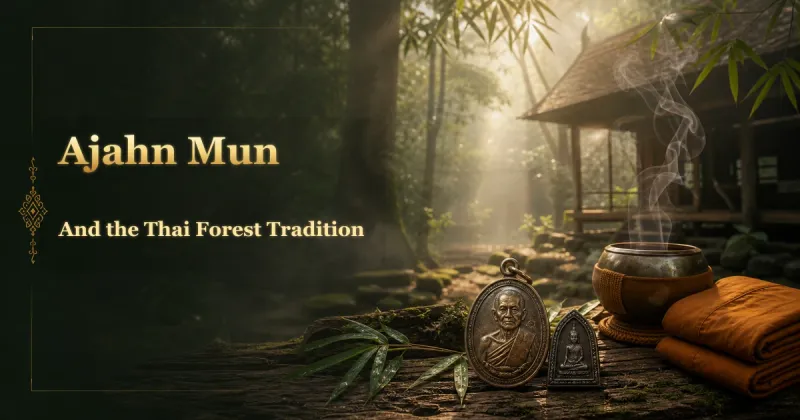
Ajahn Mun Bhuridatta (1870-1949) holds a paradoxical place in the amulet world: he is one of the most revered monks in Thai history, and he made almost no amulets. He owned nearly nothing, walked the forests for half a century, and taught that the only true protection is a purified mind. Yet precisely because of that renunciation, everything genuinely connected to him — posthumous medallions, relics, pieces by his forest disciples — carries a reverence money can barely price. Understanding Ajahn Mun means understanding why scarcity of intention, not marketing, builds the deepest trust in Thai devotional culture.
The wanderer: a life on foot
Born on 20 January 1870 in Ban Kham Bong, Khong Chiam district, Ubon Ratchathani, Mun ordained fully on 12 June 1893 at Wat Liap, and with his teacher Ajahn Sao Kantasilo turned toward the strictest reading of the monk's life: dhutanga — austere wandering practice — through the forests along both the Thai and Lao banks of the Mekong. In 1912, in Sarika Cave in Nakhon Nayok, he passed through the decisive breakthrough of his practice — meditating through chronic illness to a profound realization that anchored his authority for the rest of his life.
He spent his final years teaching at forest monasteries in Sakon Nakhon province, and died on 11 November 1949 at Wat Pa Sutthawat, aged 79, after 56 years in robes. With Ajahn Sao he is credited as founder of the Thai Forest Tradition (the Kammatthana lineage) — today the most internationally respected school of Thai Buddhism.
The relics: why devotees speak of crystals
Central to Ajahn Mun's posthumous veneration is the widely held account that fragments of his cremated remains transformed over the years into crystalline relics — in Thai belief, a physical signature of arahantship. Devotees and forest monasteries across the northeast preserve and venerate these relics; for millions of Thais they settle the question of what his practice attained. Whatever one's view, the relic tradition explains the devotional gravity around anything that touched his lineage.
What collectors actually acquire
Because Ajahn Mun created no amulet editions in the modern commercial sense, the market around him works differently:
- Posthumous medallions (rian): portrait medals struck by temples from the 1950s onward to honor him and fund monasteries — the earliest editions are serious collectibles.
- Disciples' pieces: the realistic devotional path. His students became masters in their own right — Ajahn Thate, Ajahn Maha Bua, Luang Pu Fan, Luang Pu Waen among them — and their documented editions carry the lineage's aura at every price level.
- Relic-associated items: lockets and stupas containing soil, robe fragments, or relic grains from forest monasteries — provenance here is everything and forgery rampant.
The rule of thumb: with a lineage built on owning nothing, paper provenance does all the work. The checklist in buying Thai amulets online safely applies at full strength.
What Forest Tradition pieces are worn for
- Meditation and mental steadiness: the lineage's home ground — students and practitioners wear forest-master pieces as commitment tokens.
- Protection through purity: Thai belief holds that the power of a forest master's blessing lies in the emptiness behind it — nothing asked, nothing performed.
- Discipline and simplicity: many wearers describe these pieces as reminders rather than shields — which is exactly what Ajahn Mun taught.
His place among Thailand's great monks
Thai devotional culture holds two summits that rarely meet: the amulet masters and the meditation saints. Ajahn Mun anchors the second — alongside figures like Kruba Srivichai in the north and Luang Phor Sodh of Wat Paknam — and collector lists of the greatest masters routinely include him even though he pressed no tablets. That inclusion is the point: in Thailand, the deepest source of an object's sanctity is the attainment of the person it touches. The wider category map is in Thai amulet types explained.
FAQ
Q: Did Ajahn Mun ever bless amulets?
A: Accounts exist of him blessing objects brought by devotees, but he issued no editions and discouraged fixation on objects. Authentic "lifetime" pieces are vanishingly rare and mostly unverifiable — treat claims accordingly.
Q: Are Forest Tradition amulets powerful for protection?
A: Devotees believe so, precisely because nothing was sold. But the tradition itself would answer: the practice protects; the object reminds.
Q: Where do I start with the lineage?
A: Documented temple medallions of Ajahn Mun or pieces by his named disciples, from monasteries of the northeast — modest prices, deep meaning.
Last updated: July 2026 | By the Merit Messenger team, based in Bangkok
Interested in documented lineage pieces? Browse our collection or contact us.