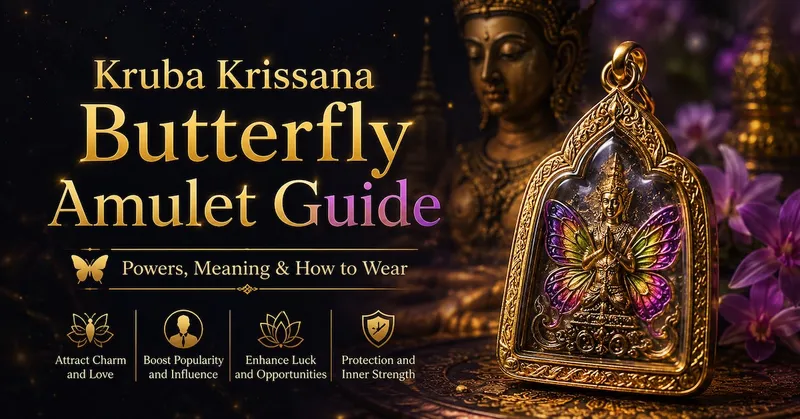
No Thai amulet looks like a Kruba Krissana butterfly. Properly named Taep Jamlaeng (Thai: เทพจำแลง, "the transformed deity"), these hand-painted, gem-studded butterfly amulets broke every convention of somber amulet aesthetics — and became one of Southeast Asia's most sought-after charm traditions, with collectors in Malaysia and Singapore leading the craze. Their maker, Kruba Krissana Intavanno of Nakhon Ratchasima, is known simply as the King of Butterfly.
The master: a forest monk from Korat
Kruba Krissana was born on 1 August 1954, the ninth of ten children. As a young man he followed the monk Kruba Pu into traditional forest practice across Cambodia and Laos, and was ordained in 1979 at age twenty-five, receiving the monastic name Intavanno. He then spent a decade meditating in the jungles of northern Thailand before villagers persuaded him to settle, clearing forest land in Nakhon Ratchasima province to build what became Wat Pa Mahawan.
When the temple's reservoir pond was dug, Kruba Krissana kept the excavated clay as sacred material. That pond mud — blended with 108 kinds of herbal powders and flower pollens — became the body of the butterfly amulets, with the editions around BE 2555 (2012) among the most widely collected.
Why a butterfly? The meaning of Taep Jamlaeng
In Kruba Krissana's teaching the butterfly is not an insect but a deity manifesting in its most beautiful form. A butterfly wins the garden without force: it visits every flower, harms none, and is welcomed everywhere. That is precisely the amulet's strategy — not authority or intimidation, but irresistible likability.
The design elements carry meaning: a deity's face on the butterfly's body, colored gems arrayed for charm in all directions, and takrut scrolls (two, four, or more) embedded in the back carrying specific blessings — more takrut generally marking a higher-tier edition.
Powers of the butterfly amulet
- Charm and likability: the core power — a warmer reception in every room you enter.
- Romantic attraction: the butterfly-and-flower imagery gives it a strong reputation in matters of the heart.
- Business popularity: shops, restaurants, livestreams — anywhere footfall and fanbase decide income; this is its main use among Southeast Asian Chinese merchants.
- Patronage: the many-flowers metaphor extends to benefactors and mentors in every direction.
Etiquette and taboos
- A deity-class amulet: wear it below Buddha amulets (see how to wear a Thai amulet).
- Standard rules apply — above the waist, removed in unclean settings and during intimacy.
- The charm-tradition precept: never use attraction to toy with hearts. Thai tradition holds that charm turned to cruelty burns the wearer's own merit.
- Most butterflies are clay-and-powder amulets — a waterproof case is essential.
Genuine pieces and famous editions
High fame plus distinctive craftsmanship equals industrial-scale faking. Three checks: the edition and year should match temple records (the classic editions such as BE 2549 and BE 2555 are well documented); the workmanship — genuine painting, gem-setting, and takrut work is fine and deliberate, fakes are crude; and the seller should disclose the provenance chain from Wat Pa Mahawan and its affiliated temples. For the checks that apply to any purchase, see buying Thai amulets online safely.
Butterfly, fox, or Khun Paen?
Thailand's three great charm routes: the butterfly works on crowd-level popularity, the Nine-Tailed Fox on personal magnetism and attraction, and the Khun Paen on the classic path of charm and love in traditional amulet form. Merchants pick the butterfly, charmers the fox, traditionalists the Khun Paen — the wider landscape is mapped in our guide to Thai love and charm traditions.
FAQ
Q: Is the butterfly amulet occult ("dark") magic?
A: No. Kruba Krissana is a fully ordained monk; the amulets are made of temple clay, pollens, and sacred powders, consecrated in temple ceremonies.
Q: Can men wear the butterfly?
A: Absolutely — salesmen and business owners are among its biggest wearers across Thailand, Malaysia, and Singapore.
Q: Are more gems and takrut better?
A: They mark higher-tier editions and higher prices, but the power comes from the consecration, not the decoration. Buy the legitimate edition your budget allows.
Q: Can I wear it with a Nine-Tailed Fox?
A: Yes — both are charm-class pieces and coexist happily below any Buddha amulet.
Last updated: July 2026 | By the Merit Messenger team, based in Bangkok
Looking for charm amulets with documented provenance? Browse our collection or contact us.