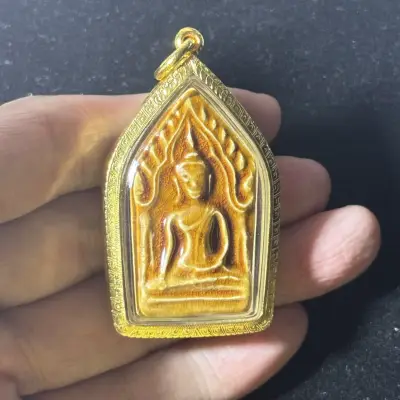
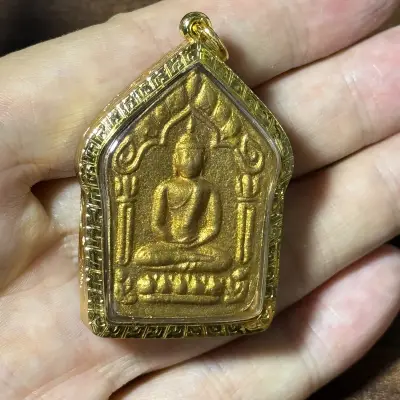
The Thai Nine-Tailed Fox amulet (นางพญาจิ้งจอกเก้าหาง, "Nine-Tailed Fox Queen") was created in 2010 by Achan Meng Khunphaen (อาจารย์เม้ง ขุนแผน, 1957–2021), a Sino-Thai lay ritual master in Bangkok. It is worn for personal allure and attraction, and also for customers and negotiation. The fox is not part of traditional Thai Buddhist iconography: Achan Meng adapted the Chinese fox-spirit cult for Chinese buyers, and whether the amulet counts as Buddhist or as a spirit ("yin") amulet is still argued over. Both sides are set out below.
What the Nine-Tailed Fox is for
a 2024 study in the Journal of the Siam Society is devoted to Achan Meng and his fox amulet. According to it, the powers claimed by Achan Meng and his associates are:
- Attraction: the core claim. A single owner will meet a suitable partner.
- Faithful relationships: a partner who stays loyal, a marriage that warms up again, even an ex who returns.
- Customers and negotiation: for people whose work depends on others, more goodwill from clients and partners, and more customers for small businesses such as restaurants.
- Charisma and confidence: a more appealing presence in social settings.
This mirrors the Chinese idea of the fox immortal (huxian) as a patron of love and fortune, and the study's author suggests Achan Meng designed the amulet with that in mind. These are devotional beliefs; no amulet guarantees an outcome.
Where the fox amulet came from: Achan Meng
Achan Meng was born in 1957 in the Hua Lamphong area of Bangkok to a Teochew Chinese family, surname Lim, and spoke Teochew. He was a lay ritualist, not a monk. As a teenager he learned spirit practices such as kuman thong and rak yom, and later studied meditation, yantra and the Khun Paen incantations under several monks, including Luang Pho Mi Khemmathammo (หลวงพ่อมี เขมธัมโม, 1911–2000) of Wat Marawichai in Ayutthaya.
In the 1980s and 1990s he traded amulets and performed rituals between Chiang Mai and Penang, mostly for Malaysian and Singaporean Chinese clients. He opened his own office in Minburi, Bangkok, in 1997. On 5 September 2010 he consecrated the first batch of fox amulets, and it was an instant hit. By his death on 27 September 2021 he had issued 55 batches of wearable fox amulets, roughly five batches and more than 1,500 pieces a year, plus a few batches of fox statues and yantra cloths. His son, Achan Paeng, took over the office and had issued 12 more batches by September 2024.
Key facts
- Thai name: นางพญาจิ้งจอกเก้าหาง (Nang Phaya Chingchok Kao Hang)
- Creator: Achan Meng Khunphaen, lay ritual master, 1957–2021
- First batch: consecrated 5 September 2010, 212 pieces
- Office: Minburi, Bangkok
- Main following: Chinese communities in mainland China, Hong Kong, Taiwan, Malaysia and Singapore; far less known among Thais
- Authentication mark: pieces consecrated by Achan Meng carry his signature, the Chinese character 明 (Ming)
What the amulets look like
There are two main types. The first is a pressed tablet of consecrated minerals, powders and plants. The front shows the Fox Queen with the words "Nine-Tailed Fox Queen, Achan Meng Khunphaen's Office". Depending on the edition, the back holds gems, see phueng charm wax or takrut, with Burmese script written around it. It has no case, so you add your own. The second is a smaller locket that comes ready to wear. Typical sizes are 4.5 × 3 cm and 5.5 × 4 cm.
Both types are pressed in contracted factories. Achan Meng and his disciples inserted the sacred materials, wrote the scripts and performed the consecration. Formats are explained in Thai amulet formats.
Buddhist amulet or spirit amulet?
This is the question to settle before buying. The study gathered three competing accounts from disciples, rivals and traders:
- The disciples: the Fox Queen is a virtuous celestial who earned her status through thousands of years of practice. The amulet venerates her, like any deity amulet.
- The detractors: the early batches used oil made with the bones and hair of a dead fox, trapping an unquiet fox spirit in the amulet. Later mass-produced batches supposedly contain no such material.
- Some traders: Achan Meng's real expertise was subduing and directing spirits, so the amulet houses a lesser fox spirit and is a yin amulet that helps its owner in return for regular offerings.
The author concludes that all three come from insiders and none can be treated as definitive. Our advice is to be cautious and treat it by the rules for a spirit amulet: keep it off the chain that holds your Buddha and monk amulets, and keep up the offerings.
How to worship the fox, and the taboos
Achan Meng's self-published 2014 catalogue sets out four rules:
- Faith: respect for the Fox Queen and for the master who consecrated the amulet.
- Conduct: try to be an upright, moral person.
- Offerings: the fox loves beauty, so perfume and cosmetics; sweets for a "sweet" life. You may eat the offerings afterwards as food shared with the fox.
- Chanting: when making a wish or an offering, hold the amulet or place it on the altar and recite the office's katha nine times, ideally every day.
Common practice in Thailand adds a few more:
- Wear it separately from Buddhist amulets, or carry it in a bag.
- Never use it to break up a couple. This is a serious taboo in Thai belief and contradicts Achan Meng's own rule of upright conduct.
- Do not throw it away. If you stop wearing it, return it to a temple or the office.
- Usual etiquette: take it off for intimacy and in unclean places. See Thai amulet rules and taboos.
Fox statues for the home follow the same rules: a clean, high place, not facing the bed and not near a bathroom.
Most fox amulets on the market are not Achan Meng's
Fakes appeared around 2011, soon after the first success, and other masters followed with fox amulets of their own, including Kruba Krissana, Achan O, Achan Pricha and Achan Subin. When the study's author surveyed Bangkok's Tha Phra Chan amulet market in 2023, most fox amulets on sale there were neither made nor authorised by Achan Meng.
- Ask who consecrated it: Achan Meng, Achan Paeng or another master. They are different amulets.
- Pieces consecrated by Achan Meng carry the 明 signature, and each batch came with an authentication guide.
- According to the study, fox amulets sold at the office cost roughly 10,000–25,000 baht, and the famous early batches (the first three, the 6th and the 9th New Year edition) normally sell for at least 50,000 baht. Be wary of "early Achan Meng" pieces priced far below that.
General checks are in how to spot fake Thai amulets.
Nine-Tailed Fox or Khun Paen?
| Nine-Tailed Fox | Khun Paen |
|---|
| Origin | Chinese fox-spirit belief, created by Achan Meng in 2010 | The Thai epic Khun Chang Khun Phaen, traditional |
| Makers | Mostly lay masters | Mostly monks |
| Focus | Personal allure, attraction | Charm and love, plus protection |
| Buddhist or spirit | Disputed; treat as a spirit amulet | Mostly Buddhist |
| Upkeep | Daily offerings and chanting | Ordinary wearing etiquette |
If you want charm without daily offerings, a Khun Paen is the easier choice. We currently have a Luang Phor Tim 146th anniversary Khun Paen and a Luang Por Charan BE 2556 glazed clay Khun Paen. For customers and business, see Kruba Krissana's butterfly amulet.
FAQ
Q: Is the Nine-Tailed Fox a traditional Thai amulet?
A: No. The study's author found no record of fox veneration in traditional Thai sources. Achan Meng created it in 2010 from Chinese fox-spirit belief, mainly for Chinese buyers.
Q: Can men wear it?
A: Yes. The Fox Queen is female, but devotees are of every gender, and salesmen and business owners often wear it.
Q: Does it attract the wrong kind of romance?
A: The common view is that it depends on what you ask for. Achan Meng required upright conduct, and using the fox for illicit relationships is believed to invite trouble.
Q: Are there still new batches after Achan Meng's death?
A: Yes. His son, Achan Paeng, continues to issue them from the Minburi office, reportedly using some of his father's leftover materials.
Last updated: 2026-10-31 | By the Merit Messenger team, based in Bangkok
Looking for a charm amulet with clear provenance? Browse our collection or contact us for a recommendation.