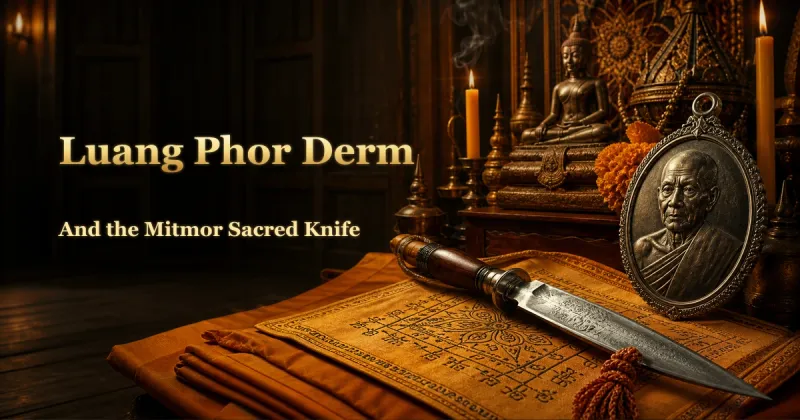
Most Thai sacred objects are worn; one is drawn. The mitmor (Thai: มีดหมอ, "healer's knife" — also called Mit Prab Pairee, "the knife that conquers enemies") is Thailand's ritual blade, believed to cut through what clings: curses, hauntings, runs of misfortune, the invisible knots that medicine cannot reach. And the tradition has one supreme name: Luang Phor Derm Phutthasaro (1861-1951) of Wat Nong Pho, revered across central Thailand as the God of Nakhon Sawan.
The master: the God of Nakhon Sawan
Luang Phor Derm was born on 6 February 1861 in Nakhon Sawan province and ordained on 31 October 1880, in the reign of King Chulalongkorn. As abbot of Wat Nong Pho he became the province's spiritual anchor for seven decades — healer, teacher, and master of protective arts — earning the extraordinary popular title of the province's guardian deity.
His school shaped a generation: disciples who studied under him include Luang Phor Jarun of Wat Ampawan — later famous as a meditation teacher — and Luang Phor Kuay of Wat Kositaram, whose obsessively empowered amulets are among today's fastest-rising collectibles. When collectors trace central Thailand's great lineages, the lines keep running back to Wat Nong Pho.
The mitmor: anatomy of a sacred blade
A mitmor is not a weapon — sizes run from finger-length talismans worn in a sheath to altar blades. What makes it sacred is the making: metals gathered and forged under mantra, handles and sheaths of auspicious materials, the blade inscribed with yant and empowered by the master. Luang Phor Derm's knives — his celebrated "Khmer knife" pattern above all — became the tradition's gold standard, credited in folk accounts with stopping bullets and blades and severing mystical attacks.
The knife's logic differs from a protective amulet's: an amulet shields; the mitmor acts. Thai practice draws it to cut over water for blessing, to sever a haunting's grip on a house, to symbolically cut a patient free from illness or a family free from a run of disasters — always by an owner who treats it as a ritual instrument, not a tool.
Powers attributed to the mitmor
- Severing black magic: the defining function — cutting curses, bindings, and hostile workings.
- Exorcistic protection: spirits are believed to retreat before a consecrated blade; homes keep one against hauntings.
- Personal invulnerability: the classic kong grapan portfolio — protection from weapons and violence; see Thai protection traditions for the wider family.
- Authority and resolve: carried by leaders as an emblem of decisive command.
Etiquette for owning a mitmor
- Keep it sheathed and stored high and clean; unsheathe deliberately, never casually.
- Do not use it as a physical cutting tool — it is an instrument of ritual, not of the kitchen.
- Small worn mitmor follow amulet rules (see our wearing guide); they pair naturally below Buddha amulets, and alongside takrut scrolls from the same protective family.
- Never point it at a person in anger — the tradition is emphatic that the blade serves protection, not aggression.
Collecting: originals and lineage pieces
Original Luang Phor Derm knives are apex collectibles — his death in May 1951 brackets the supply absolutely, and top examples with documented provenance trade at collector-car prices. The counterfeit industry is correspondingly mature: handle materials, blade construction, and inscription style all have documented signatures that experts check against references. Wat Nong Pho and masters of the lineage have continued the tradition with documented later editions — the realistic path for practitioners rather than museum hunters. The standard rules in buying Thai amulets online safely apply, doubled.
FAQ
Q: Is the mitmor a Buddhist object?
A: It belongs to Thailand's blended tradition — forged and empowered by ordained monks within temple ritual, carrying pre-Buddhist blade symbolism under the Dhamma's roof, like much of Thai sacred culture.
Q: Can foreigners own a mitmor?
A: Yes, with the etiquette above. Check your country's customs rules on blade imports for larger pieces; pendant-size mitmor travel as jewelry.
Q: Mitmor or protective amulet — which do I need?
A: Different jobs: the amulet is constant passive protection; the knife is an active instrument for cutting through specific trouble. Thai households that keep both use the amulet daily and the blade rarely — which is exactly the point.
Last updated: July 2026 | By the Merit Messenger team, based in Bangkok
Interested in protective pieces from documented central-Thai lineages? Browse our collection or contact us.