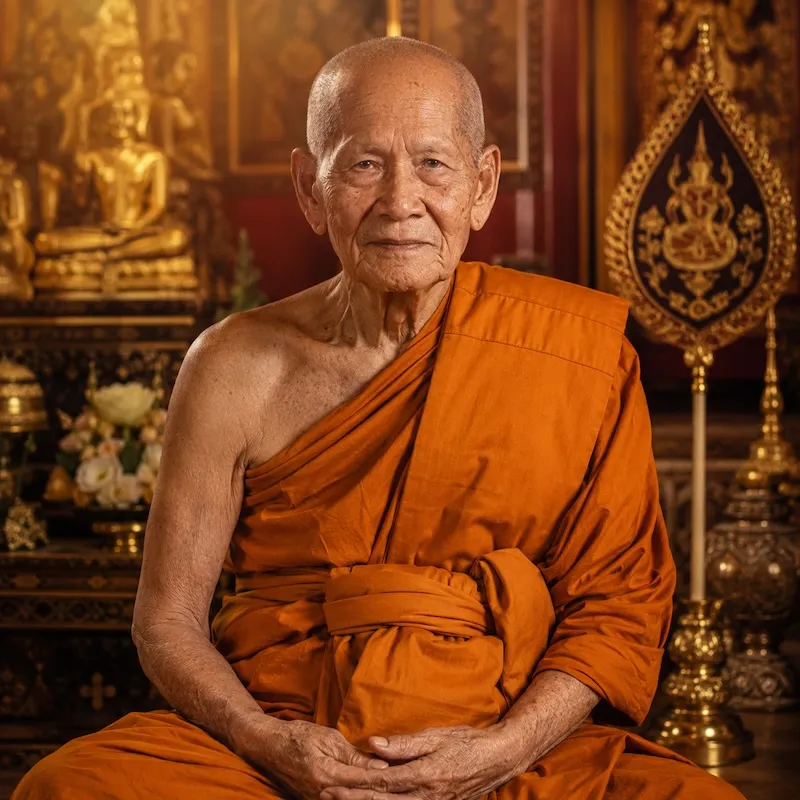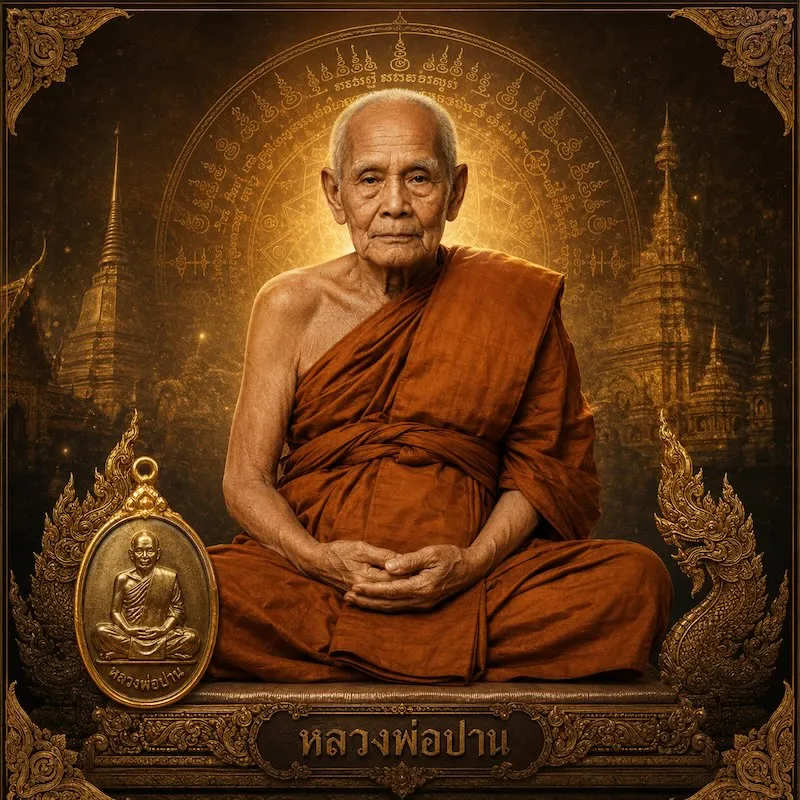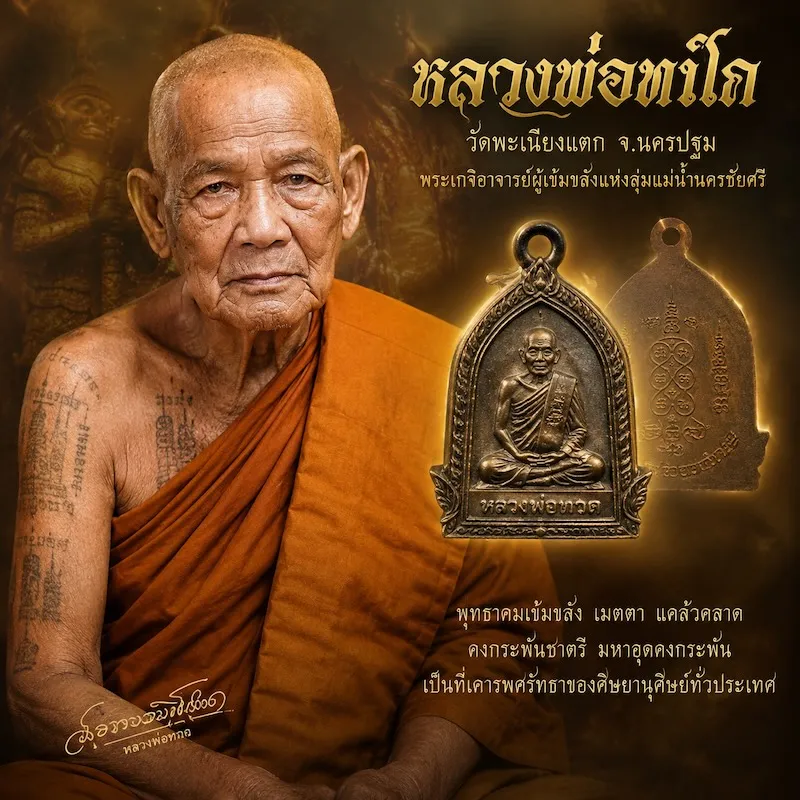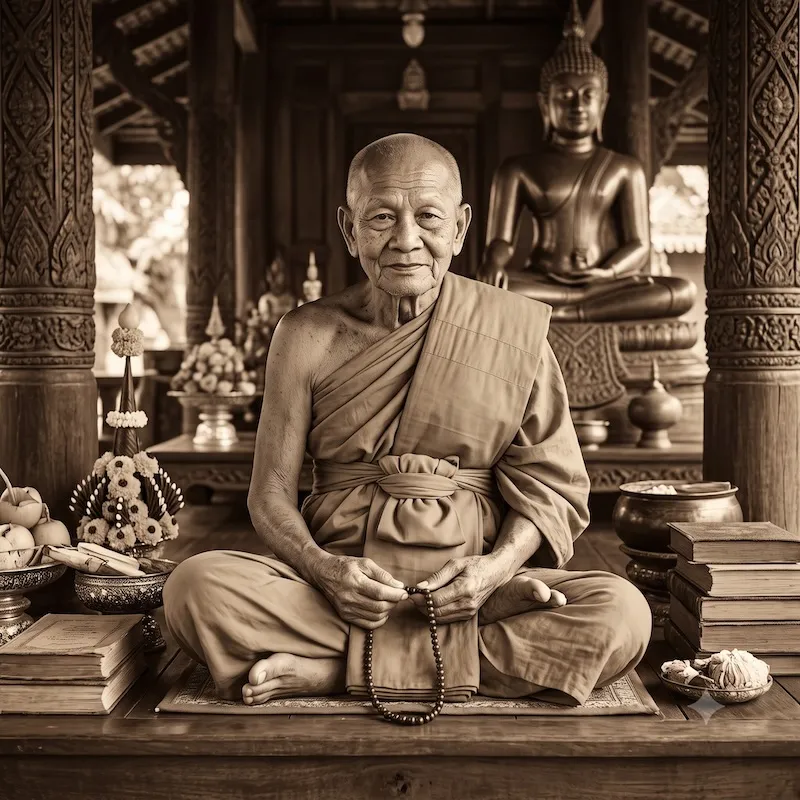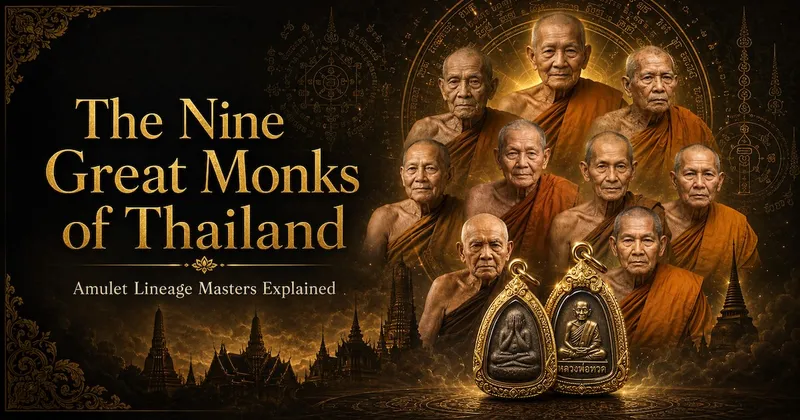
Ask a serious Thai amulet collector who matters most in the history of sacred objects, and you will hear about the Nine Great Monks (in Chinese collector circles, 九大圣僧): Luang Phor Thuad, Ajahn Mun, Somdej Toh, Luang Pu Toh, Luang Phor Ngern, Luang Phor Derm, Luang Phor Parn, Luang Phor Sodh, and Luang Pu Suk. Between them, these nine masters founded nearly every major amulet lineage — protection, meditation, Somdej, Pidta, wealth, sacred knives, animal-mount amulets, Dhammakaya, and mystical arts. This guide introduces each one.
Where does the list come from?
The Nine Great Monks is a collector convention — popularized in the Chinese-speaking amulet community — rather than an official ranking by the Thai Sangha. Different sources swap one or two names (Luang Phor Koon and Luang Phor Tim often appear in variant lists). It also differs from the Benjapakee, which ranks the five classic amulet types rather than the monks themselves. Treat the list as a map of lineages: know these nine masters and you understand most of the Thai amulet market.
The nine masters
1. Luang Phor Thuad (c. 1582-1662)
The legendary monk of Wat Chang Hai in Thailand's deep south, revered as an arahant who is said to have turned seawater fresh to save a ship's crew. His image is Thailand's most trusted protection amulet. Read our full guide to Luang Phor Thuad amulets.
2. Ajahn Mun Bhuridatto (1870-1949)
Founder of the Thai Forest Tradition of meditation, whose disciples spread across the northeast. Authentic amulets connected to him are extremely rare; most collectors instead seek pieces from his lineage of forest masters.
3. Somdej Phra Buddhacharn Toh (1788-1872)
Abbot of Wat Rakhang in Bangkok and creator of the Phra Somdej — the King of Amulets. The most influential figure in Thai amulet history. See our profile of Somdej Toh.
4. Luang Pu Toh (1887-1981)
Abbot of Wat Pradoochimplee in Thonburi and the modern master of the Phra Pidta (closed-eyes Buddha), regarded as the most powerful Pidta maker of the modern era. He was also a teacher revered by the royal family.
5. Luang Phor Ngern (1810-1919)
The wealth monk of Wat Bang Klan in Phichit province. His small self-image statuettes are the ancestral wealth amulet of Thailand — scarce, expensive, and heavily faked.
6. Luang Phor Derm (1860-1951)
Abbot of Wat Nong Pho in Nakhon Sawan, famous for consecrating the Mitmor sacred knife — the highest tradition of blade-form ritual objects, used to cut through evil influence.
7. Luang Phor Parn (1875-1938)
Abbot of Wat Bang Nom Kho in Ayutthaya, known for amulets depicting the Buddha riding sacred animals — Garuda, Hanuman, and others — combining protection with fortune.
8. Luang Phor Sodh (1884-1959)
Abbot of Wat Paknam in Bangkok and founder of the Dhammakaya meditation method. His amulets are prized for mental stability and protection. Read our guide to Luang Phor Sodh.
9. Luang Pu Suk (1847-1923)
Abbot of Wat Pak Khlong Makham Thao in Chai Nat, considered supreme in mystical attainments and teacher to Prince Krom Luang Chumphon. The grandmaster of Thai esoteric arts.
Names that often join the list
Variant lists frequently include Luang Phor Koon (the People's Monk), Luang Phor Tim of Wat Lahanrai (the Khun Paen master), and in the north, Kruba Srivichai. The exact roster matters less than the principle: lineage and provenance outrank rankings.
How collectors use the list
- Choosing a direction: protection points to Luang Phor Thuad, wealth to Luang Phor Ngern, Pidta to Luang Pu Toh, spiritual cutting-through to Luang Phor Derm.
- Judging value: original pieces by these masters are blue-chip collectibles — rare, expensive, and faked on an industrial scale. Newcomers should start with later editions from each master's temple lineage.
- Spotting scams: anything marketed as an original Nine Great Monks piece at a bargain price is almost certainly fake.
Beyond the nine: more renowned masters
Thailand honours many more revered monks beyond the nine, grouped here by lineage:
Wealth & people's monks: Luang Phor Ruay, Luang Phor Koon, Luang Phor Liew.
Protection & sacred-arts masters: Luang Pho Pern, Luang Phor Boon, Luang Phor Kuay, Luang Phor Derm, Luang Phor Parn, Luang Pu Suk.
Somdej lineage: Somdej Toh, Luang Phor Pae.
Forest & meditation masters: Ajahn Mun, Luang Pu Waen, Luang Phor Jarun.
Kruba (northern) lineage: Kruba Bounchum, Kruba Srivichai, Kruba Ariyachat, Kruba Krissana.
Kumanthong lineage: Luang Phor Tae Kongthong, Luang Pu Yeam. See also the five most famous monks.
FAQ
Q: Is the Nine Great Monks list official?
A: No. It is a collector convention. Thai sources more often discuss masters by region, lineage, or era, and variant lists exist.
Q: Can I still buy amulets from these monks?
A: Original pieces circulate mainly among advanced collectors at high prices. Temple lineage editions — consecrated by successors at the same temples — are the realistic entry point.
Q: How does this relate to the Benjapakee?
A: The Benjapakee ranks the five classic amulet types; the Nine Great Monks ranks the masters. They overlap — Somdej Toh created the Phra Somdej that heads the Benjapakee.
Last updated: July 2026 | By the Merit Messenger team, based in Bangkok
Looking for a piece with verified lineage? Browse our collection — every amulet lists its monk and temple provenance.