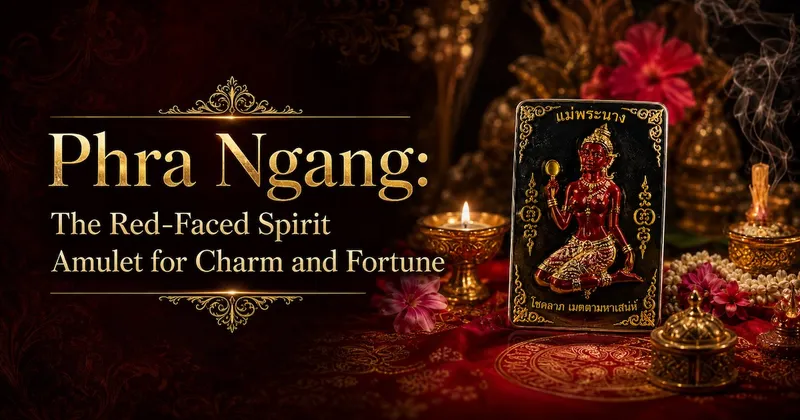
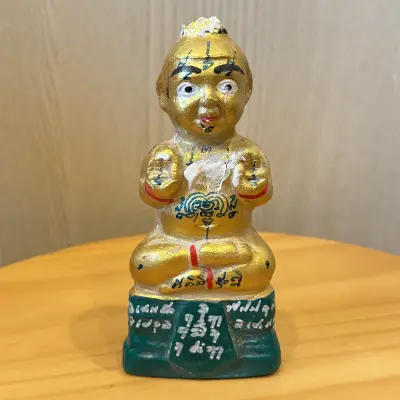
Phra Ngang (Thai: พระงั่ง) is a red-faced spirit amulet rooted in the Khmer sorcery of Cambodia and long popular across Thailand and Laos, recognizable by its fierce red eyes and half-smiling, cross-legged form. It is a classic yin (spirit) amulet, kept for charm, attraction, people-skills, and gambling luck — direct in effect, and far heavier in care and taboo than a Buddhist amulet.
What is Phra Ngang? Origin and appearance
The cult of Phra Ngang has its roots in Khmer sorcery. In legend it is variously a mountain deity, a practitioner who turned to dark arts, or a powerful Khmer protective spirit — which is why Thai folklore sometimes calls it a "ghost king." Its defining feature is its red eyes, traditionally set with amber or gemstones, giving rise to the name "red-eyed Ngang." The face is fierce yet smiling — a world away from the serene countenance of a Buddha amulet.
Powers: charm, people-skills, and windfall luck
- Charm and attraction: Phra Ngang is regarded as passionate and is best known for drawing romantic interest and goodwill from the opposite sex.
- People-skills and sales: those who deal with people, negotiate, or work in sales keep it to boost likability and persuasiveness.
- Windfall and gambling luck: many devotees turn to Phra Ngang for gambling fortune, one branch of the Thai windfall tradition.
Offerings: treat it like a temperamental companion
- Fresh water daily: offer a glass of fresh water each day; when you change it, throw the old water out in front of the house, wash the glass, and only then refill with fresh water — never top up old with new.
- Favored offerings: devotees commonly offer whisky, cigarettes, and images of beautiful women — the idea being to offer what it favors so it lends its help.
- On Buddhist holy days: set out five incense sticks, a pair of white candles, flowers, and traditional offerings. Lotus flowers are forbidden — this is an explicit Phra Ngang taboo.
Taboos every newcomer must know
- Never worn around the neck like a Buddha amulet. Traditionally it is carried in a front trouser pocket or kept separately — a matter of its yin nature and "rank."
- Approach with respect; do not misuse it. Phra Ngang is seen as both protective and vengeful; neglect or using it to harm others is believed to invite backlash.
- Not a first amulet. It demands disciplined offerings and a sound mind; newcomers are better starting with Buddhist amulets and orthodox Kumanthong first.
FAQ
Is Phra Ngang an "evil" amulet?
No — it is a yin amulet from Khmer sorcery, direct and worldly in focus but not evil in itself. What matters is orthodox origin, proper offerings, and sound intent. Using it to harm others is the real problem.
Can I wear Phra Ngang with Buddhist amulets?
You can keep both, but Phra Ngang is traditionally not worn on the neck and must be kept distinct in rank and offerings. Many keep a Buddhist amulet for protection alongside Phra Ngang for charm. See the rules and taboos guide.
Why no lotus flowers?
It is one of Phra Ngang's traditional taboos. Use other fresh flowers on holy days and simply avoid lotus, keeping the rest of the routine — water, whisky/cigarettes, incense and candles — as usual.
What if I no longer want to keep it?
As with all yin amulets, never discard it casually. Return it to a temple or a monk, or respectfully pass it to someone willing to care for it, telling it sincerely. Neglect and casual disposal are serious breaches.
Last updated: July 2026 | Author: The Merit Messenger Team (based in Bangkok)
Want to understand yin versus Buddhist amulets first? Read the full yin amulet overview, or contact us. For terminology, see the Thai amulet glossary.