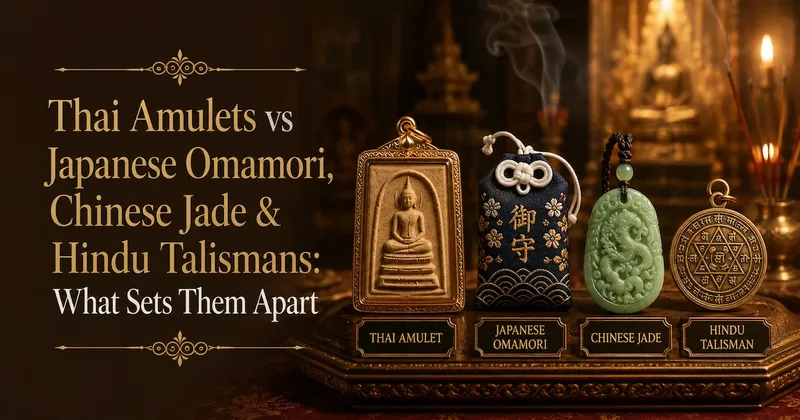
While protective charms exist across Asia, Thai amulets are unique in their monk-centered creation, elaborate consecration rituals, competitive authentication culture, and active secondary market. Japanese omamori are disposable temple blessings, Chinese jade charms emphasize material purity, and Hindu talismans focus on planetary alignment.
The universal human need for protection
Every culture in Asia has developed objects believed to offer spiritual protection, attract good fortune, or connect the wearer to divine power. If you're drawn to Thai amulets, you may have encountered similar traditions from neighboring cultures. Understanding the differences deepens appreciation for what makes each tradition unique — and helps you avoid the common mistake of applying one culture's logic to another.
Thai Buddhist amulets (Phra Khrueang)
Origin: Theravada Buddhist tradition, primarily Thailand, with influences from Khmer and Brahmanist practices.
Creation: Made by monks or under monastic supervision. The creating monk's spiritual attainment (baramee) is considered the primary source of an amulet's power. Materials include sacred powders, temple clay, metals, and ritual ingredients accumulated over years.
Consecration: Elaborate Puttapisek ceremonies involving multiple monks chanting for hours or days. Sacred thread (sai sin) connects monks to the amulets during blessing. Some ceremonies involve hundreds of monks and happen only once.
Collecting culture: Thailand has the world's most developed amulet collecting ecosystem — competitions, authentication services, magazines, grading systems, and a secondary market worth billions of baht annually. Amulets appreciate in value over time, and rare pieces trade like fine art.
Lifespan: Permanent. Thai amulets are meant to last forever and are passed down through generations. Age increases both spiritual and monetary value.
Japanese Omamori
Origin: Shinto and Japanese Buddhist tradition. The word means "to protect."
Creation: Produced at temples (Buddhist) and shrines (Shinto) by priests. Typically fabric pouches containing a paper or wooden tablet inscribed with prayers. Mass-produced in standard designs — the temple's identity matters more than individual craftsmanship.
Purpose: Highly specialized. Different omamori target specific needs: traffic safety (koutsu anzen), academic success (gakugyo joju), romantic love (en musubi), safe childbirth (anzan), and many more. You're expected to choose the right category for your current need.
Collecting culture: Not collected in the investment sense. Omamori are affordable (typically 500-1,000 yen / ฿100-7) and considered consumable blessings. There is no secondary market or authentication culture.
Lifespan: Temporary. Omamori should be returned to the temple after one year and burned in the New Year's bonfire (dondo yaki). Using an expired omamori is considered spiritually stale. This "planned obsolescence" is the sharpest contrast with Thai amulets, which gain power with age.
Key difference from Thai amulets: Omamori are anonymous and disposable; Thai amulets are deeply personalized to their creating monk and become more valuable over time.
Chinese jade charms and Buddhist pendants
Origin: Chinese folk religion, Taoism, Buddhism, and jade culture dating back over 7,000 years.
Creation: The emphasis is on the material itself. Jade (yu) is believed to have inherent protective properties — the stone itself is sacred, regardless of who carved it. Quality is assessed by color, translucency, texture, and sound when tapped. High-grade jadeite (feicui) is among the world's most expensive gemstones.
Purpose: Jade pendants serve as general protection and status symbols. Specific shapes carry meaning: Guanyin (compassion), laughing Buddha (happiness), pixiu (wealth attraction), dragon (power). Zodiac animals are popular for birth-year alignment.
Collecting culture: Jade collecting is massive in China, but focuses on material quality and carving artistry rather than spiritual provenance. A piece is valued by its jade grade, not by which temple blessed it. Some collectors spend millions on imperial-quality jadeite.
Consecration: Optional. Some buyers have jade pieces blessed at temples (kai guang / "opening the light"), but many consider the jade's natural energy sufficient. This contrasts sharply with Thai amulets, where consecration by a specific monk is the primary source of value.
Key difference from Thai amulets: Chinese jade culture prioritizes material purity and artistry; Thai amulet culture prioritizes spiritual provenance and the creating monk's power.
Hindu talismans and yantras
Origin: Hindu tradition, primarily India, Nepal, and the Indian diaspora. Strong historical connections to Thai yantra tradition through Brahmanist influence.
Creation: Made by priests (pandits) or astrologers based on the wearer's birth chart. Talismans are often prescribed to counteract unfavorable planetary positions (graha dosha). Materials are chosen based on planetary associations — ruby for the Sun, pearl for the Moon, emerald for Mercury.
Purpose: Primarily astrological remediation. While Thai amulets offer broad categories of protection and fortune, Hindu talismans are precisely calibrated to an individual's horoscope. A talisman prescribed for one person may be ineffective or even harmful for another.
Yantras: The Thai yant tradition (sacred geometry) has direct roots in Hindu yantra practices. Both use geometric patterns with Sanskrit/Pali mantras. However, Thai yant has evolved into a distinct tradition — particularly Sak Yant tattoos — that blends Hindu geometry with Theravada Buddhist theology.
Collecting culture: Hindu talismans are personal prescriptions, not collectibles. There's no secondary market because a talisman made for your birth chart has no value for someone with a different chart.
Key difference from Thai amulets: Hindu talismans are individually prescribed; Thai amulets are universally accessible.
Tibetan Buddhist amulets (Gau)
Origin: Vajrayana (Tibetan) Buddhist tradition.
Creation: Gau are portable shrine boxes — ornate metal containers holding blessed items like sacred pills (rilbu), mantra scrolls, or small tsa-tsa (molded clay images). The container itself is crafted by silversmiths; the contents are blessed by lamas.
Purpose: General protection and spiritual practice. Worn on the body or placed on home altars. Like Thai amulets, they combine Buddhist blessing with protective function.
Key difference from Thai amulets: Gau are containers for sacred items rather than being sacred objects themselves. The Tibetan tradition has less of a commercial collecting culture compared to Thailand.
What makes Thai amulets unique
Several features set Thai amulets apart from all other Asian charm traditions:
The monk's role: No other tradition places as much weight on the individual spiritual master. A Luang Pu Tuad amulet and a Luang Phor Tim amulet from the same era and similar materials can differ in value by 100x based purely on the monk's reputation.
Active secondary market: Thailand is the only country with a fully developed amulet trading ecosystem complete with authentication standards, competition grading, price guides, and a liquid resale market.
Cultural integration: In Thailand, wearing amulets cuts across all social classes — from taxi drivers to prime ministers. This universal adoption is unmatched in any other charm tradition.
Increasing value with age: Unlike Japanese omamori (which expire) or Chinese jade (where material trumps age), Thai amulets gain both spiritual and monetary value as they age — especially after the creating monk passes away.
FAQ
Q: Can I wear a Thai amulet with a jade pendant?
A: Yes. There are no cross-tradition prohibitions. Many Thai-Chinese families combine both traditions naturally. The key is treating each object respectfully according to its own tradition.
Q: Are Sak Yant tattoos related to Hindu yantras?
A: Yes, they share common roots. Thai Sak Yant evolved from Hindu-Brahmanist yantra traditions that entered Southeast Asia over a millennium ago, blending with Theravada Buddhism. Read more in our Sak Yant guide.
Q: Which tradition offers the best "investment"?
A: For financial appreciation, Thai amulets have the most established and liquid market. Chinese jade can also appreciate significantly but is valued for material quality rather than spiritual provenance.
Last updated: June 2026 | By the Merit Messenger team, based in Bangkok
Explore Thai amulets with confidence: browse our authenticated collection.