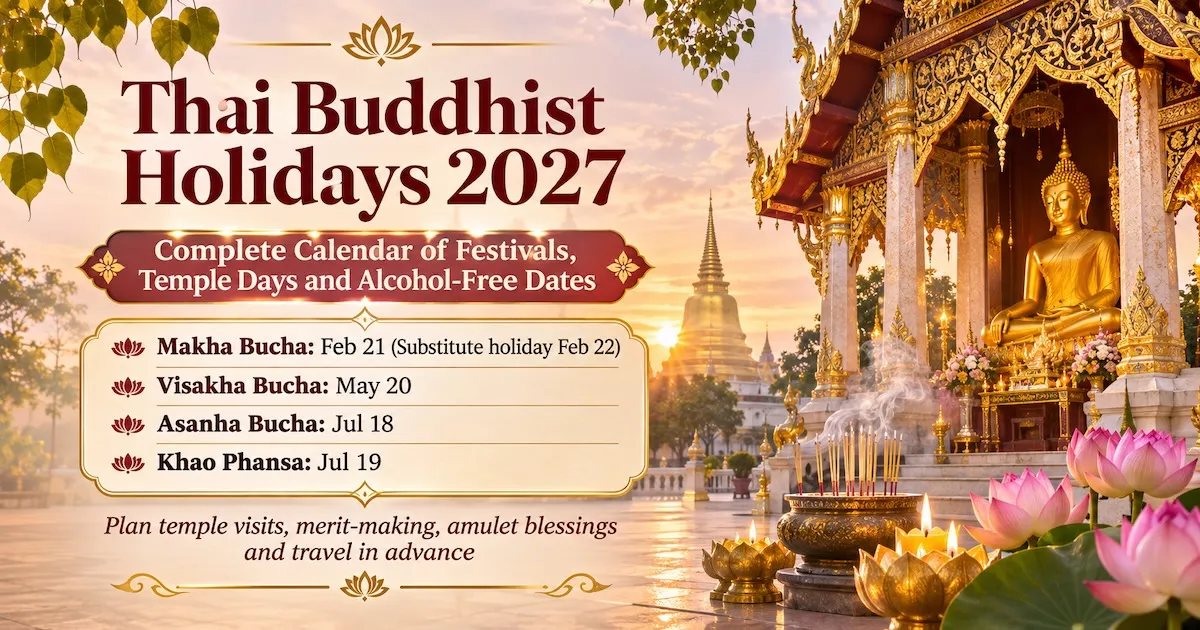
In 2027 (Buddhist Era 2570) Thailand's main Buddhist holidays fall about eleven days earlier than they did in 2026: Makha Bucha on 21 February, Visakha Bucha on 20 May, Asalha Bucha and Khao Phansa on 18 and 19 July, and Ok Phansa on 15 October. The reason is that 2026 carried an extra lunar month and 2027 does not. This guide gives the full calendar in one table, explains what each day commemorates and what actually happens at the temple, and covers the practical side: crowds, alcohol rules, and when temples tend to hold ceremonies and release new amulets.
Thai Buddhist Holidays 2027 at a Glance
| Date (2027) | Holiday (English / Thai / Chinese) | What it marks | What people do |
|---|---|---|---|
| Sun 21 Feb (substitute holiday Mon 22 Feb) | Makha Bucha / วันมาฆบูชา / 万佛节 | The unplanned gathering of 1,250 enlightened monks before the Buddha | Morning alms, evening candlelit procession. No alcohol sales. |
| Tue 13 to Thu 15 Apr | Songkran / วันสงกรานต์ / 宋干节 | Traditional Thai New Year | Bathing Buddha images, building sand stupas, blessing elders |
| Thu 20 May | Visakha Bucha / วันวิสาขบูชา / 卫塞节 | The Buddha's birth, enlightenment and passing | The most important holy day of the year. No alcohol sales. |
| Sun 18 Jul | Asalha Bucha / วันอาสาฬหบูชา / 三宝节 | The Buddha's first sermon | Alms and candlelit procession. No alcohol sales. |
| Mon 19 Jul | Khao Phansa / วันเข้าพรรษา / 守夏节 | Start of the three-month rains retreat | Offering candles and bathing cloths to monks. No alcohol sales. |
| Fri 15 Oct | Ok Phansa / วันออกพรรษา / 出夏节 | End of the rains retreat | Tak Bat Devo alms the next morning. No alcohol sales. |
| 16 Oct to 13 Nov | Kathina / ทอดกฐิน / 供僧衣节 | The one-month robe-offering season | Joining a temple's annual robe ceremony |
| Sat 13 Nov | Loy Krathong / วันลอยกระทง / 水灯节 | Full moon of the twelfth lunar month | Floating krathong; lantern festival in Chiang Mai |
| Fri 31 Dec | New Year chanting / สวดมนต์ข้ามปี / 跨年诵经 | Chanting across midnight into the new year | Evening chanting at temples nationwide |
The Makha Bucha, Visakha Bucha and Asalha Bucha dates match the Bank of Thailand's published 2027 holiday list. Ok Phansa, Kathina and Loy Krathong are not public holidays and do not appear on official holiday lists; the dates above follow the Thai lunar calendar and are subject to official confirmation in Thailand.
Why the Dates Moved: No Leap Month in 2027
Thai holy days follow a lunisolar calendar. In an ordinary year Makha Bucha falls on the full moon of the third lunar month, Visakha Bucha on the full moon of the sixth, and Asalha Bucha on the full moon of the eighth. Every two or three years the calendar repeats the eighth month, a leap month called adhikamasa, and all three holidays shift a month later. That is what happened in 2026, when Makha Bucha landed on 3 March and Visakha Bucha on 31 May.
2027 is an ordinary 354-day year with no extra month and no extra day, so the holidays return to their usual February, May and mid-July positions. If you planned a trip around the 2026 dates, do not reuse them.
The Major Holidays and What Happens at the Temple
Makha Bucha, 21 February
According to tradition, 1,250 monks, all ordained by the Buddha himself, arrived at Veluvana monastery on the same full-moon night without being summoned. The Buddha gave them a summary of his teaching: avoid harm, do good, purify the mind. Thais mark the day by offering food to monks in the morning and observing the five precepts. After dark, people walk three times clockwise around the ordination hall holding flowers, incense and a lit candle, a rite called wian thian. Because the day falls on a Sunday in 2027, Monday is a substitute holiday and the Sunday evening procession will be the busiest moment.
Songkran, 13 to 15 April
Songkran is the Thai New Year rather than a commemoration of the Buddha, but temples are central to it. People pour scented water over Buddha images, carry sand into temple grounds to build small stupas, and pour water over the hands of parents and grandparents to ask for their blessing. The water fights are a street affair; inside the temple the mood is much quieter. There is no nationwide alcohol restriction during Songkran.
Visakha Bucha, 20 May
Visakha Bucha commemorates the Buddha's birth, enlightenment and passing, which tradition places on the same full-moon day in different years. The United Nations recognises it as the Day of Vesak. It is the most solemn day in the Thai Buddhist year, with chanting, sermons and processions running from early morning into the night. In 2027 it is a Thursday with no long weekend attached, so expect local crowds in the early morning and after work.
Asalha Bucha and Khao Phansa, 18 and 19 July
Asalha Bucha marks the first sermon, given to five ascetics in the deer park at Sarnath. One of them, Kondanna, asked to be ordained, and with that the Buddha, his teaching and the monastic community, the Triple Gem, were all present in the world. The next day is Khao Phansa, when monks begin three months of residence in one monastery. Laypeople offer large candles and rains-bathing cloths; Ubon Ratchathani's carved candle parade is the best-known celebration. Many Thais give up alcohol for the retreat, and some men ordain temporarily. In 2027 the two days form a Sunday and Monday pair.
Ok Phansa and Kathina, from 15 October
On Ok Phansa the monks hold a ceremony in which each invites the others to point out his faults. The following morning, 16 October, many temples stage Tak Bat Devo: monks descend a staircase or hillside in a long line to receive alms, recalling the Buddha's return from teaching in the heavens. The month that follows, ending on the full moon of the twelfth lunar month, is Kathina season. Each temple may receive a Kathina robe offering only once a year, so the ceremony is usually a large community event.
Loy Krathong, 13 November
On the full-moon night of the twelfth lunar month, people float small rafts of banana leaf, flowers, incense and a candle to thank the water. It is closer to a folk festival than a Buddhist holy day, though many visit a temple first. Chiang Mai's lantern festival runs at the same time on dates set locally. Some travel sites list Loy Krathong 2027 as 14 November, based on the astronomical full moon; by the Thai calendar the fifteenth waxing day falls on Saturday 13 November. Check the official announcement before booking.
Wan Phra: The Weekly Holy Days
Beyond the big holidays, each lunar month has four holy days called wan phra: the eighth and fifteenth days of the waxing moon, the eighth day of the waning moon, and the last day of the month. That works out to one roughly every seven or eight days. Temples hold morning alms and a sermon, and older devotees dress in white and keep eight precepts for the day. These are not public holidays, which makes them a good time to see ordinary temple life without the crowds.
Crowds and Alcohol Rules
- Busiest times: the evening processions on Visakha Bucha (20 May), Makha Bucha (21 February) and Asalha Bucha (18 July). For a quiet visit, arrive around six or seven in the morning, with shoulders and knees covered.
- Long weekends: 20 to 22 February and 17 to 19 July. Popular temples and the roads around them will be busier.
- Alcohol-free days: sales are banned nationwide on Makha Bucha, Visakha Bucha, Asalha Bucha, Khao Phansa and Ok Phansa. In 2027 that means 21 February, 20 May, 18 July, 19 July and 15 October.
- Exemptions: under rules in force since 7 November 2026, international airport terminals, licensed entertainment venues, hotels, and officially designated tourist-area venues and major event sites may still sell. Convenience stores and supermarkets may not. These rules have changed several times recently, so confirm before you travel.
Planning a Temple Visit or an Amulet Purchase
Temple ceremonies and the consecration of new amulet batches traditionally cluster in a few periods. Each temple sets its own dates, so treat these as common patterns rather than a schedule.
- Makha Bucha to Songkran (late February to mid-April): dry weather and a full temple calendar. Many temples hold chanting ceremonies on or near the major days.
- Around Visakha Bucha (mid to late May): the most important holy day, with many commemorative ceremonies.
- The rains retreat (19 July to 15 October): with monks in residence for three months, some temples keep a batch of amulets in the hall and chant over it daily for the entire retreat, a practice known as trimas consecration. The amulets are released after Ok Phansa. Devotees believe the longer period of chanting makes these batches special.
- Kathina season (16 October to 13 November): temples raise funds for repairs, and new amulets are often issued alongside the robe ceremony.
If you want to obtain an amulet at a temple in person, an ordinary weekday or a regular wan phra is easier than a major holiday, and the monks and temple staff have more time. If you cannot travel, you can browse all amulets, ask us to make offerings on a holy day through our temple merit-making service, or spend a few minutes in the online Thai temple. In Thai culture an amulet is a reminder to keep the precepts and act well. We do not promise specific results from any amulet.
Frequently Asked Questions
When are Makha Bucha, Visakha Bucha and Asalha Bucha in 2027?
Makha Bucha is Sunday 21 February (with Monday 22 February as the substitute holiday), Visakha Bucha is Thursday 20 May, and Asalha Bucha is Sunday 18 July, followed by Khao Phansa on Monday 19 July. These match the Bank of Thailand's 2027 holiday list.
Is 2027 a leap-month year in the Thai calendar?
No. 2026 had a repeated eighth month, which pushed the holidays a month later. 2027 is an ordinary year, so Makha Bucha returns to February and Visakha Bucha to May, about eleven days earlier than in 2026.
Can I buy alcohol in Thailand on Buddhist holidays?
On the five alcohol-free days, shops, supermarkets and ordinary restaurants do not sell alcohol. Hotels, international airport terminals and licensed entertainment venues are exempt under current rules. Songkran and Loy Krathong have no nationwide ban.
Do I need to buy an amulet on a holy day?
No. More ceremonies and new releases happen around the holidays, but amulets can be obtained all year. Tradition holds that clear provenance, a known temple and monk, and your own conduct afterwards matter more than the date.