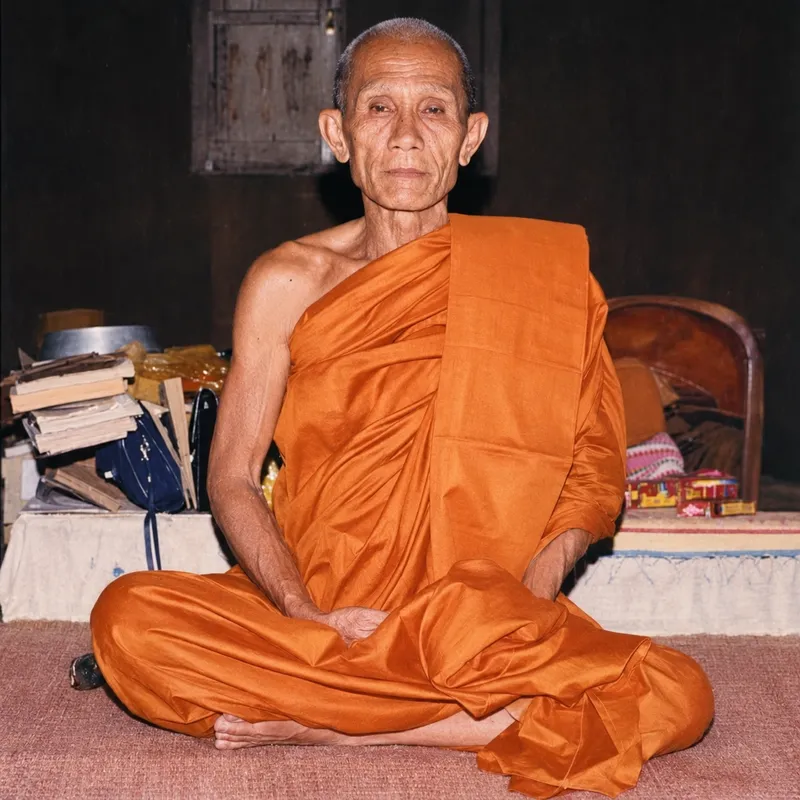
Life of Luang Phor Phina
Luang Phor Phina Piyatharo (หลวงพ่อผินะ ปิยธโร; the name is also spelled พินะ) was abbot of Wat Sanom Lao (วัดสนมลาว) in Khok Yae, Nong Khae district, Saraburi. He was born Thawai Hansarikit on 1 March 1913 (BE 2456) at Ban Hua Lamphong, Thap Than district, Uthai Thani.
Khaosod's profile records that as a child he convulsed whenever he cried. When doctors could not help, his mother took him to Luang Phor Sin in Uthai Thani, who judged the name Thawai unlucky and renamed him Phina, from a word meaning "to turn away"; the illness then eased. He became a novice after his father died and was ordained around BE 2481 (1938) at Wat Nong Tao, with Phra Khru Udom Khunaphon, the Thap Than district sangha head, as preceptor.
He then stayed with Luang Ta Kham at Wat Ko Thepho in Chai Nat, contemplating death and decay to overcome his fear of corpses, practised meditation at Wat Tham Tako in Lopburi, and spent years on foot through Thailand, Burma, Laos, Cambodia and India.
In BE 2527 (1984) he reached Ban Sanom Lao Khao Bot, where an abandoned Ayutthaya-period temple stood. Villagers asked him to stay, and the ruin was revived as Wat Sanom Lao. He remained there for eighteen years, until his death at dawn on 15 October 2002 (BE 2545), aged 89, after 64 rains as a monk. Eleven days earlier he had written instructions: no embalming injection, keep the body seated cross-legged, place it in the tomb he had prepared, hold no funeral chanting, and never cremate it. His disciples complied; the body sits in a glass coffin under a stupa about ten metres high and can still be visited.
Training and Lineage
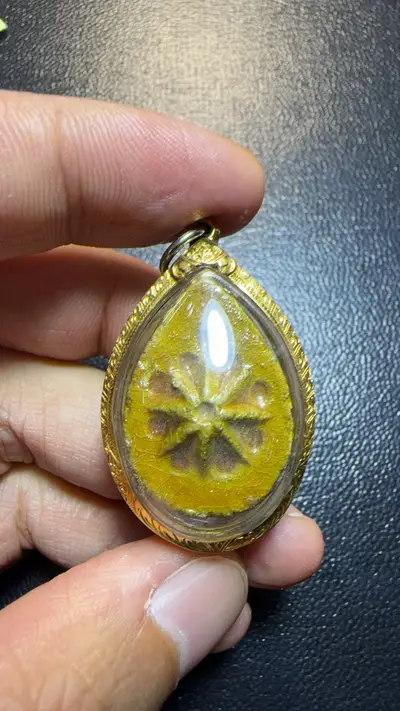
The published biographies agree that around BE 2485 (1942) he went to Luang Pu Mun Bhuridatto at Wat Pa Sutthawat in Sakon Nakhon, and that he also trained under Luang Pu Fan Acaro and Luang Ta Maha Bua, while learning incantation from several other teachers. That explains the two sides of him: the austere, solitary habits of a forest monk, and amulets that belong to the folk-magic tradition. The Banmuang amulet column calls him the originator of the "auspicious star" and notes his unusual materials, among them Nam Phi iron ore, "stone rice", auspicious woods and tungsten ore.
Notable Amulets
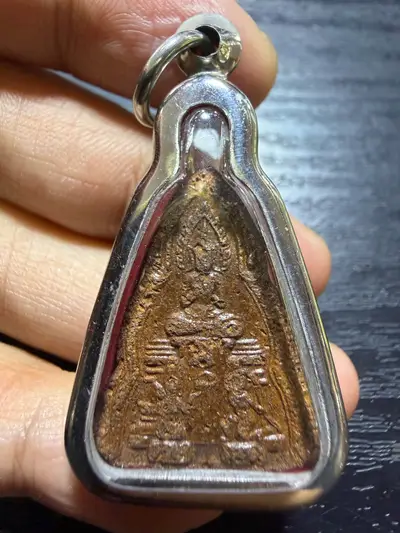
His pieces were made by hand in small batches, and there is no orderly catalogue of editions. Banmuang, citing his relatives, dates his amulet-making at Wat Sanom Lao to BE 2530 to 2543; authentication cards handled by this site register his work broadly as "about BE 2527 to 2545", his whole period at the temple. The main types are:
- Star amulets (ดาว): his most recognisable work, with named varieties such as Dao Mae Nuea Hom and the "general's star". Thai collectors associate them with charm and promotion.
- Duang Ta Sawan ("heavenly eye"): a lacquered powder piece usually mentioned together with the stars.
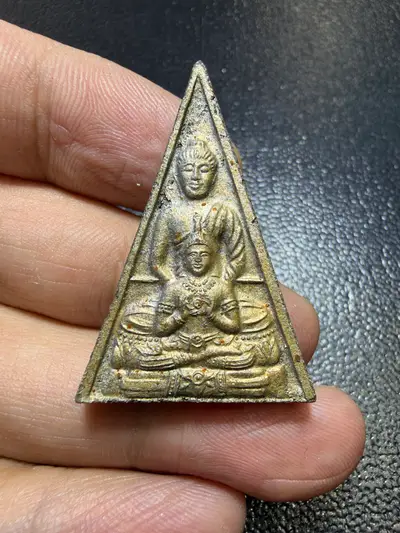
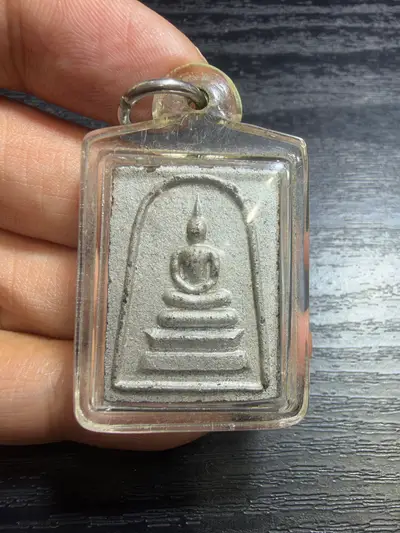
- Khun Phaen and Somdej tablets: small hand-pressed pieces in powder and clay mixtures, in many moulds.
- Charm objects: palad khik, Mae Poe, kuman thong and Phrai Krasip.
- The BE 2563 (2020) jars: on 8 August 2020 the temple broke open three jars of amulets found buried in the grounds, witnessed by Phisan Techawiphak, vice-president of the Thai amulet association. The contents were sorted and offered to devotees to fund a mondop for his body. Those present stressed that this was not an ancient hoard but his own work, stored for the temple's use.
Collecting Notes
- Everything genuine was made before his death in BE 2545. Pieces released later, from jars opened by a successor abbot and from the three jars of BE 2563, are lifetime work that surfaced afterwards, not new production. Any later commemorative issue by the temple is a different matter, so check the year.
- Dates are disputed. Some amulet listings mention a "first coin" of BE 2498 and coins of BE 2527, but he only arrived at Wat Sanom Lao in BE 2527, and Banmuang says claims of amulets from BE 2527 to 2529 are mistaken. Treat very early dates with caution.
- Both spellings, ผินะ and พินะ, appear on registrations. The monastic name ปิยธโร and the temple วัดสนมลาว, Saraburi, should appear together.
- There are no official quantities. Size and colour vary widely within a type, and the numbers quoted online have no source.