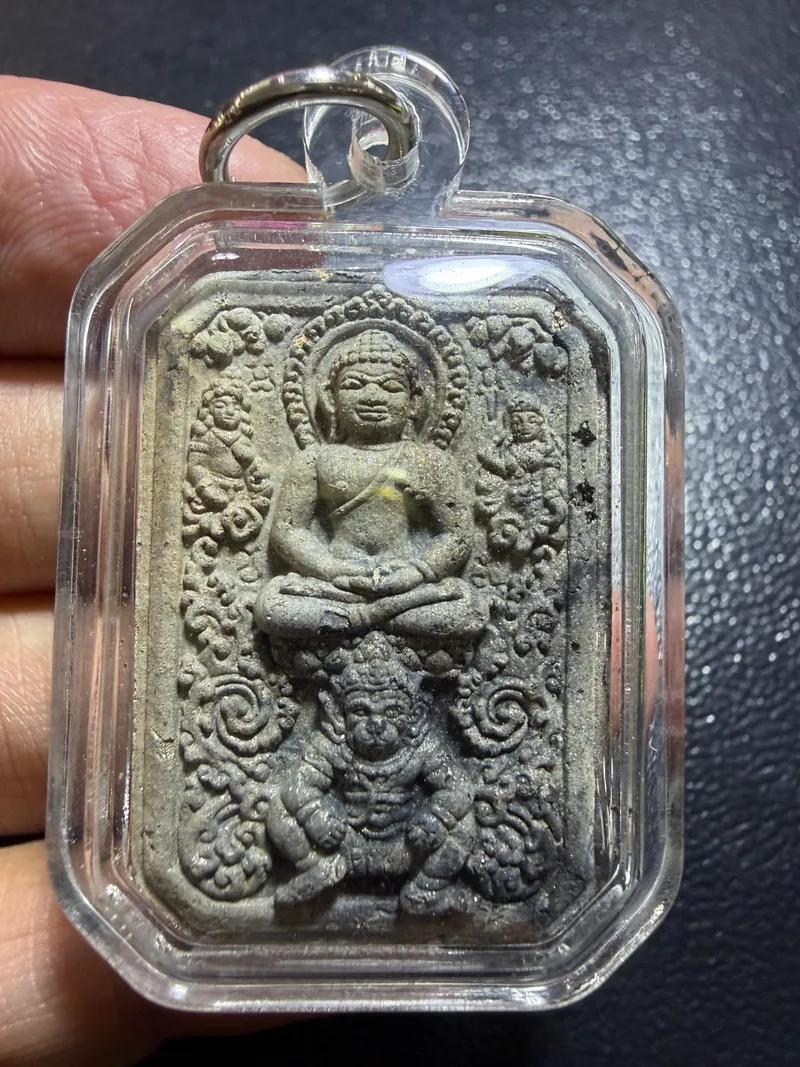
"Mongkhon Phra Khun" 168 Hanuman plaque by Ajarn Jun (พระญาคูจุณฑ์, Phra Yakhu Jun) of Senasana Wat Pa Chao Sua, Ubon Ratchathani, B.E. 2568 (2025) per the supplier, in sacred powder. The upper half shows the Buddha seated in meditation with a halo, a celestial attendant on each side; below is the monkey god Hanuman (หนุมาน), framed by curling foliage. According to the supplier, the mold draws on Dvaravati Buddhist art of about 1,600 years ago, and the Hanuman follows the composition of a Narasimha stone relief in a museum in Nakhon Pathom. The back is stamped with a blue yantra. Judged genuine by the Thai Buddha Image Admiration Association, No. 00617; the formal certificate is included. In a clear waterproof case. One piece only; it is held by a partner supplier, so please submit a request and we confirm availability by email within 24 hours.
What is this 168 Hanuman plaque?
Hanuman (หนุมาน) is the monkey god of the Ramayana, known in Thailand as the Ramakien: loyal, brave, quick-witted and immensely powerful. Thais wear him for protection from danger, courage and goodwill. This plaque places the Buddha and Hanuman on one face: the Buddha seated above with celestial attendants on either side, and Hanuman supporting the throne below.
According to the supplier, the master visited a number of ancient sites in Thailand while designing the mold. The Buddha and the surrounding pattern follow Dvaravati (ทวารวดี) Buddhist art, whose soft, plant-like curves differ from the sharp flame-like lines common in Thai art today, and the Hanuman follows the composition of a Narasimha (นรสิงห์, the lion-headed form of Vishnu) stone relief in a museum in Nakhon Pathom, keeping the two celestial figures of the original.
Key facts
- Type: plaque combining the Buddha and Hanuman ("Mongkhon Phra Khun" 168 Hanuman, as named by the supplier)
- Material: sacred powder (judged from the photos; the supplier does not state the formula)
- Back: blue stamped yantra
- Master: Ajarn Jun (พระญาคูจุณฑ์ / Phra Yakhu Jun); attribution of this piece per the supplier
- Temple: Senasana Wat Pa Chao Sua (เสนาสนะวัตรป่าเจ้าสัว), Ubon Ratchathani Province
- Year: B.E. 2568 (2025) (as stated by the supplier)
- Certification: judged genuine (แท้) by the Thai Buddha Image Admiration Association, No. 00617, barcode GJ09-A9C8F, dated 8 September B.E. 2569 (2026); the formal certificate is included
- Case: clear waterproof case with a ring
- Stock: one piece only, held by a partner supplier
About the master
Ajarn Jun is Phra Yakhu Jun (พระญาคูจุณฑ์) of Senasana Wat Pa Chao Sua (เสนาสนะวัตรป่าเจ้าสัว) in Ubon Ratchathani, rendered by Chinese-speaking collectors as "Wat Pa Chao So". Per the supplier, this "Mongkhon Phra Khun" 168 Hanuman is his B.E. 2568 design, and he is exacting about molds and materials; the finer the mold, the more pieces fail, so complete, crisp pieces are hard to come by.
Blessings
- Protection from danger: Hanuman's best-known blessing
- Goodwill: popularity and helpful people
- Competitive edge: courage and quick thinking at work and in business
- Wealth: support for income
Please note: an amulet supports your own efforts and intentions; it does not guarantee any outcome. Keeping the Five Precepts is traditionally encouraged.
Craftsmanship
A rectangular powder plaque with cut corners, grey-brown with darker flecks. Above, the Buddha sits in meditation before a round halo, with a celestial figure in each upper corner; below, Hanuman crouches beneath the throne, surrounded by curling foliage in clear layers. The back carries a blue stamped yantra with lettering at the centre. In a clear waterproof case with a ring.
FAQ
Q: What is the yellow card in the photos, and which card do I receive?
A: The yellow card is the Thai Buddha Image Admiration Association's authentication receipt, issued on the spot once a piece is judged genuine; the formal certificate is collected on the Thursday of the following week. This piece's yellow card is No. 00617, marked "แท้" (genuine), with the "มีซ่อม" (repaired) box left blank, dated 8 September B.E. 2569 (2026). The buyer receives the association's formal certificate.
Q: What is the Dvaravati style?
A: Dvaravati was the Mon culture of central Thailand from roughly the 6th to the 11th century, with Nakhon Pathom as one of its main centres. Its Buddha images have broad, gentle faces and rounded ornament. According to the supplier, this mold draws on that style.
Q: Can I wear a powder amulet every day?
A: Yes, it is in a waterproof case. Powder dislikes long soaking, so take it off for bathing or swimming.
Q: Who is it suited to?
A: People who travel a lot or work in risky jobs, anyone who needs nerve in a competitive field, and collectors drawn to ancient-style designs.
Q: Why do I request first and pay later?
A: This piece is held by a partner supplier rather than in our Bangkok stock. So that nobody pays for a piece that has already gone, we confirm with the supplier first and reply by email within 24 hours. If it is available, the email includes a payment link valid for 24 hours. Submitting a request costs nothing.
About this piece
- Includes: the amulet in a waterproof case and the Thai Buddha Image Admiration Association formal certificate (No. 00617)
- Price: ฿30,000
- Stock: one piece only
- How to buy: submit a request on this page; pay through the emailed link once availability is confirmed
Last updated: 2026-10-29 | Merit Messenger team (Bangkok-based)