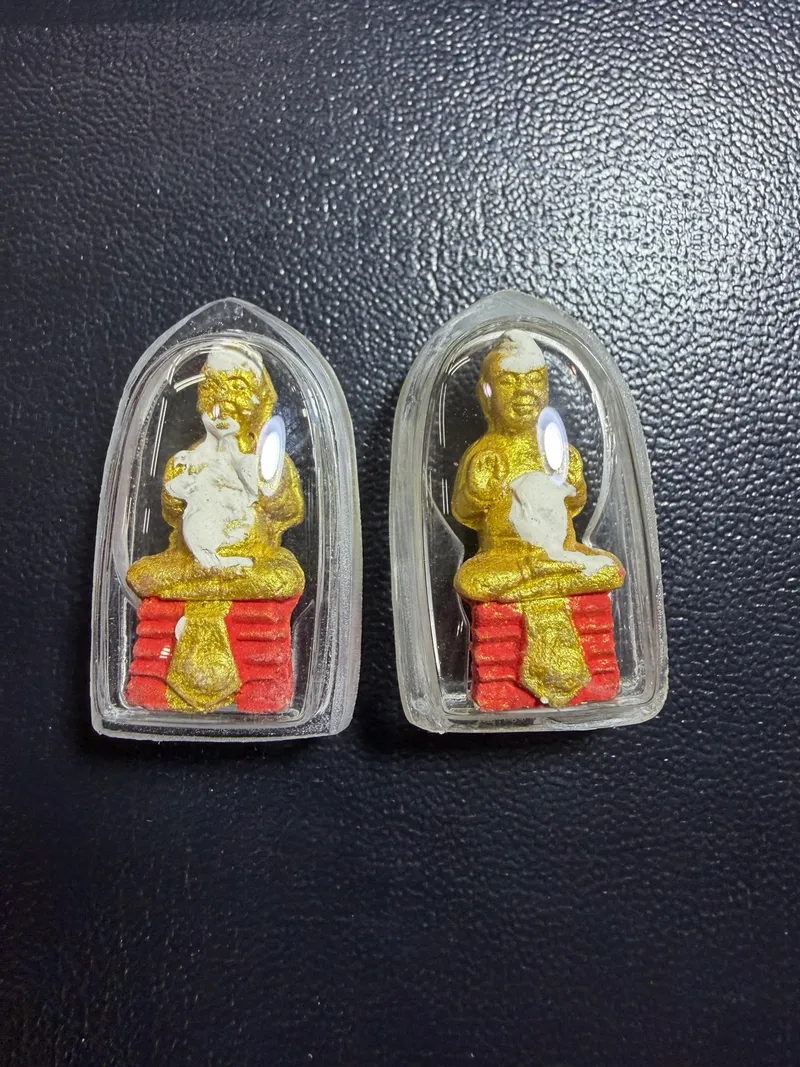
Luang Pho Yeam Kuman Thong, 100 Pi batch, rabbit-base mould (กุมารทองหลวงพ่อแย้ม รุ่น 100 ปี พิมพ์ฐานกระต่าย เนื้อดิน), clay, B.E. 2557 (2014), registered to Wat Sam Ngam (วัดอรัญญิการาม, known as วัดสามง่าม), Nakhon Pathom. Two pieces: certificates GJ08-A6012, GJ08-FC3D6. 2 pieces, each with its own card. They are held by a partner supplier, so please tap Hold this piece for me and we confirm availability by email within 24 hours.
What is the 100 Pi rabbit-base Kuman Thong?
Kuman Thong (กุมารทอง) means golden child: the image of a child spirit kept in Thai homes and shops for goodwill, customers, trade and watching over the house. Wat Sam Ngam (วัดสามง่าม, formally วัดอรัญญิการาม) in Nakhon Pathom became known through the Kuman Thong of Luang Phor Tae and is regarded as the home temple of the tradition. Luang Pho Yeam (หลวงพ่อแย้ม, written หลวงปู่แย้ม in our monk entry) was his disciple, abbot of the temple from B.E. 2500, and carried the practice on. The batch name 100 ปี means one hundred years, and the mould name ฐานกระต่าย means rabbit base. The supplier states the batch was made when the monk reached one hundred, and that the rabbit refers to his birth year.
The Association records both pieces under the same name, กุมารทองหลวงพ่อแย้ม รุ่น 100 ปี พิมพ์ฐานกระต่าย เนื้อดิน พ.ศ. 2557: Luang Pho Yeam Kuman Thong, 100 Pi batch, rabbit-base mould, clay, B.E. 2557, from วัดอรัญญิการาม (วัดสามง่าม) in Nakhon Pathom. Monk, batch, mould and year all agree with the supplier. The record calls the mould rabbit base; in the photos the gold relief on the front of the base is clogged with paint and the shape of a rabbit cannot be made out. The following are the supplier's statements and are not on the record: that the white powder on the figures is charm powder the monk added by hand after they were made and should not be cleaned off, and that the clay contains pollen and other charm powders. The last product image shows two Association yellow slips, both ticked แท้ (genuine), and two sealed boxes: box 07914 is numbered GJ08-A6012 and box 07915 is numbered GJ08-FC3D6.
Key facts
- Type: Kuman Thong (กุมารทอง), small figure in the round
- Batch: 100 Pi (รุ่น 100 ปี); little rabbit Kuman in the supplier's copy
- Mould: rabbit base (พิมพ์ฐานกระต่าย)
- Material: clay (เนื้อดิน), painted gold and red
- White powder: visible in photos; charm powder added by the monk according to the supplier, not on the record
- Year: B.E. 2557 (2014)
- Temple: Wat Sam Ngam (วัดสามง่าม, formally วัดอรัญญิการาม), Nakhon Pathom
- Case: clear arched plastic case, one per piece, no loop
- Certification: Thai Buddha Image Admiration Association, one number per piece: GJ08-A6012 (box 07914), GJ08-FC3D6 (box 07915), verifiable on the Association website; the photo shows the yellow slips and sealed boxes, and the formal cards ship with the pieces
- Stock: 2 pieces, held by a partner supplier
About Luang Pho Yeam
Luang Pho Yeam (หลวงปู่แย้ม), born B.E. 2458 (1915), ordained at Wat Sam Ngam in B.E. 2481 and its abbot from B.E. 2500, a disciple of Luang Phor Tae and known for Kuman Thong.
What people wear it for
- Goodwill and help from others
- Trade and a steady flow of customers
- A wider circle of contacts
- Watching over the home
These are devotional beliefs. An amulet does not guarantee any outcome.
Craftsmanship and condition
Two small figures in the round of the same form, each about one finger joint tall. A child sits cross-legged with a small topknot, a round face and both hands raised before the chest, painted gold all over with a fine grainy surface. Beneath is a red square base cut with horizontal steps on the front, and down the middle of the front hangs a gold relief, narrower at the top, its detail filled in by the paint. From behind, the gold back and waistband show, and the back of the red base is flatter; on one piece it is impressed with what looks like ๑๐๐, and on the other it is smeared with gold and cannot be read. Both carry white powder: the piece in box 07914 has more, covering the face and most of the chest, while the piece in box 07915 has its face clear, with powder only on the top of the head and in a lump at the lap. Each sits in a clear arched plastic case with a small round white pad inside and no loop.
FAQ
Q: How do I check the certification?
A: The photo shows the two yellow slips (the receipts) and the two sealed boxes, whose barcodes are the certificate numbers. Enter GJ08-A6012 or GJ08-FC3D6 on the Thai Buddha Image Admiration Association website to see the registered name กุมารทองหลวงพ่อแย้ม รุ่น 100 ปี พิมพ์ฐานกระต่าย เนื้อดิน พ.ศ. 2557, registered to วัดอรัญญิการาม (วัดสามง่าม), นครปฐม. The formal Association card for each piece ships with it.
Q: Why does the photo show a yellow slip instead of a plastic card?
A: The yellow slip is the receipt the Association issues on the spot. A tick at แท้ means the piece was judged genuine, and the barcode on the sealed box is the certificate number. The formal card is issued later by the Association and ships with the piece.
Q: How do the two pieces differ?
A: Registered name, batch, mould and material are the same, and each has its own certificate number. The difference is the white powder: the piece in box 07914 (GJ08-A6012) has more, covering the face, and the piece in box 07915 (GJ08-FC3D6) has its face clear. Say when you ask us to hold it which one you want.
Q: Can the white powder be cleaned off?
A: The supplier states it is charm powder the monk added after the figures were made and asks that it be left on. This is not on the record; we pass it on as stated.
Q: Is that really a rabbit on the base?
A: The Association records the mould as ฐานกระต่าย, rabbit base. The photos show a gold relief on the front of the base, but its detail is filled with paint and the rabbit cannot be made out.
Q: How is it kept or worn?
A: Both are shown in clear cases without a loop and can be placed at home or in a shop as they are; wearing one needs a case with a loop. The supplier suggests placing it below Buddha and deity images, with toys, drinks and sweets as offerings.
Q: Who is it for?
A: Shopkeepers and people in business, anyone who relies on goodwill and contacts, and collectors of Wat Sam Ngam Kuman Thong.
Q: Why do I ask you to hold it before paying?
A: This piece is held by a partner supplier rather than in our Bangkok stock. To avoid taking payment for a piece that has already sold, we confirm with the supplier first and reply by email within 24 hours, with a payment link valid for 24 hours if it is available. Asking us to hold it costs nothing.
About this piece
- Includes: one Luang Pho Yeam Kuman Thong, 100 Pi batch, rabbit-base mould (in clear plastic case), with Association card GJ08-A6012 / GJ08-FC3D6
- Price: ฿8,000 each
- Stock: 2 pieces
- How to buy: tap Hold this piece for me on this page and pay by the emailed link once availability is confirmed
Last updated: 2026-11-22 | Merit Messenger team, based in Bangkok