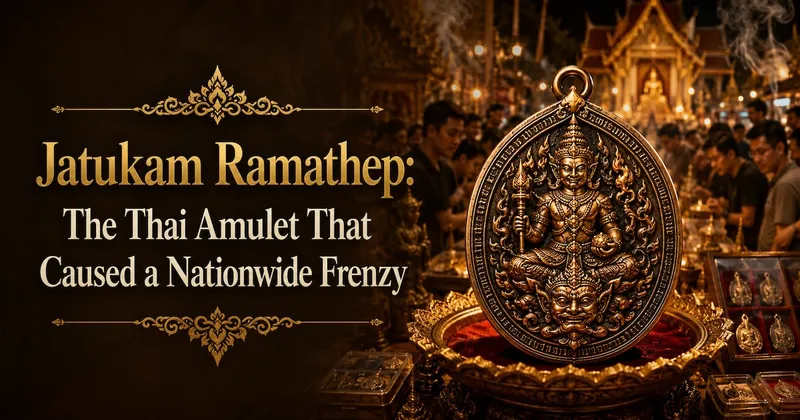
The Jatukam Ramathep amulet craze of 2006-2007 was the most dramatic episode in Thai amulet history. A police officer's death, rumored miracles, media amplification, and speculative trading created a bubble that rivaled financial manias — before collapsing just as dramatically. The story holds lessons for every amulet collector.
Origins: a forgotten deity resurfaces
Jatukam Ramathep (sometimes spelled Jatukham Ramathep) refers to two prince-deities who, according to Southern Thai legend, guarded a sacred relic of the Buddha enshrined at Wat Phra Mahathat in Nakhon Si Thammarat. For centuries, they were minor figures in regional folklore — respected locally but virtually unknown in Bangkok or the rest of Thailand.
The modern Jatukam story begins with Police Major General Khun Pantarakrajadej (known as Khun Pan), a legendary Southern Thai police officer who was also a respected practitioner of sacred arts. In the 1980s, Khun Pan helped create a series of large medallion amulets featuring the Jatukam Ramathep deities to raise funds for the City Pillar Shrine in Nakhon Si Thammarat. These early editions were modestly popular within the region.
The spark: Khun Pan's death
When Khun Pan passed away on September 5, 2006 — over a hundred years old, with published accounts of his exact age ranging from 103 to 108 — the Thai media coverage was extensive, and his royally sponsored cremation ceremony in early 2007 drew enormous crowds to Nakhon Si Thammarat. Stories of his legendary life — including dramatic tales of his police career and spiritual powers — captivated the public. Almost immediately, the value of his early Jatukam Ramathep amulets skyrocketed. First-edition pieces that had been available for a few hundred baht began trading for tens of thousands, then hundreds of thousands.
The timing coincided with Thailand's post-coup political uncertainty. Many Thais, anxious about the future, turned to amulets for reassurance. Jatukam became a symbol of hope and protection at a moment of national unease.
The mania: unprecedented demand
What followed in early-to-mid 2007 was unlike anything Thai amulet culture had ever seen:
Mass production: Temples across Thailand — not just in Nakhon Si Thammarat — began producing their own Jatukam Ramathep amulets to meet demand and raise funds. At the peak, an estimated 200+ temples were issuing Jatukam editions. Production reached industrial scale, with some batches numbering in the hundreds of thousands.
Speculative trading: People who had never collected amulets before began buying Jatukam pieces purely as investments. Prices for certain editions doubled or tripled within weeks. Some buyers took out loans to purchase amulets they planned to resell. Trading happened at makeshift markets, online, and even through dedicated Jatukam auctions.
Stampedes and injuries: Demand became physically dangerous. When popular temples announced new Jatukam editions, thousands would line up overnight. Several stampedes occurred during distribution events. In one notorious incident at Wat Mahathat in Nakhon Si Thammarat, crowd crushes caused injuries and at least one death was attributed to the chaos surrounding Jatukam distribution.
Media amplification: Thai newspapers and TV dedicated daily coverage to Jatukam. Stories of miraculous escapes, business windfalls, and lottery wins attributed to the amulets fueled demand. The media cycle became self-reinforcing — coverage drove demand, which generated more stories, which drove more demand.
Economic scale: At the peak, the Jatukam market was estimated at 20-30 billion baht ($600-900 million USD at the time). Nakhon Si Thammarat's economy was visibly transformed — hotels, restaurants, and transport services boomed as amulet pilgrims flooded the city.
The collapse
By late 2007, the bubble burst. Several factors contributed:
Oversupply: With hundreds of temples mass-producing Jatukam amulets, the market was flooded. Many editions had no meaningful connection to the original Nakhon Si Thammarat tradition. Buyers began to realize that not all Jatukam amulets were created equal.
Quality concerns: Reports emerged of factories producing Jatukam amulets with no monastic involvement at all — purely commercial products with no genuine consecration. This undermined trust in the entire category.
Speculative exhaustion: As prices stopped rising, profit-motivated buyers stopped buying. Without fresh speculative demand, prices collapsed. People who had borrowed money to buy amulets found themselves holding pieces worth a fraction of their purchase price.
Cultural backlash: Senior monks and Buddhist scholars criticized the commercialization of sacred objects. Some argued that the Jatukam craze represented a corruption of genuine Buddhist practice. The Thai Sangha (monastic authority) issued statements distancing institutional Buddhism from the speculative excess.
Prices for mass-produced Jatukam editions fell 80-90% from their peaks. Some editions that had traded at 50,000 baht returned to their original release price of a few hundred baht.
What survived: genuine value vs speculation
Not all Jatukam amulets lost value. The early editions — genuinely connected to Khun Pan, properly consecrated at Wat Phra Mahathat, and produced in limited numbers — retained significant value. First-edition pieces from the 1980s continue to trade at premium prices today.
The distinction is the same one that applies to all Thai amulets: provenance, authentication, and connection to a genuine spiritual lineage matter. Mass-produced pieces without meaningful monastic involvement were never spiritually or monetarily valuable — the bubble simply obscured that reality temporarily.
Lessons for collectors
The Jatukam episode offers lessons that apply to all amulet collecting:
Provenance over hype: An amulet's value comes from its spiritual lineage — the monk who created it, the ceremony that consecrated it, the temple that issued it. Marketing narratives and media buzz are not substitutes for genuine provenance.
Scarcity matters: Editions produced in hundreds of thousands cannot maintain premium pricing. Limited-edition pieces from meaningful ceremonies hold value because they cannot be reproduced.
Authentication is essential: The Jatukam craze attracted massive numbers of fakes and purely commercial products. Always verify through trusted authentication services. See our authentication guide.
Buy what you believe in: If you acquire an amulet primarily for resale profit, you're speculating — not collecting. The most satisfied collectors are those who value the spiritual connection and historical significance of their pieces, with financial appreciation as a welcome bonus rather than the primary motive.
Jatukam Ramathep today
Nearly two decades after the craze, Jatukam Ramathep has settled into its proper place in Thai amulet culture. The genuine early editions are recognized as historically significant pieces. The Jatukam deities remain popular in Southern Thai Buddhism, and new editions continue to be produced at Wat Phra Mahathat — but at reasonable volumes and prices, without the speculative frenzy.
For new collectors, authentic early-edition Jatukam pieces can be excellent additions to a collection — they represent a fascinating chapter in Thai cultural history and carry genuine spiritual heritage from one of Thailand's most storied sacred sites.
FAQ
Q: Are Jatukam amulets worth collecting today?
A: Early editions (pre-2006) with verified provenance — yes. Mass-produced 2007 editions from unknown temples — generally not, unless they have specific documented consecration.
Q: How do I identify a genuine early Jatukam?
A: Look for documented connection to Wat Phra Mahathat in Nakhon Si Thammarat, verifiable batch numbers, and ideally a competition certificate. The original editions have specific design characteristics that authentication experts can verify.
Q: Could a similar craze happen again?
A: It's possible but less likely. The Thai amulet community learned from Jatukam, and social media now provides faster fact-checking against false claims. However, speculative bubbles are a recurring feature of any collectibles market.
Last updated: June 2026 | By the Merit Messenger team, based in Bangkok
Browse authenticated, provenance-verified amulets at Merit Messenger.