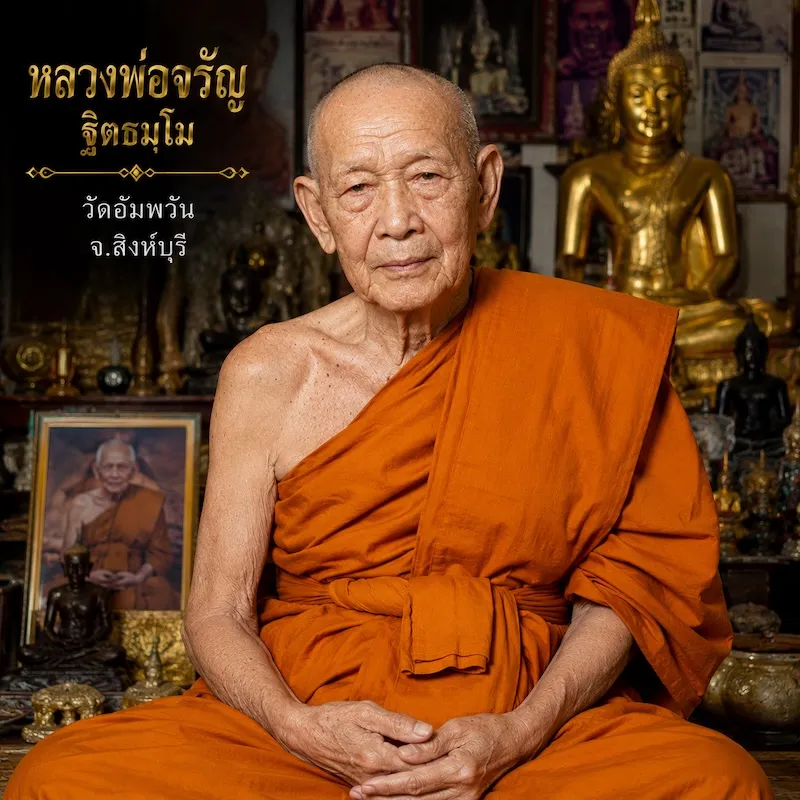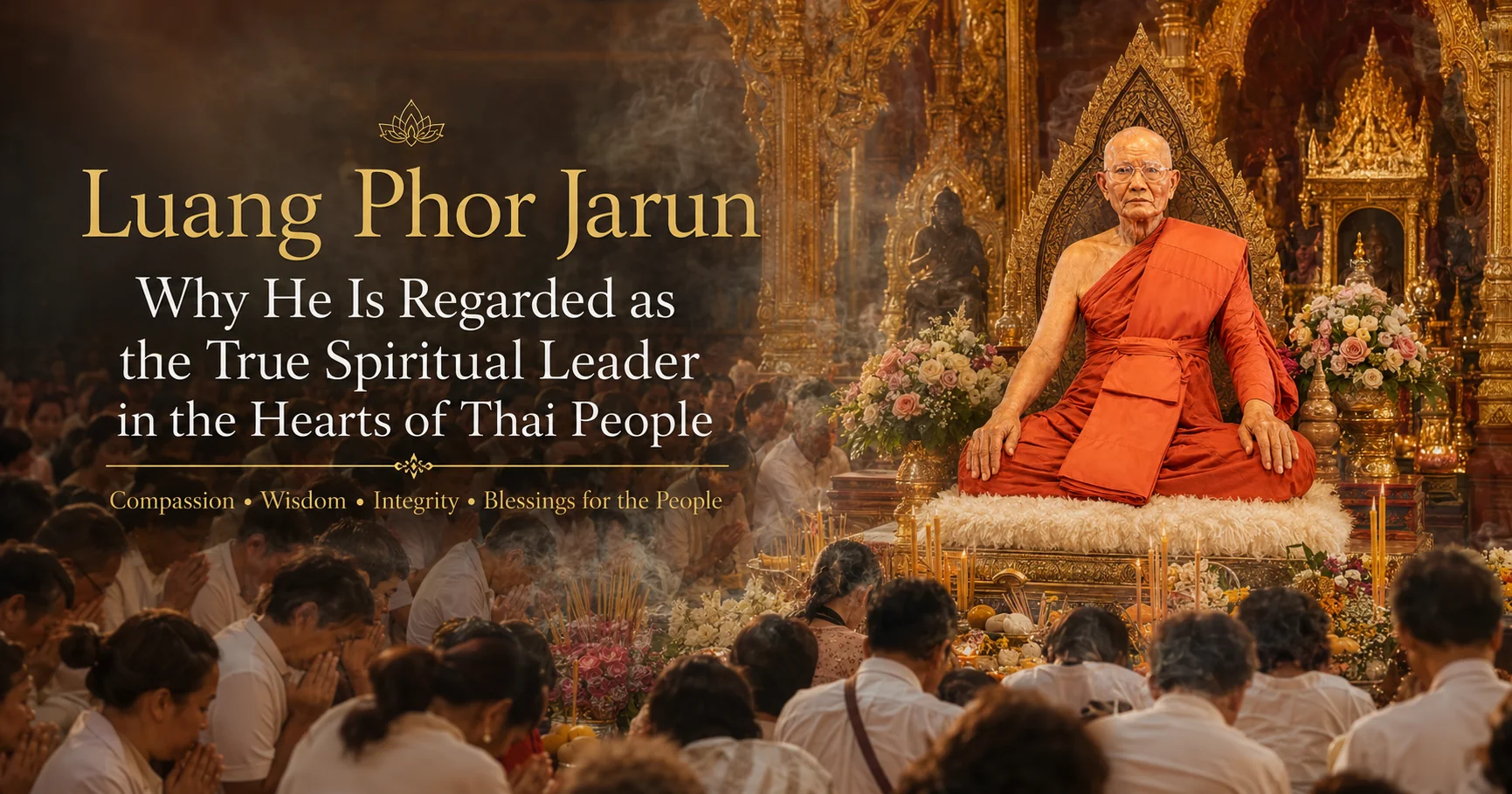
Luang Pho Jaran Thitadhammo (1925–2016) was the abbot of Wat Amphawan in Singburi Province, central Thailand. Over a 60-year ministry, he built one of Thailand's most important free Vipassana meditation centres, donated every cent raised from sacred amulets to charity and education, and became famous for accurately predicting his own near-fatal accident down to the exact injury — then making a full recovery that left his doctors speechless. Thailand's royal family, military generals, and millions of lay devotees regarded him as the most spiritually authentic monk of his era.
1. Who Was Luang Pho Jaran? — Essential Facts
- Full monastic name: Phra Rajasuddhinanamongkol (พระราชสุทธิญาณมงคล)
- Common name: Luang Pho Jaran Thitadhammo (หลวงพ่อจรัญ ฐิตธมฺโม)
- Temple: Wat Amphawan (วัดอัมพวัน), Singburi Province, central Thailand — approx. 150 km north of Bangkok
- Born / Passed: c. 1925 – 2016 (B.E. 2468–2559), aged approximately 87–92
- Core teaching: Satipatthana Vipassana — the Four Foundations of Mindfulness, drawn directly from the Pali Canon
- Known as: "Father of Vipassana in Thailand," "The Karma Master"
While many revered Thai masters are celebrated primarily for their potent amulets (phra kruang / พระเครื่อง), Luang Pho Jaran's influence was rooted in his teachings themselves. He transformed Wat Amphawan into a destination that attracted corporate executives, generals, members of Parliament, and Thai royalty — all coming not just to receive amulets, but to sit in silent meditation retreats.
2. Why His Sacred Objects Are Not Commercial Products
In a Thai amulet market that has become increasingly commercialised, Luang Pho Jaran's sacred objects stand apart for one defining reason: every baht raised was given away.
- Merit-driven, not profit-driven: Each consecration batch was created specifically to fund a new meditation hall, restore temple structures, or provide scholarships to underprivileged students
- Amulets as Dhamma doorways, not lucky charms: The master explicitly taught that a sacred object is a reminder to observe the Five Precepts and practise mindfulness — not a shortcut to wealth
- He died with nothing: Luang Pho Jaran maintained strict monastic discipline throughout his life; he left behind no personal assets, only a thriving meditation centre and thousands of devoted students
- Wat Amphawan retreats remain free: The centre he built continues to offer free Vipassana courses to the public — the most enduring proof of his intentions
This is precisely why his amulets command a premium on the secondary market: the value is not manufactured hype, but the irreplaceable spiritual weight behind each piece.
3. The Legendary Miracle: Predicting His Own Accident
The story most widely told about Luang Pho Jaran concerns a series of events in 1977 (B.E. 2520) that many Thais cite as a living demonstration of the Buddhist law of karma:
- The prophecy: Months before the incident, Luang Pho Jaran calmly informed his disciples that he would soon be involved in a severe accident that would injure his cervical spine (neck vertebrae)
- The accident: The crash occurred exactly as foretold — the master suffered a catastrophic neck injury that doctors assessed as almost certainly fatal or permanently paralysing
- The recovery: Through deep meditative concentration and what witnesses describe as extraordinary composure, Luang Pho Jaran made a complete recovery in a fraction of the expected time, to the astonishment of his medical team
- The teaching: Afterward, he explained that the accident was the karmic consequence of an act in a past life — accidentally injuring the neck of a bird. He chose to receive the result fully, using his own body as a teaching on the infallibility of karma
This account, widely verified by disciples and documented in Thai Buddhist literature, is the single story most often cited by Thais who say Luang Pho Jaran converted them from sceptics into believers.
4. His Most Celebrated Sacred Objects
Luang Pho Jaran created far fewer amulets than many of his contemporaries — a deliberate choice that has made his pieces significantly rarer:
- Phra Somdej (พระสมเด็จ): Early Wat Amphawan editions pressed from sacred powder incorporating hand-collected holy earth and antique amulet fragments — considered his most iconic type
- Phra Leela (พระลีลา — Walking Buddha): Elegant "walking" Buddha posture symbolising the master's own steady, mindful forward progress in Dhamma
- Roop Lor (รูปหล่อ — Self-Image): Cast or pressed monk-likeness amulets bearing the master's own image, worn for protection and as a constant reminder of his teachings
- Phra Khun Paen Khlueb (พระขุนแผนเคลือบ): The glazed Khun Paen consecrated at Wat Amphawan — one of his three signature piece-types, renowned for love, charm, and interpersonal harmony
All genuine Luang Pho Jaran pieces should come with verifiable provenance. Every Merit Messenger piece in this category includes an official Certificate of Authenticity with a QR-verifiable serial number and a 10× refund guarantee.
5. What Blessings Do His Amulets Carry?
- Klaew Klaad (แคล้วคลาด — Danger Evasion): Turning near-misses into clear escapes; historically favoured by soldiers, police, and drivers
- Clarity and Wisdom: The meditative merit of a Vipassana master is said to quiet the wearer's mind, supporting better decisions under pressure
- Harmonious Relationships: Improved interpersonal dynamics and the attraction of helpful mentors
- Protection from Negative Forces: Spiritual shielding from ill will, negative energy, and misfortune
- Career and Business Stability: Steady, sustainable progress — aligned with the master's own teaching of patient, ethical effort
Important note: Thai amulets are spiritual aids for mindfulness and merit-making. They are not guaranteed outcomes. Practitioners are encouraged to observe the Five Precepts and cultivate good intention alongside wearing any sacred object.
6. Frequently Asked Questions
Q: When did Luang Pho Jaran pass away?
A: He passed in 2016 (B.E. 2559), aged approximately 87 to 92 (sources vary on his birth year). Wat Amphawan remains an active Vipassana centre and pilgrimage site.
Q: Can I still find genuine Luang Pho Jaran amulets?
A: Yes, but only through trustworthy channels. His passing means the supply is permanently fixed and will only decrease over time. Merit Messenger offers verified pieces with Certificates of Authenticity and a 10× refund guarantee against fakes.
Q: Who should wear a Luang Pho Jaran amulet?
A: Anyone seeking spiritual protection or mental clarity — but particularly: frequent travellers and drivers (Klaew Klaad protection), professionals in high-stress or high-risk roles, those navigating difficult personal relationships, and anyone interested in Theravada Buddhist practice or Thai spiritual culture.
Q: Can I visit Wat Amphawan?
A: Yes. Wat Amphawan is located in Singburi Province, roughly 150 km north of Bangkok (about 2 hours by car or bus). The temple welcomes visitors year-round and regularly hosts free Vipassana meditation retreats open to both Thais and foreigners.
Q: How do I verify whether a Luang Pho Jaran amulet is authentic?
A: Purchase only from sellers who provide a third-party Certificate of Authenticity with a unique serial number and QR code. Merit Messenger certificates can be verified instantly by scanning the QR code, or by entering the certificate number on our verification page. We offer a 10× refund if any piece is proven inauthentic.
Q: What is Vipassana meditation, and why does it matter for amulets?
A: Vipassana (วิปัสสนา) is the contemplative insight practice at the heart of Theravada Buddhism — training the mind to observe reality directly, without delusion. In Thai amulet culture, an object consecrated by a practising Vipassana master carries the accumulated meditative merit (บุญ / bun) of that master's decades of practice. Luang Pho Jaran's lifetime of intensive Vipassana sits is considered the primary source of potency in his pieces.
Last updated: May 2026 | Curated by: Merit Messenger Team (Bangkok-based)
Ready to find your piece? Browse our verified Luang Pho Jaran collection — or contact us for personalised advice on authenticity and selection.