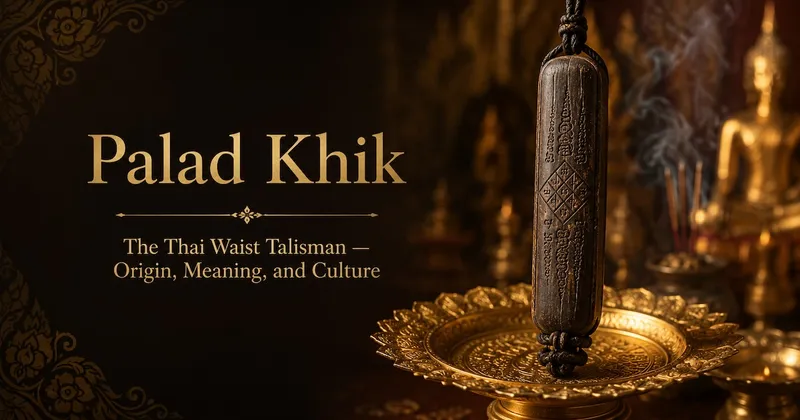
Palad Khik (Thai: ปลัดขิก) is a phallic talisman rooted in the Indian Shiva Lingam tradition and brought into Thailand via the Khmer. Its name means roughly "honorable surrogate" — literally "one who stands by your side" — a symbol of life-force and protection. This cultural guide explains its origin, meaning, and wearing customs; it is an unavoidable part of understanding the full range of Thai sacred objects.
Origin: from Shiva Lingam to a Thai waist charm
The belief traces to India, tied to the god Shiva and his symbol, the lingam. It entered Siam with Khmer influence as early as the 8th century AD, at first as larger objects of worship placed at the center of temples. As Brahmanic belief and Theravada Buddhism intermingled in Thailand over more than a millennium, the lingam's idea of "the source of life-force" gradually took the form of a small, worn talisman. "Palad" means surrogate or attendant — the sense that it accompanies and protects its keeper wherever they go.
Meaning and powers: protection, wealth, and popularity
Thai folk belief credits the Palad Khik with several powers:
- Warding off danger: traditionally believed to guard against blades, bullets, and accidents — a strong folk protective charm.
- Wealth and good fortune: it also carries meanings of Choke Laap (luck and fortune) and good salesmanship.
- Popularity and charm (Metta Mahaniyom): symbolizing being well-liked and drawing goodwill and affection.
It carries the primal meaning of "life-force plus protection," a strand of Thai folk belief blended with Brahmanic tradition, distinct from Buddha-image amulets.
Wearing customs: why at the waist?
The most distinctive custom is that Palad Khik is worn on a cord at the waist, under the clothing and off-center — not around the neck like a Buddha amulet, a matter of its nature and "rank." Traditionally worn by men, and often several at once. Folk etiquette even holds that wearing it on the right favors popularity and charm, while the left favors business and sales luck. These customs reflect its distinct standing as a folk protective talisman.
How to view the Palad Khik sensibly
- It is a cultural phenomenon, not a novelty: a folk protective charm with a thousand-year history in Thailand, worth understanding to grasp the diversity of Thai sacred objects.
- Check origin and consecration: orthodox pieces are made and blessed by temples or folk practitioners (such as the reclusive Ruesi/ascetic tradition) through traditional rites; clear provenance is the right path.
- Respect the custom: wearing it at the waist and with a respectful heart is basic courtesy toward this folk tradition.
FAQ
Is the Palad Khik a Buddha amulet?
Strictly, no. It is a folk protective talisman rooted in Shiva Lingam belief and brought via the Khmer — a blend of Brahmanic and Thai folk tradition, consecrated by temples or folk practitioners, with powers leaning toward protection, wealth, and popularity.
Why isn't it worn around the neck?
The tradition is to wear it on a cord at the waist, under the clothing and off-center, rather than on the neck — a matter of its nature and "rank." This is what most distinguishes its wearing from a Buddha amulet.
Can women wear a Palad Khik?
Traditionally it is worn mainly by men. If interested, it is best to first understand its folk background and wearing customs and to approach the belief with respect.
What does the Palad Khik mainly bring?
Warding off danger is its best-known power, along with meanings of wealth, popularity, and charm. At its core it symbolizes "life-force plus protection."
Last updated: July 2026 | Author: The Merit Messenger Team (based in Bangkok)
Want to understand how Thai folk objects differ from Buddhist amulets? Read the yin amulet overview, or contact us. For terminology, see the Thai amulet glossary.