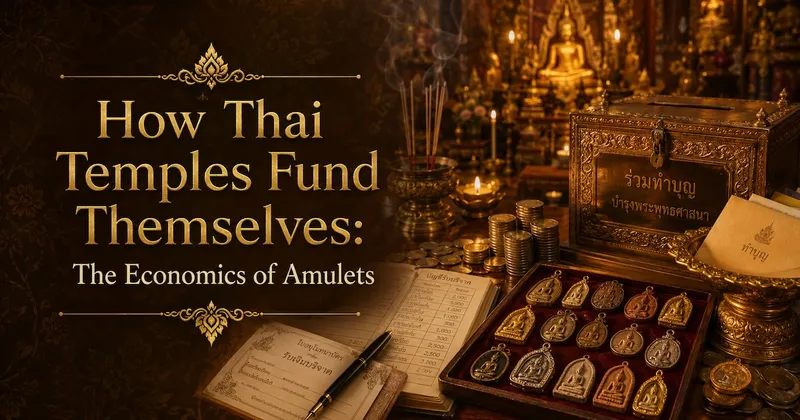
Thai temples are self-funded institutions that rely on donations — and amulet distribution is one of their primary revenue sources. Understanding this economic model helps collectors appreciate why amulets exist, how pricing works, and why supporting reputable temples matters.
Thai temples are not government-funded
A common misconception among foreign visitors is that Thailand's 40,000+ Buddhist temples are government-funded. While the state provides some support for officially registered temples — primarily administrative recognition and occasionally infrastructure grants — the vast majority of temple operating costs are covered by donations from the lay community.
Temples need money for the same reasons any institution does: building maintenance, electricity, water, food for monks (when not provided by alms rounds), educational programs, funeral services, community festivals, and new construction. A mid-sized temple in Bangkok might need 200,000-500,000 baht per month to operate. Rural temples need less but have smaller donation pools to draw from.
How amulet economics work
When a temple produces amulets, the process typically follows this pattern:
Planning: The abbot and temple committee decide to create a new amulet edition, usually tied to a specific project — building a new meditation hall, repairing the main chapel, funding a school. The project gives the edition its purpose and name.
Production: Materials are gathered (sacred powders, metals, herbs), molds are created, and amulets are produced. For powder amulets, monks may spend months or years preparing sacred ingredients. For metal amulets, a foundry handles casting under monastic supervision.
Consecration: The Puttapisek ceremony is organized, with invited monks chanting over the amulets. Larger ceremonies with more famous participating monks increase the amulets' perceived spiritual value — and their donation price.
Distribution: Amulets are offered to devotees in exchange for donations. The language is important: Thai Buddhists "bucha" (worship/receive) amulets and make "tham bun" (merit-making donations). The transaction is framed as a spiritual exchange, not a commercial one — though the practical effect is similar to a sale.
Fund allocation: Donation proceeds go to the designated project. Well-managed temples publicly account for the funds. Some print financial reports in temple newsletters or post them on notice boards.
Pricing: how temples set donation amounts
Amulet donation amounts (the functional equivalent of prices) vary enormously:
Standard temple amulets: 20-200 baht. These are basic monastery amulets given to anyone who makes a modest donation. Available at temple offices year-round. Low material cost, high production numbers, minimal collector value — but spiritually valid if properly consecrated.
Special edition amulets: 200-5,000 baht. Created for specific ceremonies or projects, produced in documented limited numbers. These form the core of most Thai collections. The donation amount reflects production costs, ceremony expenses, and the project's funding needs.
Premium editions: 5,000-100,000+ baht. Small-batch amulets in precious metals (silver, gold), numbered editions, or pieces created by highly revered monks. The high donation amount reflects material costs and the edition's exclusivity. These are often pre-ordered by serious collectors.
Factors that increase donation amounts: famous presiding monk, expensive materials (gold, silver), very small edition size, historically significant occasion, and high-profile consecration ceremony.
Where the money goes
For well-managed temples, amulet revenue funds tangible community benefits:
Construction and maintenance: The most common purpose. Building a new ubosot (ordination hall) can cost 10-50 million baht. Roof repairs, painting, structural maintenance, and grounds upkeep are ongoing expenses. Many of Thailand's most beautiful temples were built largely through amulet-related donations.
Education: Over 400 Thai temples operate schools (Phra Pariyattidhamma schools) providing free education to underprivileged children, particularly novice monks. Temple schools in rural areas are sometimes the only educational option for impoverished families. Amulet donations help fund teachers, textbooks, and facilities.
Social services: Temples serve as community centers providing funeral services, counseling, meditation instruction, drug rehabilitation programs, and disaster relief. During Thailand's major floods, temples became shelters. These services are funded by the donation economy, including amulet revenue.
Monk support: While monks receive daily food from alms rounds, they also need medical care, transportation, robes, and study materials. Senior monks traveling for teaching or ceremony duties incur costs that the temple covers.
The secondary market: where temples don't profit
Here is an important distinction: when an amulet appreciates in value on the secondary market — sometimes to hundreds of times its original donation amount — the temple that created it receives nothing from those subsequent transactions. A Somdej Wat Rakhang that originally cost 1 baht in the 1860s might trade for millions of baht today, but Wat Rakhang sees none of that secondary market value.
This is why some monks and temples have complicated feelings about the amulet collecting culture. The initial donation serves the temple's mission. But the speculative secondary market can distort the spiritual purpose of amulets and create perverse incentives — as the Jatukam Ramathep craze demonstrated.
Transparency and accountability
Not all temples handle amulet revenue equally well. Most operate with integrity, but the system's informal nature creates room for problems:
Well-managed temples: Document production numbers, publish financial reports, clearly link amulet editions to specific projects, and show donors the completed results. When a temple says "this edition funded the new school building," you can visit and see the school.
Concerns: Some temples produce excessive amulet editions without clear project justification. In rare cases, temple finances have been mismanaged. The Thai National Office of Buddhism provides oversight, but resources are limited across 40,000 temples.
What collectors can do: Support temples with transparent practices. Ask what project an edition funds. Visit the temple if possible. Established, well-known temples with long histories of community service are generally safe choices. When you buy from Merit Messenger, we verify temple provenance and can tell you what project each edition supported.
Why this matters for foreign collectors
Understanding the economics changes your relationship with amulet collecting:
Your donation matters: When you acquire an amulet at the original donation price, your money directly supports a temple's mission. This is merit-making (tham bun) — one of the most important practices in Theravada Buddhism.
Price context: A 3,000 baht donation for a quality amulet is not "expensive" — it reflects real costs (materials, ceremony, production) and funds real community benefits. Compare this to a mass-produced souvenir that costs the same but benefits no one spiritually or socially.
Choosing wisely: By selecting amulets from reputable temples with clear community impact, you participate in a centuries-old system of Buddhist patronage. You become part of the merit economy that sustains Thai Buddhism.
FAQ
Q: Do monks personally profit from amulet sales?
A: No. Theravada monks take vows of poverty and cannot own personal wealth. Amulet revenue belongs to the temple, managed by the temple committee (typically a mix of senior monks and lay administrators). Individual monks do not receive payment.
Q: Is buying amulets on the secondary market still merit-making?
A: Traditional belief says the amulet's spiritual power remains regardless of how you obtained it. However, the merit from donation goes to the original donor who supported the temple. Some collectors make additional donations to the originating temple when acquiring secondary-market pieces.
Q: How can I donate directly to a Thai temple?
A: Many temples accept transfers via Thai bank accounts or QR code payments. Some larger temples have international donation options. If you visit Thailand, donating in person at the temple office is straightforward. Our team can help connect you with specific temples — contact us.
Last updated: June 2026 | By the Merit Messenger team, based in Bangkok
Support Thai temples by acquiring authentic amulets: browse our collection.