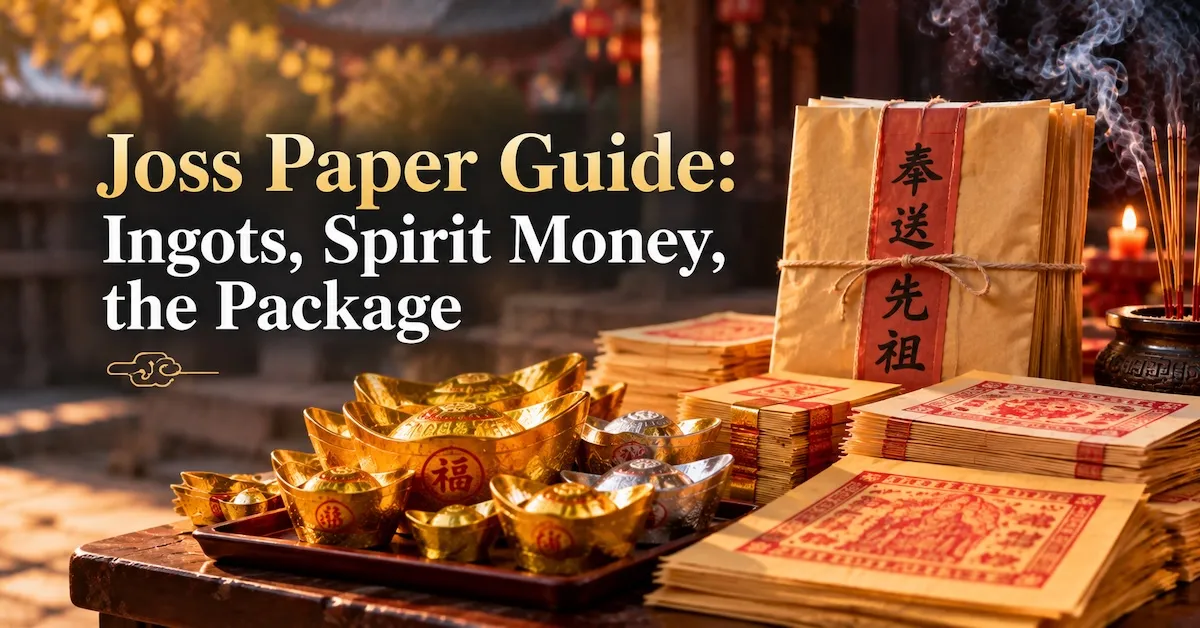
What gold and silver joss paper ingots mean, and how to address an offering package for an ancestor, explained field by field on a real package.
TL;DR: Joss paper and folded paper ingots for an ancestor are usually sealed in a paper package and burned whole. The package states three things: who it is for (the ancestor), who it is from (the living relative), and when it was sealed.
Gold ingots, silver ingots and spirit money
- Gold ingots: gold foil paper folded into the shape of old Chinese ingots, symbolising wealth.
- Silver ingots: the same in silver foil, widely used in offerings to ancestors.
- Spirit money: printed paper notes or plain joss paper, sometimes called hell money.
Customs differ by region. In southern Fujian and Taiwan a common rule is "gold for deities, silver for ancestors"; in much of northern China gold and silver are burned together. Follow your family's practice; there is no universal standard.
What does the package look like?
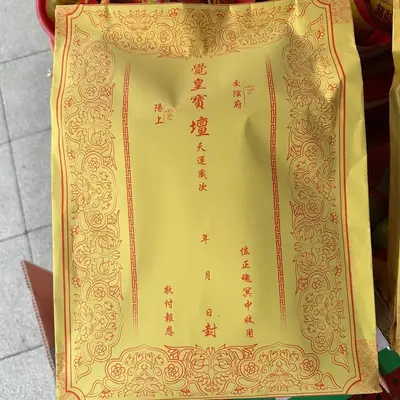
The package is a large paper envelope. Joss paper and ingots go inside, it is sealed, and it is burned without being opened. The packages we use are yellow with red lotus borders and have printed spaces to fill in:
- At the top, 覺皇寶壇, referring to the altar before the Buddha.
- On the right, a space followed by 冥中收用 ("to be received in the afterlife"): this is where the ancestor's name goes.
- On the left, 陽上 ("from the living") followed by a space and 敬付報恩 ("offered in gratitude"): this is where the offerer's name goes.
- In the centre, 天運歲次 年 月 日 封: the date the package is sealed.
How to address the package
The ancestor
Write the name of the person who has passed away. Traditional forms add a respectful title, such as 顯考 for a late father or 顯妣 for a late mother. If you are not familiar with these, writing the full name clearly is enough.
The offerer
Write the name of the living relative making the offering, often with the relationship, for example "grandson" followed by the name. Several family members can be listed together.
The date
Traditionally the lunar date is used, for example the first day of the tenth month for Hanyi Festival. Many people simply write the Gregorian date.
Common practices
- One package per ancestor, each clearly addressed, so the offering reaches the right person.
- Burn the package whole once it is sealed.
- Get the name right: use the characters from the family record or gravestone rather than a simplified or homophone substitute.
- Burn safely, only where it is permitted, and make sure the ashes are out.
If you cannot do it yourself
Merit Messenger's ancestral offering service in Bangkok uses exactly this kind of package. You enter the ancestor's name and your own at checkout; we write them on the package exactly as entered, without correction, bring it before the Buddha at Wat Mangkon Kamalawat for recitation, burn it whole at a designated site nearby, and send you video in which the names on the package are clearly visible. Offerings can be booked for Hanyi Festival (November 9, 2026) and the Winter Solstice (December 22, 2026).
For other ways to honor ancestors from overseas, see How to make joss paper offerings when you live abroad.
FAQ
Q: Do I have to write a name on the package?
A: Popular belief holds that you should, so the offering reaches the right person. At minimum, write the ancestor's name and yours.
Q: Can I write in English or pinyin?
A: Many families use Chinese characters, but what matters is that the name is correct. If you only know the romanised name, that is still better than leaving it blank.
Q: Should gold and silver ingots be burned separately?
A: It depends on local custom. Most families put them in the same package.
Q: Is joss paper the same as hell money?
A: Hell money is one type of joss paper: printed notes. Joss paper also includes plain paper, foil ingots and paper goods.
Last updated: September 2026 | Written by the Merit Messenger team, based in Bangkok
See the ancestral offering service, or read Hanyi Festival 2026: date, meaning and customs.