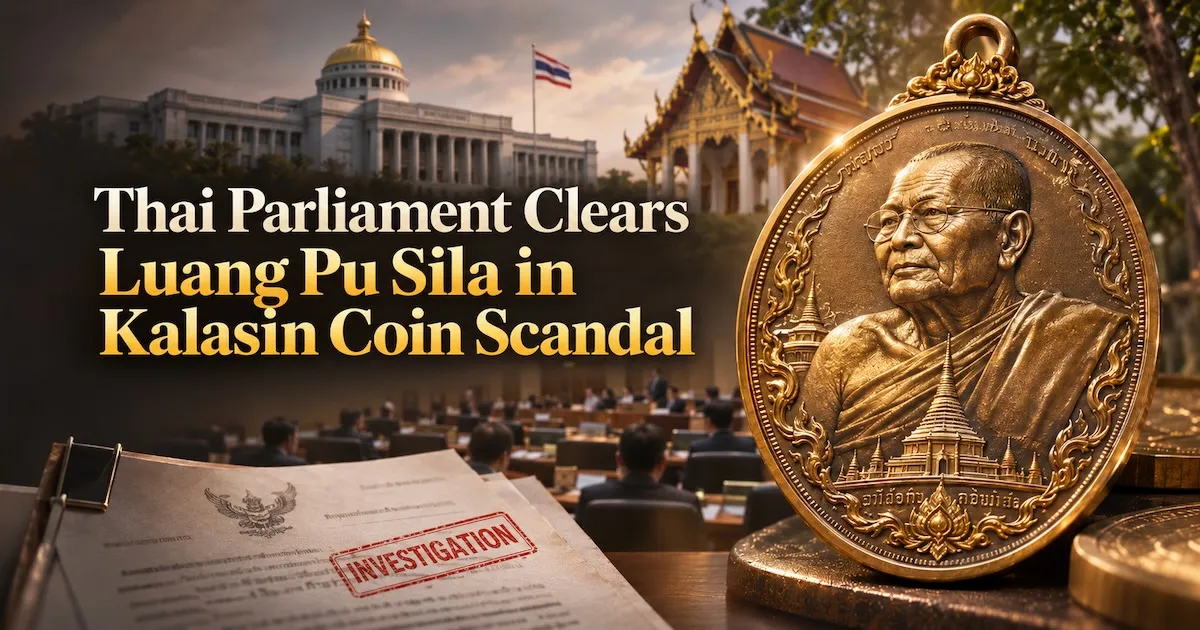
Thailand's House Standing Committee on the Prevention and Suppression of Corruption and Misconduct ("กมธ.ป.ป.ช.") held a hearing at Parliament on the afternoon of November 19, 2026, into the "Khrut Ruay Ruay" ("Wealthy Garuda") commemorative coin scandal in Kalasin province. Committee spokesperson Thanathorn Pramoonphong told reporters afterward that the fact-finding inquiry found the coin was never an official Kalasin provincial project, but rather a personal venture of a former Kalasin governor. The committee also clarified that Luang Pu Sila (หลวงปู่ศิลา), the locally revered monk whose blessing was invoked in the coin's marketing, was not personally involved.
A coin sold under the banner of a royal monument fund
The case traces back to a June 2026 complaint. Kalasin-area businessman Panya Nitayaros, 62, filed a police report at Kalasin City Police Station and a formal accusation with the provincial office of the National Anti-Corruption Commission (ป.ป.ช.), alleging the former governor and associates violated Section 157 of the Criminal Code (dereliction of duty) by producing and selling "Khrut Ruay Ruay" coins under the guise of a fundraising drive to build a Rama V monument. Promotional material reportedly described the coins as consecrated by Luang Pu Sila and featured the former governor, in uniform, presenting himself as the project's chairman. Documents the complainant submitted listed planned production across several tiers — a custom-order gold edition at 99,999 baht, silver pieces at 9,999 and 2,999 baht, nawaloha-alloy pieces at 599 baht, and base-metal pieces at 199-299 baht — totaling over 36,000 planned non-gold pieces. A district registry clerk in Kalasin City told investigators her district alone had taken pre-orders for more than 500 coins, with cash payments redirected into personal transfers rather than official receipts. The complainant also alleges a provincial letter asked villages to order at least one coin each, though the sub-district head named in reports denies any coercion, describing it as a request for voluntary support.
Parliament hears testimony, case still under review
At the November 19 hearing, Kalasin's sitting governor sent the province's permanent secretary to testify in his place. The permanent secretary confirmed the coin project was the former governor's personal matter, not a provincial program, and that staff who collected payments handed the money directly to the former governor rather than depositing it into official accounts, leaving no paper trail. A provincial administration representative said the funds were described as donations for upgrading government offices and ceremony costs, but gave no total figure and promised further verification. The committee voted to refer the case to the Kalasin branch of the Office of the Auditor-General and requested procurement and acceptance documents plus meeting minutes. Separately, the provincial NACC office said it has held the June complaint under case-acceptance review since receiving it, with no decision yet on whether to open a formal inquiry; once accepted, review proceedings run up to 180 days. The former governor's lawyer has asked police to investigate six additional points and filed a counter-complaint accusing the businessman of misleading others about the coins. No court has ruled on any aspect of the case, and all allegations against the former governor remain unproven.
What this means for amulet collectors
Luang Pu Sila is a widely venerated monk in Kalasin; collectors can find his background and fake-spotting tips in our guide to Luang Pu Maha Sila's life and amulets. This is now the third controversy this year to put his name in the headlines without implicating him directly — we previously covered a fake-blessing scratch-card scam and a fraud probe into a charity he once donated to. The pattern across all three cases is the same: the monk himself has not been accused of wrongdoing, but his name and reputation keep being attached to schemes he had no hand in. For collectors, the lesson isn't about Luang Pu Sila's spiritual authority — it's that any coin marketed as "blessed by" a famous monk needs a traceable, temple-verified consecration, not just a claim printed on a flyer by a local official or fundraiser. We'll follow how this affects the resale market for Khrut Ruay Ruay coins as the audit and NACC review proceed.
Source: MGR Online