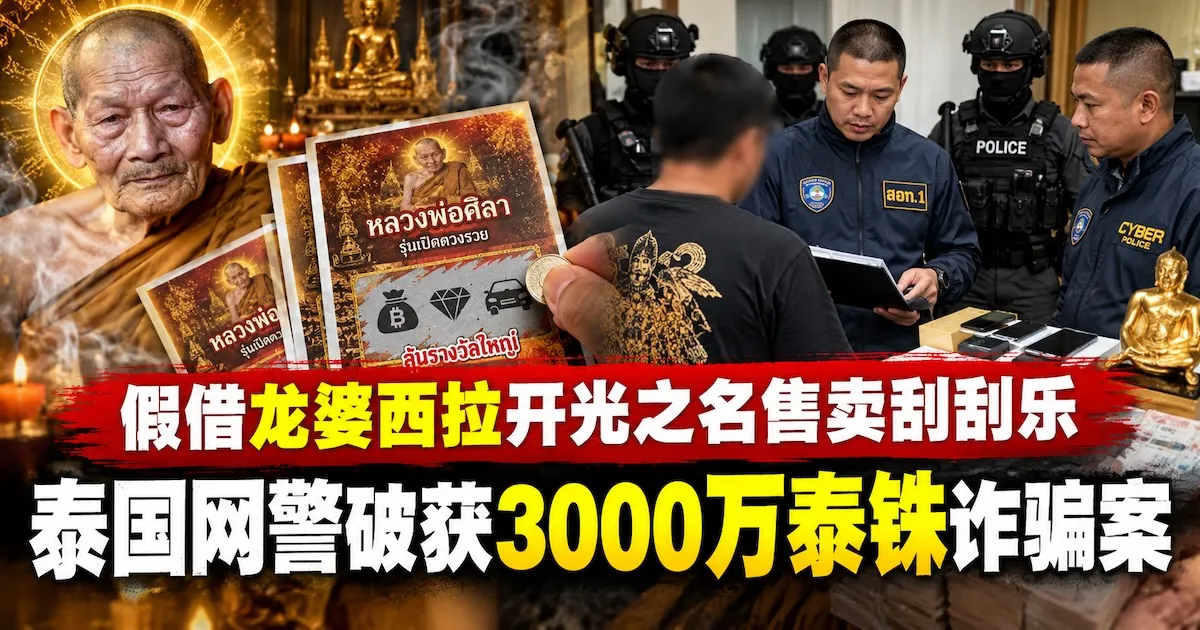
Thailand's Cyber Crime Investigation Bureau 3 (CCIB 3) announced on October 17, 2026 that it had dismantled a roughly three-year fraud network that falsely claimed senior monk Luang Pu Sila Sirichantho, abbot of Wat Phra That Muen Hin in Kalasin province, had personally blessed scratch-off lottery cards sold through Facebook. Acting on Bangkok Criminal Court search warrants No. 605/2026 and 606/2026, police raided two locations in the Lat Phrao Wang Hin area of Bangkok on October 16, then arrested the alleged ringleader in the northern province of Phayao under a Kalasin Provincial Court warrant, bringing the total to three suspects. Police say the scheme generated more than 30 million baht (roughly US$830,000) in transactions.
Three Years, 360,000+ Cards "Blessed" by a Monk Who Never Touched Them
According to the investigation, the suspects ran a Facebook page called "Scratch Card Luang Pu Sila 99 V.3," printing cards bearing the monk's photograph and advertising that he had personally performed a consecration ritual, or puttapisek, over them. Buyers scratched the cards to reveal numbers used for underground and cross-border lottery betting. The alleged ringleader, a 36-year-old man from Phayao, opened a corporate bank account to receive payments, while two women — aged 27 and 20, one based in Phayao and one in Bangkok — managed the page's orders and shipping. Police say the page sold more than 363,000 cards over roughly three years, and that the investigation only began after a wave of public complaints.
Fraud, Money Laundering, and Computer Crime Charges — Still at the Investigation Stage
Police have provisionally charged the suspects with public fraud, violations of the Computer Crimes Act for inputting damaging data into a computer system, conspiracy to commit money laundering, and defamation by advertisement. Investigators seized more than 20 items, including computers, phones, and the bank accounts used to receive payments. As of this writing, the case remains at the police investigation stage and has not been forwarded for prosecution or ruled on by any court — the allegations described here are the police's account of events, not a judicial finding of guilt.
What It Means for Overseas Amulet Collectors
Luang Pu Sila is a widely respected monk in northeastern Thailand; earlier in 2026 he took part in a Buddha image consecration ceremony at the Udon Thani horticultural expo (see our report on Luang Pu Sila joining the Buddha eye-opening rite). That genuine reputation is exactly what this scam traded on. For buyers of Thai amulets, the case is a useful reminder that a real consecration ceremony (phutthaphisek) follows a defined ritual process and typically requires the monk's direct, verifiable participation — it is never established by a seller's claim alone, whether on Facebook or anywhere else. Before buying any amulet, relic, or novelty item advertised as blessed by a famous monk, verify the claim directly with the temple or a reputable authentication source rather than relying on photos and sales copy. The Thai amulet trade has seen several similar authenticity disputes in recent years, including a nine-figure counterfeiting case involving multiple appraisers (see our coverage of the amulet dealer fraud scandal) and a retired official who lost over $100,000 in a fake amulet and gold scam. Keeping a paper trail and verifying provenance at the source remains the best protection against this kind of fraud.