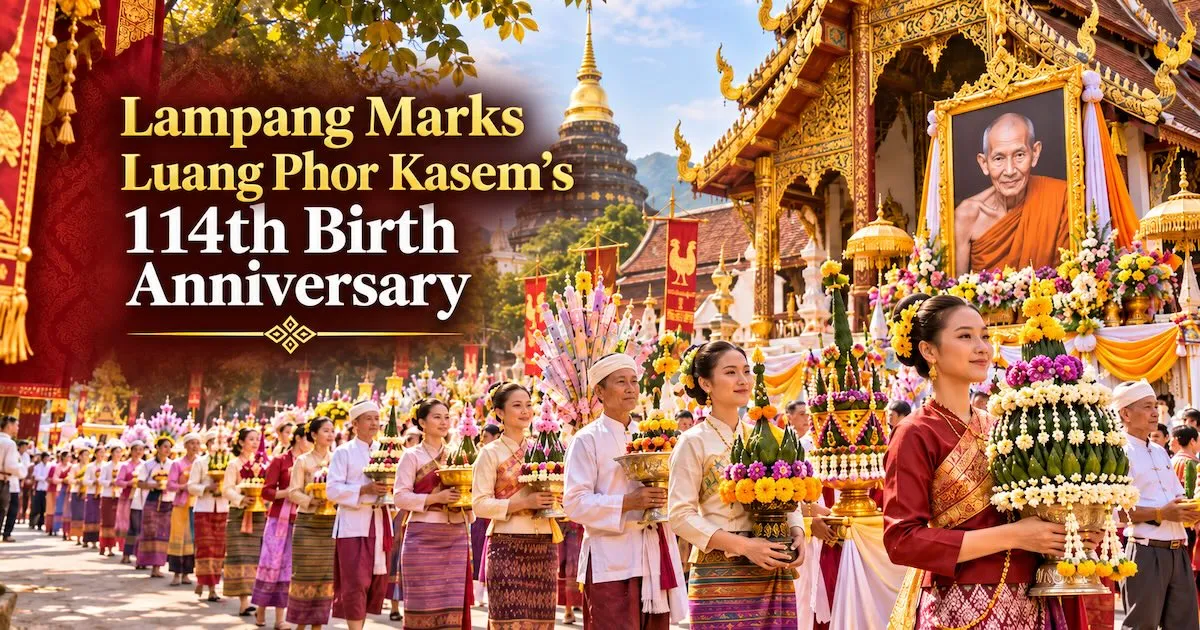
Thousands of devotees gathered in Lampang, northern Thailand, from 27 to 29 November 2026 for the 114th birth anniversary of the late Luang Phor Kasem Khemako (หลวงพ่อเกษม เขมโก). The festival took place at the Luang Phor Kasem Khemako meditation centre in Ton Thong Chai subdistrict, Mueang Lampang district. The Trilak Khemaka Bhikkhu Foundation organised it together with local authorities. Lampang Governor Wiwat Inthaiwong opened the event at 4:30 pm on 27 November by presiding over the traditional offering rite (thawai khrua tan). After that, more than twenty processions of Lanna-style offerings walked over two kilometres from the royal temple Wat Phra Kaeo Don Tao Suchadaram to the centre.
Three days of merit-making
Chiang Mai News and Khaosod reported that government offices, state enterprises, private firms, schools and community groups each prepared their own procession. Reports give different counts: Chiang Mai News lists 26 and other outlets cite 27. Phra Rajajintavachiraphon, head of the Lampang provincial Sangha and abbot of Wat Phra Kaeo Don Tao, gave the morning sermon. Foundation chairman Phraichit Thammarotphinit, Mueang Lampang district chief Thanarat Saithep and descendants of Lampang's former ruling family also attended. Disciples ran a charity kitchen and gave away more than 500 sacks of rice. The grounds also had exhibitions on the monk's life and on Buddhist art, and a market for local and organic produce.
On the morning of 26 November, the day before the festival, the centre held blessing rites at set auspicious times. They took place at the Buddha hall, the standing statue of Luang Phor Kasem, and the shrines of Thao Wessuwan, the hermit Pu Ruesi Narot and Chao Mae Suchada.
Who was Luang Phor Kasem?
Luang Phor Kasem was born Kasem Mani-arun on 28 November 1912 beside the Wang River in Lampang. He belonged to the Lampang ruling family, which is why devotees still call him Chao Kasem na Lampang. He was ordained young but later left temple administration behind and spent decades practising austerities in cemetery forests. He kept the dhutanga ascetic practices strictly and became known across the north for his simplicity and compassion. He died in January 1996. Northern Thais call him a ton bun, a person of great merit, and he is revered much like the Lanna kruba saints such as Kruba Srivichai.
Among collectors, his coins, photo lockets and yantra cloths are some of the most sought-after northern Thai amulets. Pieces blessed during his lifetime command the highest prices, for example the 2517 BE (1974) Lampang army battalion coin that collectors often cite. He was not part of the central-Thai lineage covered in our guide to the nine great monks of Thailand, but his name carries comparable weight for protection amulets in the north.
What this means for collectors
First, based on published reports, this was a commemorative religious and cultural festival. Chiang Mai News, Khaosod and 4 Force News made no mention of a new amulet release or a phutthaphisek consecration. If pieces later appear advertised as "114th anniversary editions" or "blessed at the birthday festival", ask the foundation or the organisers whether such a release was official before paying for one.
Second, Luang Phor Kasem died in 1996. Any amulet bearing his image that was made after that date is a commemorative piece issued by others. He did not personally consecrate it. Such items are fine for devotion, but their collector value is a different category from his lifetime pieces, and they should be priced accordingly. Check the issue year carefully: anything dated 2539 BE or later is posthumous.
Third, interest in his amulets tends to rise around each anniversary, and so does the number of copies on the market. For an expensive vintage piece, ask for a recognised authentication certificate and read our guide to spotting fake Thai amulets first. If you simply want an everyday protective piece, our best Thai amulets for protection guide covers options at every budget. There is no need to chase vintage pieces when attention is at its peak.
Source: Chiang Mai News; Khaosod; 4 Force News