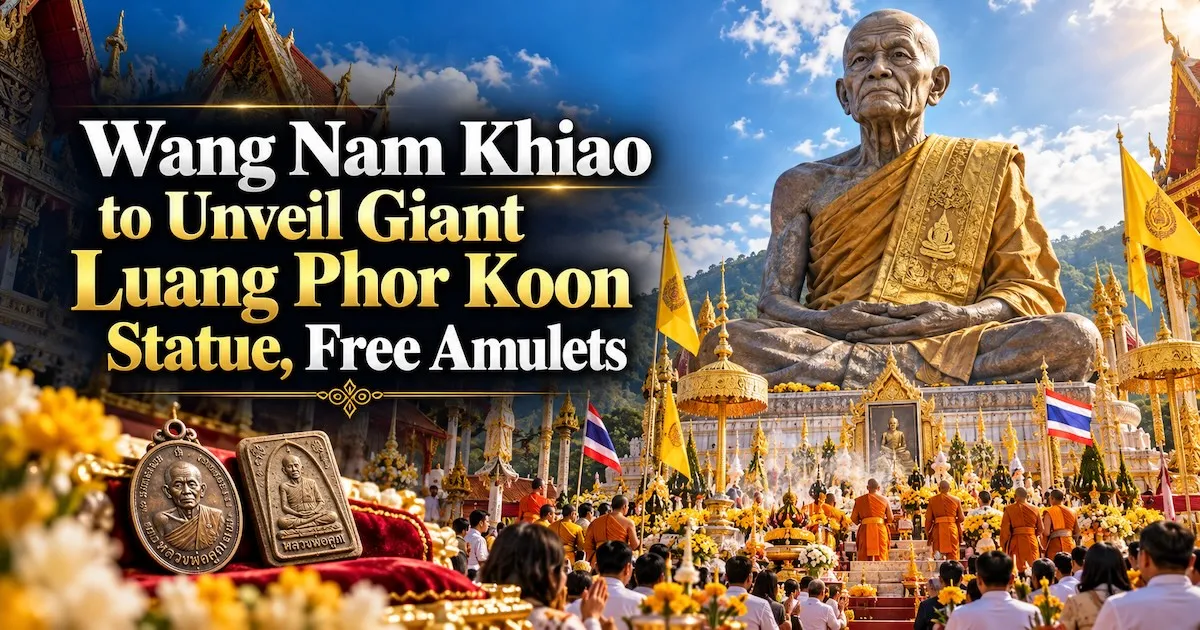
On Sunday, October 4, 2026, the Wang Nam Khiao district of Nakhon Ratchasima province, Thailand, will hold a consecration ceremony for a newly built giant green sandstone statue of the revered monk Luang Phor Koon Parisuttho (หลวงพ่อคูณ ปริสุทโธ). The event will also mark the first public giveaway of a rare batch of old amulets discovered sealed inside the ceiling of a building being demolished at Wat Ban Rai (วัดบ้านไร่), Luang Phor Koon's home temple in Dan Khun Thot district, according to Thai outlet Thairath.
What Is Happening on October 4
The statue at the center of the ceremony stands at Wat Ban Rai 2 (also known as Wat Bu Phai) in Wang Nam Khiao — 9 meters wide across the chest and 18 meters tall, carved from green sandstone and billed by organizers as the largest Luang Phor Koon statue in the world. The morning program begins at 7:30 a.m. with the statue's consecration ceremony (สมโภช), followed by a 10:15 a.m. ribbon-cutting for a newly built headquarters on Highway 304 and a 10:30 a.m. unveiling of the Luang Phor Koon Parisuttho Foundation, chaired by retired police Major General Mahakkhaphan Surakhup. In the afternoon and evening, an adjacent concert titled "Embracing the Mountain, Singing Songs" will run from 6:30 p.m. to 11:10 p.m. at The Lakeside By Krathom Hin, featuring six bands, with tickets priced at 150 baht.
Why the "Gru Taek" Amulets Matter to Collectors
In Thai amulet culture, a "gru taek" (กรุแตก, literally "the vault has cracked open") describes the moment when amulets sealed decades earlier inside a stupa, ordination hall, or building structure are exposed by decay, renovation, or demolition. Because these finds carry a documented origin — a specific temple and, often, an approximate consecration period — they are typically regarded by serious collectors as more credible than amulets circulating without provenance. The batch found in the ceiling at Wat Ban Rai fits this pattern exactly: amulets hidden since an earlier, undated period at Luang Phor Koon's original temple, only surfacing now during demolition work.
Luang Phor Koon (1923–2015) was widely known as Thailand's "people's monk," famous for his blunt manner and his amulets, which triggered nationwide buying frenzies in the 1990s and remain a staple of the best Thai amulets for wealth and prosperity category today. Readers wanting his fuller biography and a rundown of his amulet series can see our guide to Luang Phor Koon of Wat Ban Rai.
What This Means for Overseas Collectors
Because organizers plan to distribute this batch for free at the event rather than sell it, the amulets are unlikely to be available through any official overseas channel on the day itself. Experience with past "gru taek" discoveries in Thailand suggests two things overseas buyers should expect: first, that a limited, non-reproducible batch like this tends to reappear weeks or months later in Bangkok's amulet markets or on auction platforms; and second, that a well-publicized "vault crack" story is exactly the kind of narrative counterfeiters like to borrow. Anyone encountering amulets marketed as being from the "Wang Nam Khiao opening" or the "Wat Ban Rai gru taek batch" in the coming months should ask for provenance documentation or third-party certification rather than relying on the story alone — a pattern that repeats with nearly every notable amulet discovery in Thailand.
Source: Thairath