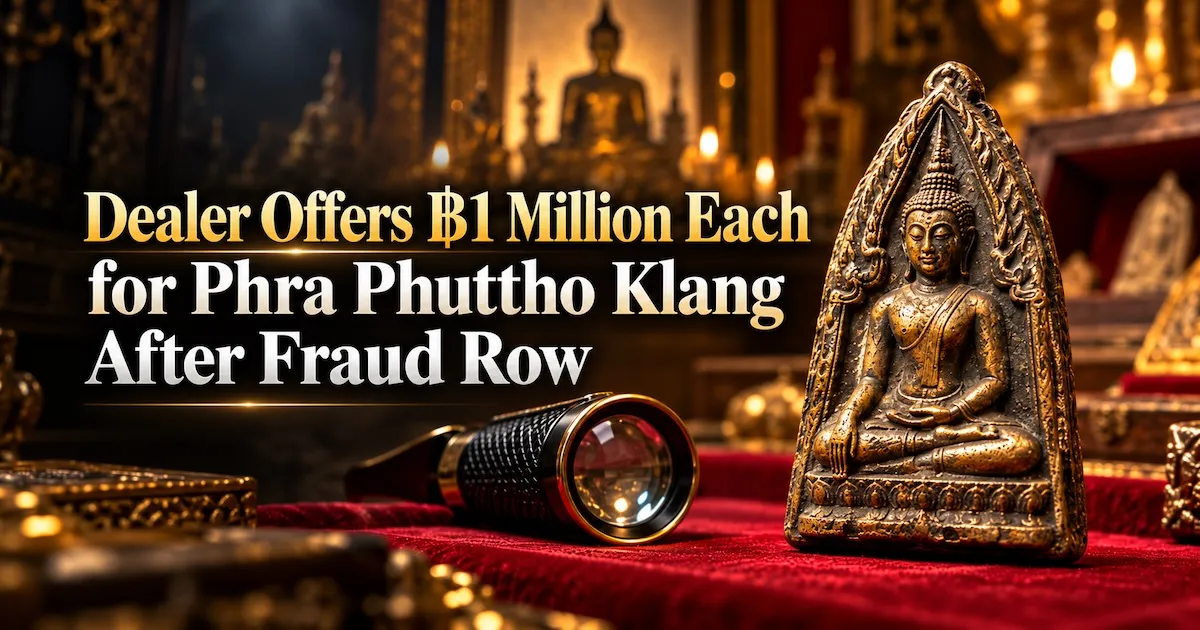
In mid-October 2026, Thai television program Hone Krasae (โหนกระแส, hosted by Kanchai Kamnerdploy) aired a dispute over a ฿950,000 amulet sale. Buyer Jua (จั๊วะ) had purchased a bronze Buddha image, sold to him as a genuine "Phra Phuttho Klang" with four authentication certificates, from collector Nat Fanpanthae (นัท แฟนพันธุ์แท้). Several experts who reviewed the piece afterward concluded it was actually a "Phra Rachakan" — a visually similar model from the same workshop, Patthana Chang (พัฒนะช่าง), distinguishable only by subtle differences in the chest, head tilt, and base size. A day after the controversy broke, prominent Bangkok amulet dealer Boy Tha Phra Chan (บอย ท่าพระจันทร์, real name Attawat Sirisitthongchai) posted on Facebook that he would buy up to ten genuine, good-condition Phra Phuttho Klang amulets for ฿1 million (roughly $27,000) each.
A Nine-Month Chain of Resale
Thai outlets reconstructed the amulet's trading history: collector Yot (ยศ) bought it roughly a year earlier for about ฿5,000 from a stall in southern Thailand, where the seller had called it a "Phra Rachakan." Yot insisted it was the more valuable Phra Phuttho Klang. Nat then bought it for about ฿200,000, resold it to a collector named Gun (กัน) for roughly ฿600,000, who resold it to Sakdakhom (ศักดาคม) for about ฿680,000 — who finally sold it to Jua in October 2026 for ฿950,000, with a ฿50,000 deposit already paid. After the dispute surfaced, dealer Ton Tha Phra Chan (ต้น ท่าพระจันทร์) admitted he had issued the first certificate based solely on photos Nat sent him over LINE, and has since retracted it, saying he will now require physical inspection before certifying any piece. A second certificate, issued October 6 by the Thai Amulet Collectors Association's deputy chairman Pa Toi Muang Non (ป๋าต้อย เมืองนนท์), was also based only on photos and has likewise been withdrawn; the association says it will keep its appraisal committee's membership confidential going forward. Jua says he felt "set up" and is considering a fraud complaint against Nat; a lawyer involved noted that deliberate concealment could constitute criminal fraud, while an honest misjudgment would be a civil matter. No police report or court ruling has been confirmed at this stage, and all accounts so far come from the parties involved.
Why Phra Phuttho Klang Commands Such Prices
The amulet's value traces back to Mae Boonruen Tongbuntoem (คุณแม่บุญเรือน โตงบุญเติม), a revered Thai Buddhist laywoman who died in 1964 at age 70 and is remembered for her advanced meditative attainments. Memorial halls housing her relics and image stand at several temples, including Wat Awut Wikasitaram in Bangkok and Wat Sarnarddhammaram in Rayong, and amulets tied to her legacy are treated as protective and wealth-bringing relics. That is the backdrop against which Boy's million-baht offer reads less as pure generosity and more as a confidence play: if doubt spreads across the entire Phra Phuttho Klang line because of one disputed piece, prices across the category could soften — and a dealer with deep pockets stepping in publicly can reset the narrative, and his own standing, in one move.
What This Means for Collectors
The real lesson here isn't about one fake amulet — it's that the certification system itself failed twice, once from an individual dealer and once from an established association, both issuing paper based on photographs rather than physical inspection. For overseas buyers who can't travel to Thailand to inspect a piece in person, that's a serious warning. Our guide on what a Samakom Phra certificate actually guarantees and our breakdown of a prior nine-dealer fraud scandal both cover the same underlying risk: a certificate is a reference point, not a guarantee. The higher the price, the more essential it is to insist on physical verification before any deposit changes hands.
Source: MGR Online