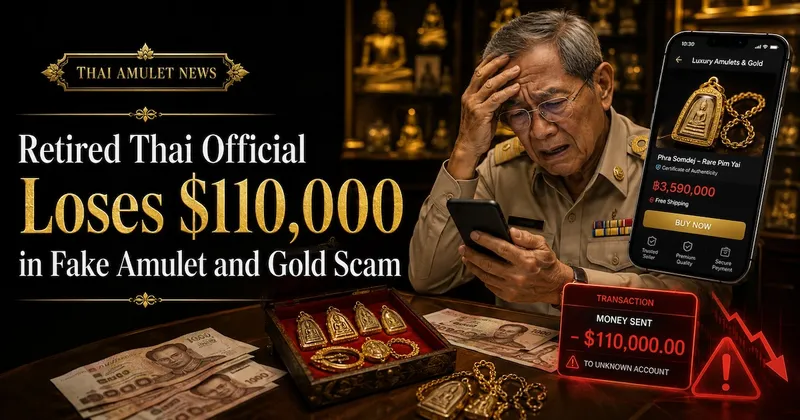
On August 1, 2026, a Bangkok goldsmith, Namo Baan Chang Thong Jewelry (ร้านทำทองนะโมบ้านช่างทอง เพชร ทอง & จิวเวอรี่), posted a public warning on Facebook describing how a retired Thai civil servant lost 4 million baht, roughly USD 110,000, buying gold jewelry, a naga-pattern gold belt (เข็มขัดนาค), and several Buddhist amulets through online sales pages. The sellers claimed the items had come "from the homes of wealthy families, retired officials, and generals," and promised the buyer could resell them later at a profit. The retiree kept purchasing more pieces on that promise, only to eventually discover that everything bought was counterfeit. The case was picked up and reported by Thai outlets including kapook.com, sparking wide discussion among Thai amulet collectors online.
A Familiar Scam: Inventing "Old Wealthy Family" Provenance
According to the goldsmith's post, this is not an isolated case — multiple differently named sales pages have used near-identical scripts, each inventing a story that the gold or amulets came from a prominent family's estate or a retired senior official's collection. This fabricated provenance makes the items seem rare and likely to hold or increase in value, and the promise of a future buyback or an introduction to another buyer is used to encourage victims to keep spending. Because gold jewelry and amulets both lack a single, transparent public price reference, ordinary buyers have little way to verify authenticity or a fair price at the time of purchase — the fraud is often only discovered later, when the buyer tries to resell the pieces or has them formally appraised, by which point the money is usually gone.
What This Means for Overseas Buyers
For collectors outside Thailand who cannot personally inspect an amulet before buying, this case is a useful warning. Any seller who emphasizes a dramatic "came from a wealthy family's estate" backstory but cannot produce a proper amulet-society authentication certificate should raise immediate suspicion. Amulets bought through legitimate channels can typically be traced to a specific temple, consecration year, and production batch, and a trustworthy seller should be able to provide verifiable provenance — not just a compelling story.
- Red flag: seller claims the item came from a "wealthy family," official, or general's estate with no proof
- Red flag: promises of a future buyback or introduction to another buyer
- Red flag: the same script appears across multiple, differently named sales pages
- Red flag: price is noticeably below the going rate for a genuine piece
For guidance on spotting fakes and choosing a trustworthy seller, see our Buying Thai Amulets Online: How to Spot Fakes and Find a Trusted Seller and our What Is a Samakom Phra Certificate? A Complete Guide for Overseas Buyers before trusting any "rare estate find" sold through an unfamiliar page.
Source: kapook.com