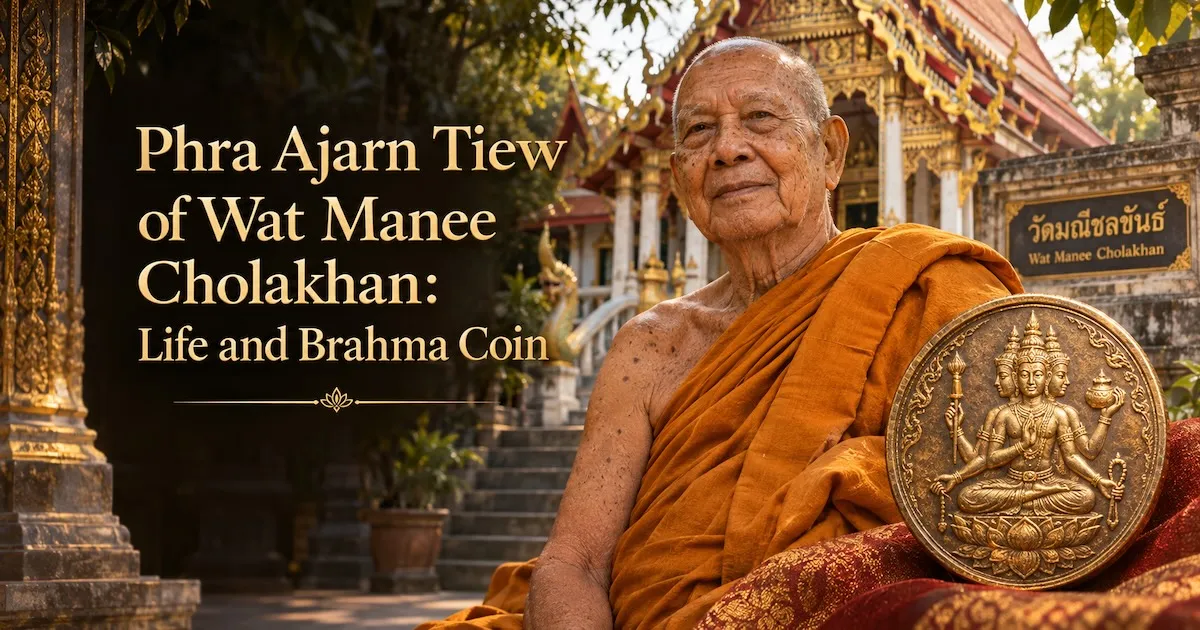
Phra Ajarn Tiew (พระอาจารย์ติ๋ว), formally Phra Khru Wimon Yan Udom, is the abbot of Wat Manee Cholakhan (วัดมณีชลขัณฑ์), a royal temple in Lopburi, about two and a half hours north of Bangkok. Born in 1959 and still active today, he is a Lopburi-born monk who studied traditional Thai sacred arts, from Khmer-script yantra to takrut and sacred powders, under several well-known teachers. Among collectors, one of his notable early pieces is the first-batch "Rasami Phrom" (เหรียญรัศมีพรหม) coin of B.E. 2545 (2002), a diamond-shaped Phra Phrom (Four-Faced Brahma) medal. This guide covers who he is, his temple, how to read the certificate for that coin, and what a foreign buyer should know.
Who is Phra Ajarn Tiew?
"Ajarn" means teacher, and "Tiew" (ติ๋ว) is the nickname by which Thai devotees know him; it is not part of his monastic name. According to a profile in the Thai newspaper Daily News (August 2026), he was born Thammanoon Koetphu (ธรรมนูญ เกิดภู่) on 2 December B.E. 2502 (1959) in Lopburi. He became a novice at 17, in B.E. 2518, at Wat Thep Kunchon Worawararam in Lopburi, and took full ordination at 20 at Wat Manee Cholakhan, receiving the monastic name Thitawatthano (ฐิตวัฑฒโน).
The same profile says he was drawn to sacred arts from childhood. He studied Pali grammar (Mula Kaccayana) and Khmer script, the inscribing of takrut (rolled metal scrolls), and the making of traditional sacred powders such as Itthije (ผงอิทธิเจ), with a lay master of the area, Kamnan Yot Mueanphan. He also learned from Luang Pho Dam of Wat Sao Thong Thong, a disciple of Luang Pu Chan of Wat Nang Nu; placed himself as a pupil of the well-known meditation master Luang Pu Du of Wat Sakae in Ayutthaya; and received teachings from Luang Pho Maha Pho of Wat Khlong Mon, who carried on the lineage of Luang Pu Suk of Wat Pak Khlong Makham Thao. In B.E. 2565 (2022) Thailand's Sangha Supreme Council appointed him abbot of Wat Manee Cholakhan, with the ecclesiastical title Phra Khru Wimon Yan Udom.
Key facts
- Known as: Phra Ajarn Tiew (พระอาจารย์ติ๋ว)
- Title: Phra Khru Wimon Yan Udom (พระครูวิมลญาณอุดม)
- Monastic name: Thitawatthano (ฐิตวัฑฒโน)
- Born: 2 December 1959 (B.E. 2502), Lopburi
- Temple: Wat Manee Cholakhan, Phrommat, Mueang Lopburi; abbot since B.E. 2565
- Teachers named in the Thai press: Luang Pu Du (Wat Sakae), Luang Pho Dam (Wat Sao Thong Thong), Luang Pho Maha Pho (Wat Khlong Mon)
Wat Manee Cholakhan
Wat Manee Cholakhan sits by the Lopburi River in Phrommat subdistrict, on the west side of Lopburi town. According to the Thai travel site Love Thailand, it is thought to date from the reign of King Narai (17th century), when it was called Wat Ko Kaeo, "jewel island temple", after its island-like setting; King Chulalongkorn (Rama V) later gave it its present name. Its landmark is the tall, angular Chedi Luang Pho Saeng. Several kings visited the temple, and King Vajiravudh (Rama VI) presented Kathin robes there in B.E. 2458 and 2469 (1915 and 1926). Lopburi is an easy day trip from Bangkok, and the temple can be combined with the town's Khmer-era ruins.
The "Rasami Phrom" first-batch coin, B.E. 2545
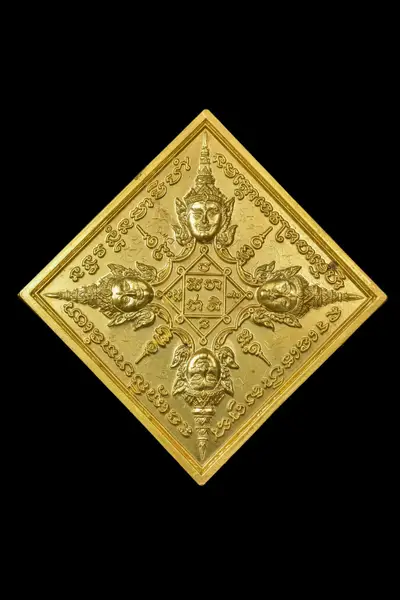
"Rasami Phrom" means "radiance of Brahma", and "run raek" means first batch. Phra Phrom is the Thai form of the Hindu god Brahma, honoured in Thailand for wealth, career, goodwill and safety; if he is new to you, start with our guide to Phra Phrom. The coin was issued in B.E. 2545, twenty years before Ajarn Tiew became abbot. It is diamond-shaped, with a face of Phra Phrom at each point, a square yantra frame at the centre and scripture running along the edges.
We have not found a public record of how many coins were struck in this batch or of the consecration ceremony, so we do not quote figures. What can be checked is the certificate. A Samakom Phra (Thai Buddha Image Admiration Association) card for this coin should read เหรียญรัศมีพรหมพระอาจารย์ติ๋ว รุ่นแรก, followed by the metal and พ.ศ. 2545, with the temple วัดมณีชลขัณฑ์ (ลพบุรี). The metal word matters most, because the same design exists in several metals and the price follows the metal. How to verify a card online is explained in our Samakom Phra certificate guide.
The piece in our collection
We currently offer one Ajarn Tiew "Rasami Phrom" first-batch coin in gold, B.E. 2545 (฿300,000). Its Association formal certificate, No. 09084 (barcode GJ09-B5970), names it เหรียญรัศมีพรหมพระอาจารย์ติ๋ว รุ่นแรก เนื้อทองคำ พ.ศ. 2545, and "เนื้อทองคำ" means gold. The back is a hand-engraved yantra grid. The supplier says the engraving was done by Ajarn Tiew himself and that the master's hair is sealed into the piece; the certificate does not comment on either, so we present both as the supplier's description. It is held by a partner supplier, so we confirm availability before taking payment.
Buying an Ajarn Tiew amulet from abroad
- He is a living monk. New batches still appear, so check the year and batch name rather than assuming every piece is early.
- Read the metal on the card. Gold, silver and base-metal versions of a design can look similar in photos.
- Plan for a case. Gold is soft. A fitted case protects the edges and the engraved back; see our amulet casing guide.
- Check import rules for gold. Some countries treat gold items differently at customs, so check your local rules before ordering a gold piece.
FAQ
Q: Is Ajarn Tiew still alive?
A: Yes. As of the Daily News profile in August 2026 he is abbot of Wat Manee Cholakhan.
Q: What is a Phra Phrom amulet worn for?
A: In Thai belief, Phra Phrom is prayed to for wealth, career progress, goodwill and safety. These are devotional beliefs; no amulet guarantees an outcome.
Q: Can non-Buddhists wear it?
A: Yes. Phra Phrom is a deity shared by Hindu and Thai Buddhist practice, and many foreign visitors pray at Bangkok's Erawan Shrine. Wear it with respect, above the waist.
Q: How is "Tiew" pronounced?
A: Roughly "tee-ew", with a rising tone. You may also see it spelled Tiw or Tew.
Last updated: 2026-11-01 | By the Merit Messenger team, based in Bangkok
Questions about this piece? Contact us or browse the collection.