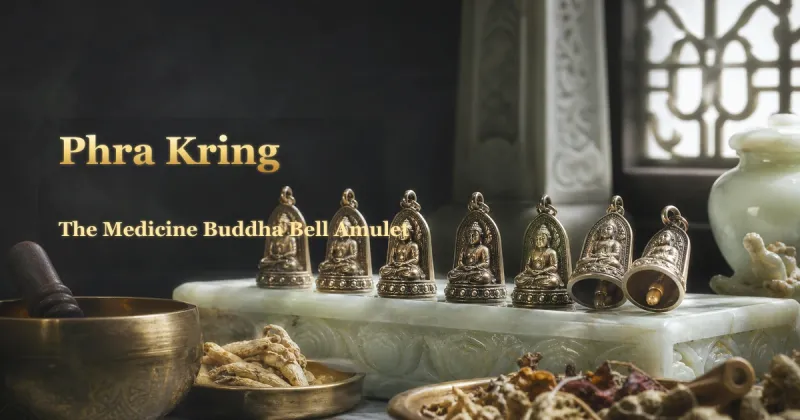
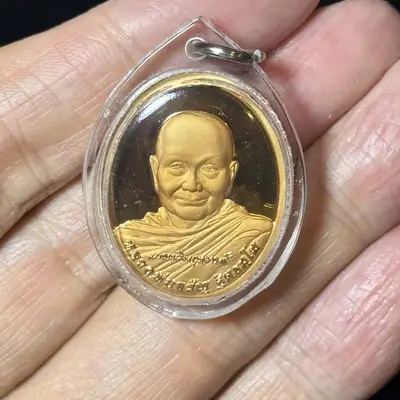
Shake a Phra Kring (Thai: พระกริ่ง) gently and it answers with a soft chime — a sacred bead sealed inside the hollow-cast Buddha figure. That sound gives the "ringing amulet" its name and its character: Thai devotees regard the Phra Kring as a representation of the Medicine Buddha, and its domain is healing, health, and deliverance from illness. Among metal amulets, no category is more closely tied to the royal temples of Bangkok or more obsessively collected.
Origins: from ancient scripture to Bangkok's royal temples
Thai tradition traces the Phra Kring's consecration formula to old scriptures reaching back to the Ayutthaya era. The craft as Thailand knows it, however, begins at Wat Bowonniwet in Bangkok, where the prince-patriarch Pavares Variyalongkorn cast the first celebrated Thai Kring — the Phra Kring Pavares — in the late nineteenth century. Cast in tiny numbers for royalty and senior monks, original Pavares pieces are among the rarest and most expensive amulets in existence.
The tradition's great flowering came at Wat Suthat. After witnessing his teacher healed by holy water infused with a Kring Pavares, Somdej Sangharaj Pae of Wat Suthat devoted himself to mastering the casting scripture — and made Wat Suthat the definitive Phra Kring lineage. Its editions from the early twentieth century onward set the standard every later Kring is measured against.
The Medicine Buddha connection
The Phra Kring's iconography — a seated Buddha holding a medicine bowl or myrobalan fruit — mirrors the Medicine Buddha (Bhaisajyaguru) of the Mahayana tradition, and Thai devotees petition it accordingly: recovery from illness, protection of health, and relief for ailing family members. The chime is part of the practice; the sound is considered auspicious, a small bell of blessing carried on the body. Holy water made by immersing a Phra Kring remains a living healing custom, echoing the miracle that started the Wat Suthat lineage.
Powers of the Phra Kring
- Health and healing: the defining domain — worn through illness, surgery, and recovery, and by those caring for sick relatives.
- Protection: as a Buddha-image amulet it carries the full protective portfolio; the classic phrase is that the Kring guards body and spirit alike.
- Longevity and steadiness: a traditional gift to elders, and a favorite of doctors and nurses in Thailand.
- Auspicious presence: the chime marks moments — devotees ring it before travel or difficult days.
Famous editions and the collector hierarchy
- Phra Kring Pavares (Wat Bowonniwet): the founding rarity — museum-grade, essentially unobtainable.
- Wat Suthat editions (Sangharaj Pae era and successors): the benchmark lineage; pre-war editions are blue-chip collectibles with prices to match.
- Later temple editions: royal and provincial temples across Thailand continue casting Krings in documented ceremonies — the realistic entry point, from modest prices upward.
The market logic mirrors every top category: verify the temple, the edition year, and the certificate. Hollow casting with an internal bead is also a craft signature — crude seams and dead, rattly sounds mark cheap copies. The general checklist in buying Thai amulets online safely applies.
Wearing the Phra Kring
A Buddha-image amulet: it takes the top position when worn with deity or animal amulets (see how to wear a Thai amulet), with standard etiquette throughout. Metal Krings are durable but deserve a case — the casting details carry much of the value. It pairs naturally with a Phra Somdej: king of amulets above, healer alongside.
FAQ
Q: Is the Phra Kring only for sick people?
A: No — health protection is petitioned before illness, not just during. It is also a traditional gift for parents and elders.
Q: Does the bead inside wear out or "lose power"?
A: No. The bead is part of the casting, sealed at consecration; the chime lasts as long as the amulet. A silent Kring usually indicates damage — have it checked, never pried open.
Q: What does Kring holy water mean?
A: A traditional practice: the amulet is briefly immersed in clean water while chanting, and the water is drunk or sprinkled for blessing — the very custom that launched the Wat Suthat lineage.
Q: How does Phra Kring differ from other Buddha amulets?
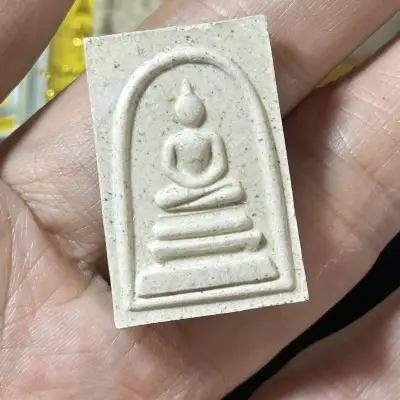
A: Form and focus. Most Thai amulets are pressed tablets; the Kring is a hollow-cast statuette with the healing specialization. The wider map is in Thai amulet types explained.
Last updated: July 2026 | By the Merit Messenger team, based in Bangkok
Looking for a Phra Kring with documented temple provenance? Browse our collection or contact us.