What Is Phra Somdej?
Phra Somdej is the single most revered type of Thai amulet, often called the King of Amulets (Phra Jao Sua). Created by the great Buddhist master Somdej Phra Buddhachan Toh Brahmaransi in the mid-19th century, these bell-shaped amulets made from sacred powder are considered the gold standard of Thai Buddhist talismans. A genuine antique Phra Somdej from Wat Rakang can command prices exceeding one million US dollars at auction — not because of the material, but because of the spiritual legacy behind it.
Whether you are new to Thai amulets or building a serious collection, understanding Phra Somdej is essential. This guide covers its origins, the monk who created it, the spiritual benefits practitioners believe it provides, and how to evaluate one before you buy.
The History: Somdej Toh and Wat Rakang
Somdej Toh (1788–1872) was one of the most accomplished Buddhist monks in Thai history. He served as the supreme patriarch's right hand, was a personal spiritual advisor to King Rama IV, and is still regarded as the greatest amulet creator Thailand has ever produced.
At Wat Rakang Kositaram in Bangkok, Somdej Toh mixed sacred powder from five key ingredients — powdered limestone from temple walls, crushed dried flowers used in worship, banana tree sap as a binding agent, rice grains offered by devotees, and incense ash collected over years of chanting. He hand-pressed each amulet into molds and consecrated them through extended meditation sessions, sometimes lasting weeks.
The result was not a mass-produced trinket but a spiritual artifact. Each Phra Somdej from Somdej Toh's own hands carries over 150 years of accumulated reverence. After his passing, disciples at Wat Rakang, Wat Bangkhunprom, and Wat Ketchiyo continued creating Phra Somdej in his tradition, though these later editions are distinguished from the originals.
How to Recognize a Phra Somdej
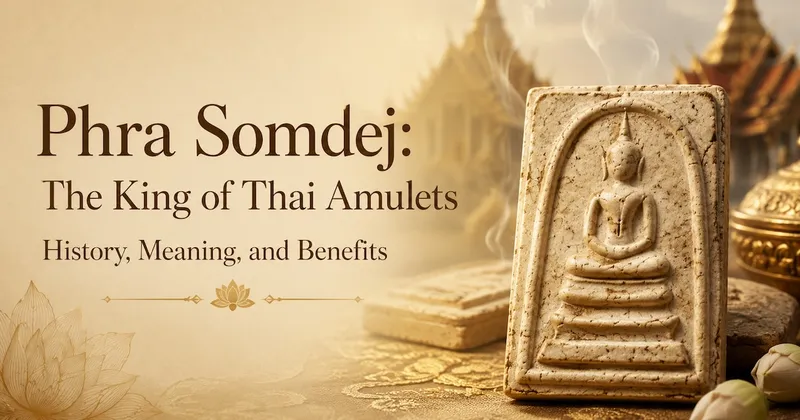
Phra Somdej amulets share a distinctive design that has remained remarkably consistent since Somdej Toh's era. Here are the key visual elements:
- Bell shape (thong) — The outer frame resembles the profile of a Thai bell, wider at the base and tapering toward the top. This shape is unique to Phra Somdej and immediately distinguishes it from other amulet types.
- Tiered base — The Buddha image sits on a layered pedestal, usually three tiers representing the Triple Gem: the Buddha, the Dhamma (teaching), and the Sangha (monastic community).
- Meditation posture — The central Buddha figure sits in the Maravijaya (subduing Mara) posture, with the right hand touching the earth — the gesture associated with the moment of enlightenment.
- Sacred powder texture — Authentic Phra Somdej has a distinctive grainy, slightly porous surface from the mixed sacred ingredients. Over decades, the surface develops a patina and may show tiny crystalline formations called "phong" that collectors prize.
Different versions exist — some with pointed arch tops, some with rounded tops, some with additional decorative elements — but the fundamental bell shape with tiered base remains the constant identifier.
Spiritual Benefits of Phra Somdej
Phra Somdej is considered an all-purpose amulet, meaning its spiritual benefits cover virtually every aspect of life rather than specializing in one area. Practitioners and collectors attribute these primary benefits to it:
- Metta Mahaniyom (loving-kindness) — Wearing Phra Somdej is believed to make the wearer more likeable, respected, and surrounded by goodwill. In Thai culture, strong Metta energy helps in negotiations, leadership, and social harmony.
- Maha Pokasap (wealth attraction) — Many business owners in Thailand wear Phra Somdej specifically for its reputation in attracting financial prosperity and business opportunities.
- Kong Grapan Chadtri (protection) — Though not primarily a protection amulet like Phra Pidta, Phra Somdej is believed to provide a baseline of spiritual shielding against danger and ill intent.
- Klaew Klaad (danger evasion) — Stories abound in Thai culture of Phra Somdej wearers narrowly escaping accidents, disasters, or dangerous situations.
- Serm Duang (fate enhancement) — Phra Somdej is said to elevate the wearer's overall fortune, smoothing obstacles and opening doors that would otherwise remain closed.
This breadth of coverage is precisely why Phra Somdej is recommended as a first amulet — it does not require the wearer to choose a single area of focus.
Famous Versions of Phra Somdej
Not all Phra Somdej are equal. Among collectors and practitioners, certain versions carry exceptional prestige:
- Phra Somdej Wat Rakang — The original, created by Somdej Toh himself. These are the most valuable amulets in existence. Authentic pieces from Somdej Toh's hand are museum-grade artifacts.
- Phra Somdej Wat Bangkhunprom — Created at the temple where Somdej Toh's disciples continued his work. Highly regarded, though typically more accessible than Wat Rakang originals.
- Phra Somdej Wat Ketchiyo — Another temple associated with Somdej Toh's lineage, known for a slightly different mold design.
- Modern master editions — Many respected modern monks create Phra Somdej following Somdej Toh's traditional methods. These are far more affordable and still carry genuine spiritual significance from proper consecration ceremonies.
For most practitioners — especially those outside Thailand — a well-consecrated modern Phra Somdej from a reputable monk offers genuine spiritual value without the six-figure price tag of antique originals.
Who Should Wear Phra Somdej?
Phra Somdej is genuinely suitable for anyone. Unlike some Thai amulets that serve specific purposes or carry cultural nuances, Phra Somdej is the universal recommendation:
- First-time amulet wearers — Its all-purpose nature means you do not need to know exactly what you want before choosing it.
- Business professionals — The combination of Metta (goodwill) and Pokasap (wealth) energy makes it a natural fit for anyone in commerce or leadership.
- Those seeking general spiritual support — If you are looking for balanced protection, luck, and positive energy without specializing, Phra Somdej covers all bases.
- Collectors — No serious Thai amulet collection is complete without at least one Phra Somdej.
How to Identify Authentic Phra Somdej
Because of Phra Somdej's prestige and value, counterfeits are common. Here is what to look for when evaluating one:
- Material consistency — Sacred powder Phra Somdej should feel slightly chalky and porous, not smooth like plastic or dense like ceramic. The weight should feel light relative to its size.
- Mold detail — Authentic pieces show natural imperfections — slightly uneven edges, minor asymmetry in the Buddha figure, and organic variations that come from hand-pressing. Machine-made fakes tend to be too perfect and uniform.
- Age indicators — For vintage pieces, look for genuine patina, fine surface cracking consistent with decades of natural aging, and the tiny crystalline deposits that form on old sacred powder over time.
- Provenance — A reputable seller should be able to tell you which temple and which monk created the amulet, and ideally provide documentation or a competition certificate from a recognized Thai amulet association.
For high-value antique Phra Somdej, always seek evaluation from a recognized Thai amulet competition (Samakom). For modern editions at reasonable prices, buying from a trusted dealer with direct temple sourcing is your best protection.
Phra Somdej in Our Collection
At Merit Messenger, we source Phra Somdej amulets directly from Thai temples, ensuring every piece comes with verified provenance and proper consecration. Our collection ranges from accessible modern editions perfect for first-time wearers to premium pieces from renowned masters.
Browse our full amulet collection to find a Phra Somdej that resonates with you, or read our beginner's guide to Thai amulets if you are still exploring. For questions about authenticity and sourcing, see our guide to buying amulets online.