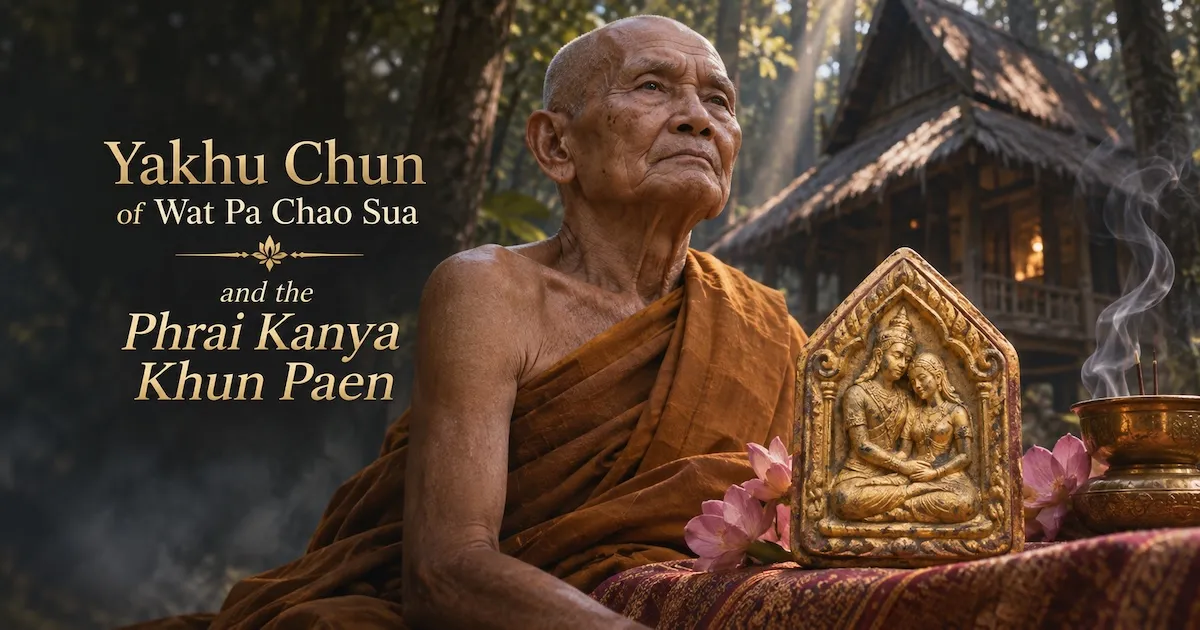
Yakhu Chun (พระญาคูจุณฑ์, also written ญาครูจุณฑ์ and known in Chinese-speaking circles as Ajarn Chun) is a forest-tradition monk of Senasana Wat Pa Chao Sua (เสนาสนะวัตรป่าเจ้าสัว) in Ubon Ratchathani, northeast Thailand. He is best known for one amulet: the Phra Khun Paen Phrai Kanya (พระขุนแผนพรายกัญญา) of B.E. 2557 (2014), a small handmade powder Khun Paen that was given away to raise funds for other temples and has since become one of the most sought-after modern Khun Paen in Thailand. This guide explains his title, what is and is not known about him, how the Phrai Kanya was made, and what to check before buying one.
What "Yakhu" means
"Yakhu" is not a name but a rank from the Lao and Isan (northeast Thai) monastic tradition. In Isan, lay supporters honour a respected monk with a bathing ceremony called hot song (ฮดสรง), a custom that came from the old Lan Xang kingdom. Each ceremony raises the monk one step, and Thai academic studies of the custom list the steps as Samret (สำเร็จ), Ya Sa (ญาซา), Yakhu (ญาคู) and Ya Than (ญาท่าน). So "Yakhu Chun" means roughly "the venerable Chun, honoured three times by his community". It is a local, community-given title, different from the royal ecclesiastical ranks such as Phra Khru.
The name of his residence is also worth a note. A senasana (เสนาสนะ) is a monks' dwelling or practice place, and wat here is part of the name "Wat Pa Chao Sua", the "rich man's forest monastery". It should not be confused with Wat Klang Bang Kaew in Nakhon Pathom, whose famous "Chao Sua" coins have nothing to do with Ubon.
Who is Yakhu Chun?
Public information about his life is thin, and we have not found a reliable record of his birth year, ordination date or teachers, so we do not give them. What is documented comes from visitors and the Thai amulet press:
- He keeps the strict practice of the Isan forest lineage of Luang Pu Mun Bhuridatto: one meal a day, eaten from the alms bowl. A visitor's account from October 2014 says he does not handle money.
- The same account says the monastery has no counter selling amulets and no donation box, and that visitors were given only a small Salika takrut, with a token six-baht offering left in a bowl.
- Thai press coverage in 2021 described him as designing his amulets himself and overseeing every stage of making them. Besides the Phrai Kanya, the monastery has issued a Phra Kring Lan Chang and, later, an Upagupta (พระอุปคุต) coin in the "binding Mara" posture, also distributed in return for donations to temple building.
Key facts
- Thai name: พระญาคูจุณฑ์ (ญาครูจุณฑ์ on Samakom Phra certificates)
- Residence: Senasana Wat Pa Chao Sua (เสนาสนะวัตรป่าเจ้าสัว), Ubon Ratchathani
- Lineage: Isan forest tradition, following Luang Pu Mun's monastic rule
- Best-known amulet: Phra Khun Paen Phrai Kanya, B.E. 2557 (2014)
- Birth year and teachers: not found in reliable sources
The Phrai Kanya Khun Paen
Khun Paen amulets take their name from the hero of the Thai epic Khun Chang Khun Phaen and are worn above all for charm, popularity and goodwill; see our complete Khun Paen guide. Yakhu Chun's version has the house-shaped arch of a Khun Paen with a seated Buddha inside, which is why collectors describe it as a Khun Paen on the outside and a Somdej on the inside.
"Phrai Kanya" refers to a female spirit, a phrai, named in devotion as Mae Nid (แม่นิด). In Thai belief a phrai is a spirit that can be invited to help the wearer, which puts this amulet partly in the spirit-amulet family; for how that differs from a purely Buddhist amulet, see what yin amulets are. According to the 2014 visitor's account, the monastery itself has no statue, painting or shrine of Mae Nid, and those who feel their wish has been answered are asked simply to make merit and dedicate it to her.
The same account, relaying what Yakhu Chun told the visitor, describes how the powder was made:
- He gathered sacred materials for more than twenty years, following six traditions, including erasure powder (ผงลบ) in the line of Somdej To of Wat Rakhang, Phrai Kanya powder in the line of Luang Pu Sang Thao (named as a teacher of Luang Pu Tim), and the Salika takrut tradition of Isan.
- The pieces were pressed by hand, one bowl of powder a day, so no two are quite alike in texture, shrinkage or pores.
- They were made to give away, mostly to other temples to fund their buildings, and by April 2014 none were left at Wat Pa Chao Sua.
How many were made is uncertain. A Thai dealer's listing says about 3,000, and the supplier of the piece we offer says the same; a collector on the same forum thread put the total across all materials at over 4,000. We treat every figure as approximate.
Buying a Phrai Kanya safely
Because the batch was handmade, small and free at source, and then became famous, prices rose sharply and copies followed. Three things matter:
- The certificate. A Samakom Phra card for this piece should read พระขุนแผนพรายกัญญา ญาครูจุณฑ์, with the material (for example เนื้อผง, powder), the year พ.ศ. 2557 and the issuer เสนาสนะวัตรป่าเจ้าสัว. How to read and verify a card is in our Samakom Phra certificate guide.
- Inserts and cases. Many pieces carry a small metal takrut set into the back, and many are sold in gold or silver cases. Certificates cover the amulet itself, so treat any "solid silver takrut" or "solid gold case" as the seller's claim unless separately tested.
- Handmade variation. Irregular texture is normal for this batch, so "it looks different" is not by itself a sign of a fake; the certificate is the reference.
The piece we offer
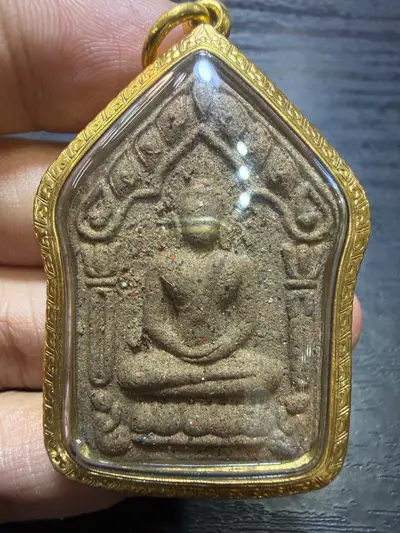
Our Yakhu Chun Phrai Kanya Khun Paen, powder, B.E. 2557 (฿150,000) carries a Samakom Phra formal certificate, No. P02501 (barcode GJ02-41755), naming it พระขุนแผนพรายกัญญา ญาครูจุณฑ์ เนื้อผง พ.ศ. 2557 from เสนาสนะวัตรป่าเจ้าสัว. The powder shows red, white and black grains. A silver-coloured metal piece is set into the back, which the supplier describes as a solid silver takrut, and it comes in a gold-coloured case the supplier describes as solid gold; the certificate does not cover either. It is held by a partner supplier, so we confirm availability before taking payment.
FAQ
Q: Is Yakhu Chun the same as Ajarn Chun or Yakhru Chun?
A: Yes. ญาคู and ญาครู are two spellings of the same Isan title, and Chinese-speaking sellers often call him Ajarn Chun (阿赞尊). Check the Thai name and the issuer on the certificate rather than the transliteration.
Q: Is the Phrai Kanya a spirit amulet?
A: Partly. The image is a seated Buddha in a Khun Paen frame, but the name and devotion refer to the female spirit Mae Nid. People who prefer purely Buddhist amulets should know that before buying.
Q: What do people wear it for?
A: Mainly charm, goodwill, trade and luck, the usual Khun Paen purposes. These are beliefs; no amulet guarantees an outcome.
Q: Can I visit Wat Pa Chao Sua?
A: The 2014 visitor's account says visitors are welcome in the morning to offer food at around 8 a.m. Amulets are not sold there, so do not travel expecting to buy one.
Last updated: 2026-11-01 | By the Merit Messenger team, based in Bangkok
Questions about this piece? Contact us or browse the collection.