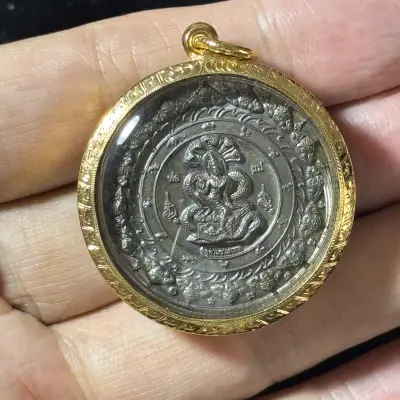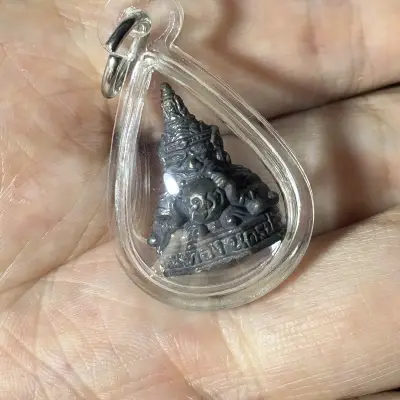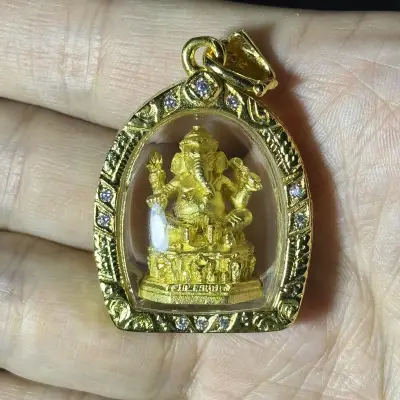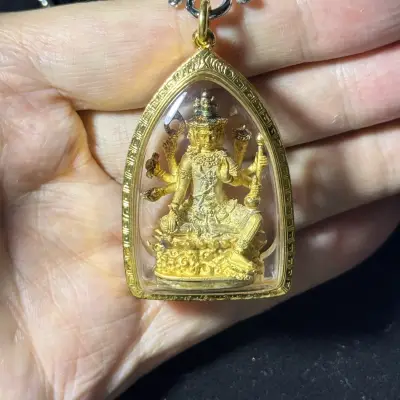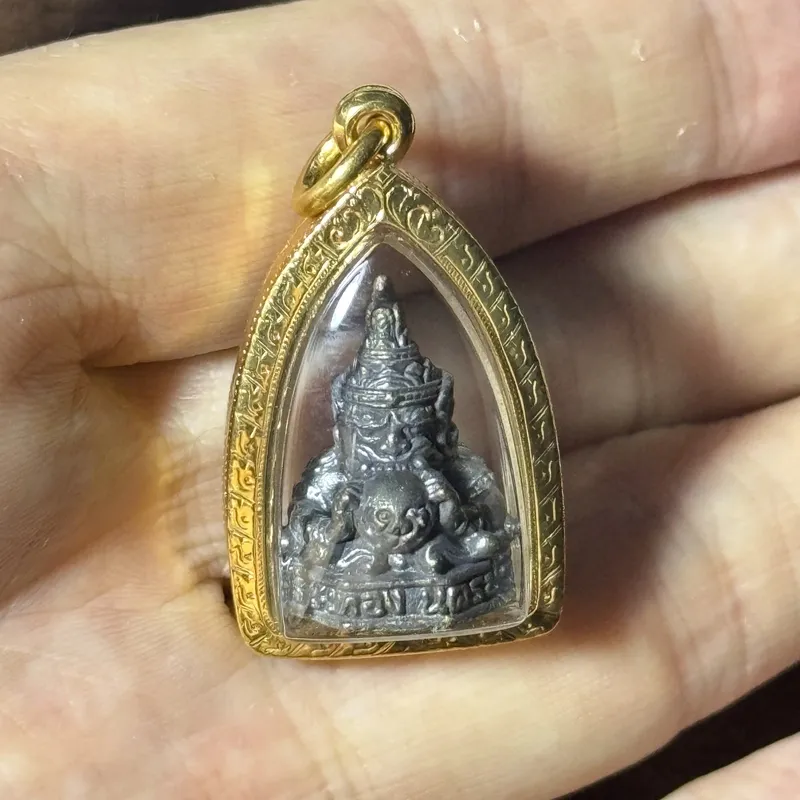
Phra Rahu, Run Chanthanupparakha (the lunar eclipse batch), made in the tradition of Luang Pho Noi and issued by Wat Sisathong in Nakhon Chai Si, Nakhon Pathom, the home temple of Rahu worship in Thailand. Released to fund the building of the vihara of the seven day-of-week Buddhas. Comes with its original temple box and is already fitted in an Italian gold waterproof case. No certificate, no year stated; we make no claim beyond the item itself and what the box records.
1. Who Rahu is: the one who swallows sun and moon
Rahu comes from Indian myth and is widely venerated in Thailand as the deity who governs turns of fortune. He drank the nectar of immortality by stealth and was cut in two for it, but the nectar had already passed his throat, so he did not die. Ever since he pursues the sun and the moon and swallows them when he can, which is how eclipses are traditionally explained.
The logic Thais apply is direct: a power that can swallow the moon can swallow the dark stretch in your fortune. Rahu is therefore not a wealth deity but a deity of reversal, addressed to the situation where nothing works, progress is blocked, rivals undermine you and effort does not convert.
Key facts
- Type: Phra Rahu
- Tradition: Tamrap Luang Pho Noi, the Luang Pho Noi formula
- Batch: Run Chanthanupparakha, the lunar eclipse batch
- Cause: to fund the vihara of the seven day-of-week Buddhas
- Temple: Wat Sisathong, Nakhon Chai Si, Nakhon Pathom
- Material: cast in dark metal, four-armed Rahu holding sun and moon, Thai temple name cast at the base
- Casing: already fitted in an Italian gold waterproof case, pointed-arch form, engraved scrollwork frame, original loop, ready for a chain
- Included: original temple box, gold-lettered with temple, batch, tradition and cause
- Certificate: none; no year stated, a recent release
2. Wat Sisathong, the home of Rahu worship
Wat Sisathong, literally golden head, sits in Nakhon Chai Si district of Nakhon Pathom and is the most important centre of Rahu devotion in Thailand. The monk who turned Rahu from a mythic figure into something you can wear was Luang Pho Noi of this temple, who carved Rahu into single-eyed coconut shell, a scarce natural form, and in doing so set the conventions the whole category still follows.
The temple has continued to produce Rahu pieces in his tradition ever since, and this one belongs to that line. At every solar and lunar eclipse Wat Sisathong holds a Rahu ceremony that draws crowds, which is where this batch takes its name.
3. The lunar eclipse batch
Chanthanupparakha means lunar eclipse. In the tradition an eclipse is the moment Rahu takes the moon and his power shows, so Rahu objects have always been most properly consecrated during a solar or lunar eclipse.
Naming a batch after the eclipse therefore states the moment of consecration rather than serving as a commemorative label, and to anyone who follows Rahu that line carries more weight than an anniversary name.
4. What it funded
The box reads sang wihan phra prajam wan: to build the vihara of the day-of-week Buddhas. Thai temples commonly house seven Buddha images, one for each day of the week, and devotees pay respect to the image for the day they were born. A release issued to fund that hall is a merit offering, and taking the piece was a contribution to the building.
A documented cause like this makes provenance far more solid than a vague consecration label, and here it is printed on the box rather than asserted by a seller.
5. What it is for, and who it suits
- Turning bad fortune: the core of the Rahu cult, addressed to a low or blocked period
- Dispelling ill-wishers and gossip: among the most common requests made of Rahu in Thailand
- Breaking deadlock, a turn in work: for situations that will not move however hard you push
- Protection: Rahu is a fierce deity and carries a guarding aspect
- Seizing an opening: popular practice also asks Rahu for opportunity and unexpected gain
Suited to anyone in a low or transitional stretch, to people constrained or undermined at work, to founders and the self-employed, and to collectors interested in Thai deity worship. Not recommended for pregnant women or children under 16.
Note: Amulets and sacred images are objects of faith and cultural collection. Their purpose is to remind the wearer to keep precepts and act well. What is described here reflects Thai devotional tradition and is not a guarantee of financial, medical, legal or any other outcome. Do not substitute a sacred object for necessary professional judgement and effort.
6. Workmanship and casing
The figure is cast in dark metal: Rahu with four arms, a tall pointed crown, the sun and moon held at the chest, the face fierce, with the Thai temple name cast at the base. The casting is dimensional and reads clearly inside the case.
The Italian gold waterproof case is already fitted: a pointed-arch form with continuous engraved scrollwork on the frame, an original loop at the top and clear windows on both faces. It takes a chain directly with no further fitting needed.
The same figure from the same batch is also offered in a clear acrylic waterproof case: lighter, more discreet and friendlier in price, made for everyday wear. The case affects appearance, weight and price, not the nature of the sacred object — choose by how you intend to wear it: gold for formal occasions or as a gift, acrylic for daily wear.
7. FAQ
Q: Does it come with a certificate?
A: No. It does come with its original temple box, gold-lettered with the temple (Wat Sisathong), the batch (Run Chanthanupparakha), the tradition (Tamrap Luang Pho Noi) and the cause it funded, so four elements of provenance rest on a physical record. We state no year, because the box states none; this is a recent release.
Q: How does Rahu differ from a wealth amulet, and which should I choose?
A: Turtle and Khun Paen amulets work with momentum you already have and help it run smoother. Rahu is for breaking a deadlock: the stalled, sinking, suppressed stretch. If your situation is that nothing you do lands, Rahu fits. If it is that you want to grow further, a wealth piece fits better.
Q: How is Rahu venerated?
A: Thai practice favours Wednesday night, with offerings of eight black items such as black grapes, black coffee, black soy milk and black glutinous rice. Wearing has no special restriction beyond the usual: keep the five precepts and give to others, which devotees consider the most important part.
Q: Is the Italian gold case real gold?
A: Italian gold is the trade term in Thailand for a style of gold-plated waterproof casing and describes the engraving style, not solid gold. Its job is to keep out water and sweat, protect the piece and make it easy to wear. We label these accurately and never present plating as solid gold.
Q: Why is it cheaper than your certified pieces?
A: Price reflects certainty. With no card and no stated year, this sits below a comparable certified piece. What it does have is an original box documenting its release and a fitted Italian gold case, which saves you the cost and the wait of having one made. You pay less for certainty, not less for usability.
8. About this specific piece
Photographed as received. Original temple box included, Italian gold waterproof case already fitted, no certificate. Our team is based in Bangkok, handles every item in Thailand before it ships, and ships worldwide. Certified items carry our ten-times refund guarantee; for uncertified pieces like this one we guarantee that the description is accurate and the item is as photographed.
Last updated: 2026-09-15 | Merit Messenger team, based in Bangkok