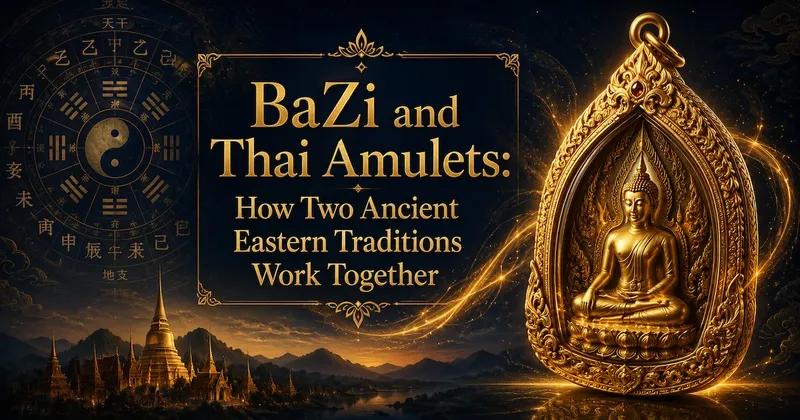
BaZi and Thai amulets represent two of Asia's most enduring spiritual traditions, and their intersection in Thailand has created a uniquely powerful system for personal guidance. For centuries, Chinese immigrants brought their Four Pillars of Destiny (BaZi) knowledge to the shores of Siam, where it merged with Thai Buddhist practices in ways that few outsiders have ever witnessed. As someone who has spent years visiting temples across Thailand where both traditions coexist, I can tell you that this combination is not a modern marketing invention — it is a living, breathing cultural reality that Thai-Chinese families have relied on for generations.
This article explores the historical and philosophical connections between Chinese astrology and Thai Buddhism, and explains why our platform at Merit Messenger is uniquely positioned to bridge both traditions for international collectors and spiritual seekers.
The Chinese Five Elements and Thai Buddhist Cosmology: Shared Roots
Both BaZi and Thai Buddhist cosmology organize the universe into elemental forces that shape human destiny. In BaZi, the Five Elements — Wood, Fire, Earth, Metal, and Water — form a cycle of creation and destruction that governs everything from personality to fortune. Thai Buddhism, influenced by both Indian and Southeast Asian cosmological traditions, also recognizes elemental forces, planetary influences, and cyclical time. The overlap is more than superficial.
In the Chinese system, your birth date and time produce eight characters (the "Four Pillars") that reveal your elemental composition. A person might be strong in Fire but weak in Water, which tells a BaZi practitioner exactly what kind of support that person needs. Thai astrology, known as Horasat Thai, similarly uses birth data to calculate planetary positions and elemental balances, though it draws from a different astronomical tradition rooted in Indian Vedic astrology.
What makes Thailand unique is that these two systems have been practiced side by side for so long that experienced masters often consult both. In Bangkok's older neighborhoods, you can find astrologers who read your BaZi chart in the morning and consult Thai astrological texts in the afternoon — not because the systems are identical, but because each illuminates aspects the other might miss.
Historical Connections: Chinese Immigrants and Thai Spiritual Culture
The story of BaZi in Thailand begins with the waves of Chinese immigration that started in the Ayutthaya period (1351-1767) and intensified during the Rattanakosin era. Chinese merchants, primarily from Fujian, Teochew, Hakka, and Cantonese communities, brought not only their commercial skills but their entire spiritual framework: ancestral worship, Taoist practices, and BaZi divination.
Unlike in some countries where immigrant spiritual practices remained isolated, in Thailand something remarkable happened. The Thai kingdom's openness to Chinese settlers — many of whom intermarried with Thai families and became part of the aristocracy — meant that Chinese and Thai spiritual practices began to blend organically. By the reign of King Rama V, Thai-Chinese families were among the most prominent patrons of both Buddhist temples and Chinese shrines.
This blending is visible in Thailand's temple architecture. At Wat Mangkon Kamalawat (Dragon Lotus Temple) in Bangkok's Chinatown, you can see Thai Buddhist monks performing ceremonies alongside Chinese Mahayana rituals. The temple itself combines Thai, Chinese, and even Tibetan architectural elements. At Wat Boromracha Kanchanapisek Anusorn (Wat Leng Noei Yi), one of the largest Chinese Buddhist temples in Southeast Asia, devotees come to pray to both Chinese deities and Thai Buddhist figures.
In southern Thailand, temples like Wat Chalong in Phuket — where the Chinese tin-mining community was historically prominent — blend Thai Theravada Buddhism with Chinese folk religious elements. The famous wax figures of Luang Pho Chaem and Luang Pho Chuang at Wat Chalong are venerated by both Thai and Chinese devotees, each bringing their own spiritual framework to the experience.
Why BaZi Analysis Enhances Thai Amulet Selection
BaZi analysis provides a precise diagnostic framework that makes Thai amulet selection far more effective than choosing based on general categories alone. Rather than simply picking an amulet labeled "for wealth" or "for protection," a BaZi-informed approach identifies exactly which elemental energy you lack and matches it to an amulet whose properties address that specific deficit.
Consider a practical example. Two people both want help with their careers. Person A has a BaZi chart dominated by Water and Metal, with almost no Fire element. Person B has excessive Fire and needs more Earth and Metal. Even though both seek "career help," they need completely different amulets. Person A would benefit from amulets associated with warmth, visibility, and assertiveness — qualities aligned with Fire energy. Person B needs grounding and structure, pointing toward amulets consecrated for stability and steady accumulation.
Thai amulets, consecrated by monks during specific ceremonies, carry energetic signatures that correspond to elemental qualities. A Phra Somdej amulet, for instance, is associated with purity, authority, and balanced energy — useful for someone whose chart needs centering. A Khun Paen amulet carries strong charm and social magnetism, corresponding to Fire and Wood energies. A Phra Pidta (closed-eyes Buddha) offers protection and containment, resonating with Metal and Water qualities.
This is why our BaZi Amulet Finder asks for your birth details before recommending specific pieces. The recommendations are not random — they are based on the intersection of your elemental needs and each amulet's energetic profile.
Living Tradition: What I Have Observed in Thai-Chinese Communities
Walking through Bangkok's Yaowarat district (Chinatown) during the Vegetarian Festival or Chinese New Year, you see the fusion of these traditions in real time. Shop owners display both Thai Buddhist amulets and Chinese talismans. Family altars hold images of Guanyin alongside Thai Buddhist monks. And when a new business opens, the owner will often consult both a BaZi master and a Thai Buddhist monk before choosing the opening date and the protective amulets to install.
At the famous Sampeng Market, wholesale amulet dealers — many of whom are third- or fourth-generation Thai-Chinese — evaluate amulets using criteria from both traditions. They consider the monk's reputation and the consecration ceremony (Thai Buddhist factors) alongside the amulet's elemental resonance and suitability for specific BaZi profiles (Chinese metaphysical factors). This dual evaluation is not something you will find written in textbooks. It is passed down through apprenticeships and family businesses.
I have personally sat with amulet collectors in Yaowarat who pull out their BaZi charts before examining a single amulet. For them, knowing their elemental composition is as fundamental as knowing their shoe size before buying shoes. The idea of choosing an amulet without understanding your BaZi chart strikes them as incomplete — like prescribing medicine without a diagnosis.
The Five Elements Bridge: Mapping Chinese and Thai Systems
While the Chinese Five Elements and Thai cosmological categories are not identical, experienced practitioners have developed working correspondences over generations. Here is a simplified framework that reflects how Thai-Chinese amulet experts typically map the two systems:
| Chinese Element | Quality | Thai Amulet Correspondence | Common Amulet Types |
|---|---|---|---|
| Wood | Growth, creativity, kindness | Metta (loving-kindness) energy | Metta-focused amulets, Phra Nang Phaya |
| Fire | Visibility, passion, influence | Mahaniyom (great popularity) energy | Khun Paen, charm-type amulets |
| Earth | Stability, trust, nourishment | Maha Ud (invulnerability) energy | Phra Somdej, sacred soil amulets |
| Metal | Precision, protection, authority | Kong Grapan (protective) energy | Phra Pidta, military monk amulets |
| Water | Wisdom, flow, adaptability | Siang Choke (lucky fortune) energy | Lucky draw amulets, navigation charms |
This table is a starting point, not a rigid formula. Real-world matching requires considering the full BaZi chart, including the interactions between elements, the strength of the Day Master, and the current luck period. This is precisely what our amulet recommendation system is designed to calculate.
Why Merit Messenger Bridges Both Traditions
Most Thai amulet sellers focus exclusively on the Buddhist provenance of their pieces — which monk consecrated it, which temple it came from, what ceremony was performed. This information is important, and we provide it for every piece in our collection. But we go further by also analyzing each amulet's elemental resonance and matching it to your personal BaZi profile.
This dual approach is not something we invented from theory. It reflects the actual practice of knowledgeable Thai-Chinese collectors and dealers who have been combining these systems for generations. We have simply made this wisdom accessible to an international audience through technology.
Our founder's background spans both Chinese metaphysical traditions and deep familiarity with Thailand's Buddhist amulet culture. This is not a surface-level combination of two Wikipedia articles. It comes from years of temple visits, conversations with monks and collectors, and personal practice within both traditions.
Common Misconceptions About Combining BaZi and Thai Amulets
Some purists argue that mixing Chinese and Thai spiritual systems is inappropriate or disrespectful. This concern deserves a thoughtful response.
First, the combination is not our innovation — it has been practiced by Thai-Chinese communities for centuries. The Thai-Chinese population, estimated at 11-14% of Thailand's total population (with many more having partial Chinese ancestry), has been the primary bridge between these traditions. Their practice is not theoretical; it is lived culture.
Second, both traditions share a fundamental belief in the interconnectedness of natural forces and human destiny. Neither tradition claims to be the only valid spiritual framework. Thai Buddhism, in particular, has a long history of absorbing and coexisting with other spiritual practices — from Hindu-Brahmanistic rituals to animist traditions to Chinese folk religion.
Third, the combination is practical. BaZi provides a diagnostic tool — a way to understand what you need. Thai amulets provide a remedy — a consecrated object carrying specific spiritual energies. Using one to inform the other is no different from using a medical diagnosis to choose the right treatment, even if the diagnostic system and the treatment system come from different medical traditions.
Getting Started: Your Personal East-Meets-East Journey
If you are new to both BaZi and Thai amulets, here is a straightforward path to begin your exploration. Start by discovering your BaZi elemental profile using our BaZi Amulet Finder. Enter your birth date and time, and the system will calculate your Four Pillars chart, identify your dominant and deficient elements, and recommend amulet categories that address your specific needs.
From there, you can explore our curated collection with confidence, knowing that each recommendation is grounded in centuries of combined wisdom from both the Chinese Five Elements tradition and Thai Buddhist amulet culture. You are not just buying an object — you are participating in a living tradition that spans two of Asia's greatest civilizations.
The bridge between BaZi and Thai amulets is not a modern gimmick. It is a cultural reality built over centuries by millions of Thai-Chinese families who found that these two ancient systems, used together, provide a more complete picture of human destiny than either one alone. We are honored to share this tradition with you.