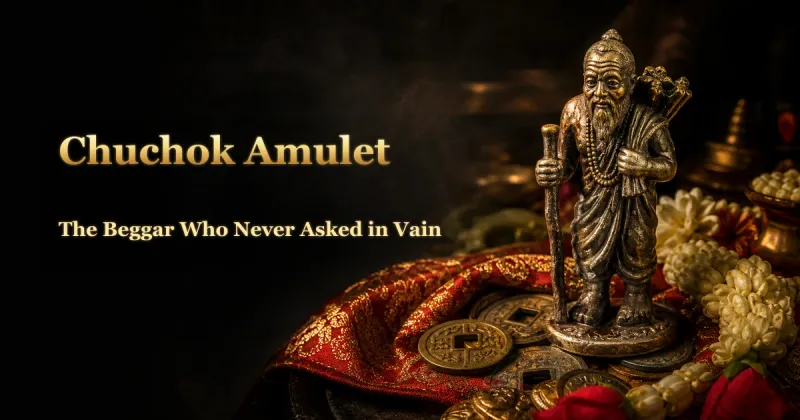
Of all Thai amulets, the Chuchok (Thai: ชูชก, also spelled Jujaka) is the most counterintuitive. Its figure is not a monk or a deity but an old, hunchbacked beggar from the Buddha's birth stories — a man who, in his entire life, was never once refused anything he asked for. He even asked a prince for his own children, and received them. Thai folk tradition distilled that outrageous track record into a practical power: the art of asking and receiving. Salespeople, negotiators, debt collectors, and fundraisers wear Chuchok for exactly that.
The story: the great taker of the Vessantara Jataka
Chuchok appears in the Vessantara Jataka — the tale of the Buddha's final birth before enlightenment, and the best-loved Jataka in Thailand. Prince Vessantara embodies giving carried to perfection; Chuchok is his mirror: taking carried to perfection. An ugly old Brahmin with a beautiful young wife, he begs so that she will never have to work — and no one can say no to him. His ultimate request, for the prince's own son and daughter as servants, is granted, completing the prince's perfection of generosity.
The ending matters just as much: the king ransoms his grandchildren and showers Chuchok with wealth — and the old beggar promptly eats himself to death at the feast. Thai tradition reads the whole arc as one teaching: the skill of asking can be cultivated; the discipline of enough must never be lost.
Powers of the Chuchok amulet
Thai masters explain Chuchok's unrefusable asking as Metta Mahaniyom — a charm so complete that people find themselves unwilling to say no. The amulet's powers follow:
- Asking and receiving: negotiations, quotes, collections, loan requests, sponsorships — any moment where you must open your mouth and ask.
- Sales closing: traveling salespeople and street traders are his classic devotees; Thai folk belief holds him especially kind to mobile businesses.
- Windfall luck: lottery and gambling reputations attach naturally to the man who got rich overnight.
- Approachability: the underlying metta makes the wearer seem easier to help — the wider charm landscape is mapped in our guide to Thai charm traditions.
Common forms
- Standing or seated beggar with staff and bowl — the classic hunchbacked figure, as pendant or altar statue.
- Praying Chuchok — hands raised in respect, symbolizing asking with humility.
- Materials — bronze, sacred powder, carved wood or horn; as always, legitimate temple editions over anonymous carvings.
Offerings and vows
Chuchok is honored like the glutton he was: food offerings — rice, sweets, fruit — refreshed regularly by devotees who keep his statue. State requests plainly: what you want, by when, and what you will offer in return. Worn pendants need no upkeep beyond ordinary respect (see how to wear a Thai amulet; as a venerated-figure amulet he hangs below Buddha images).
The taboo that defines the tradition: enough
- Know when to stop: the man died of overeating. Every Thai master who teaches Chuchok teaches the ending; greed turns the blessing.
- Honor your vows: what is received must be repaid as promised — offerings or charity; taking and giving stay in balance.
- Never ask to harm: his power makes people give willingly; fraud and coercion are outside the tradition entirely.
Who wears Chuchok?
- Salespeople, agents, business developers, and collectors of debts
- Small traders and mobile vendors
- Founders negotiating for capital and resources
- Lottery hopefuls — with the ending of the story kept firmly in mind
FAQ
Q: Chuchok is the villain of the story — is it appropriate to venerate him?
A: Thai tradition sees him differently: he is the catalyst who completed the prince's perfection of giving, and his unrefusable charm was merit earned in past lives. Devotees petition the skill and accept the warning — the tradition deliberately keeps both.
Q: How does Chuchok differ from other wealth amulets?
A: Most wealth amulets attract fortune passively. Chuchok is transactional — he strengthens the specific moment of asking. If your income depends on conversations, he is the specialist. For the broader map, see Thai amulet types explained.
Q: Can women wear Chuchok?
A: Yes — venerated-figure amulets carry no gender restriction, with standard etiquette.
Q: How do I avoid fakes?
A: Chuchok figures are widely carved as souvenirs. Insist on a named temple or master, edition year, and consecration record — the checklist in buying Thai amulets online safely applies in full.
Last updated: July 2026 | By the Merit Messenger team, based in Bangkok
Looking for a Chuchok or other fortune amulet with documented provenance? Browse our collection or contact us.