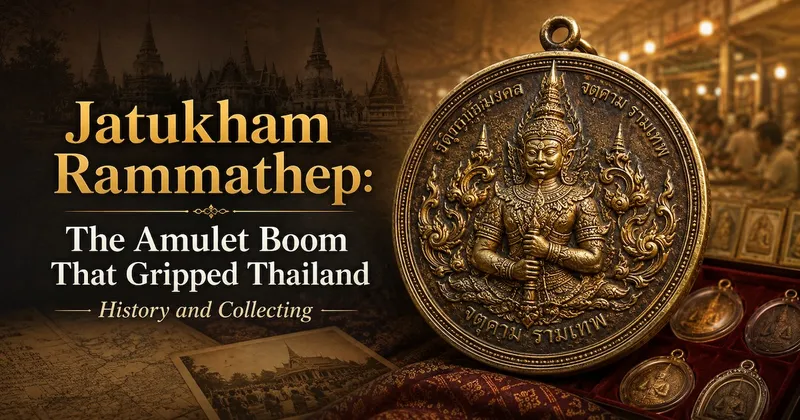
The Amulet That Became a National Obsession
For a few extraordinary years in the mid-2000s, one amulet dominated Thailand like no sacred object before it. Jatukham Rammathep (จตุคามรามเทพ) was everywhere — worn by taxi drivers and cabinet ministers, queued for by tens of thousands, and blamed for at least one fatal stampede when a temple released a new batch. At the peak of the boom in 2007, the Jatukham trade was estimated to move billions of baht a year. Then, almost as fast as it rose, the market collapsed.
Understanding Jatukham means understanding both a genuine sacred tradition and one of the most remarkable speculative manias in the history of religious objects. This guide covers where it came from, why the boom happened, and what a serious collector should look for today.
Origins: Nakhon Si Thammarat and the Guardian Deities
Jatukham Rammathep is not a Buddha image. It is a pair of guardian deities — Jatukham and Rammathep — associated with the great southern city of Nakhon Si Thammarat and its ancient royal stupa, Wat Phra Mahathat Woramahawihan. In local belief the two names refer to guardian princes of the old Srivijaya kingdom who became protective spirits of the city and its sacred relic.
The amulet's iconography reflects this guardian role. A typical Jatukham coin shows the central deity seated in majesty, surrounded by the eight directional guardians (thepphanom), with the reverse commonly depicting Rahu swallowing the moon ringed by the twelve zodiac animals — a cosmological design tied to fate, fortune, and protection from calamity.
Khun Phan: The Policeman Who Created It
The modern Jatukham amulet owes its existence to one of the most legendary figures in 20th-century Thailand: Police Major General Khun Phantharak Rajadej (ขุนพันธรักษ์ราชเดช), known simply as Khun Phan. A famously fearless southern lawman reputed to be invulnerable to bullets, Khun Phan spent decades promoting the Jatukham cult and organized the first major consecration batches at Wat Phra Mahathat. The earliest widely recognized issue dates to B.E. 2530 (1987).
For twenty years Jatukham remained a respected but regional devotion. Everything changed after Khun Phan's death in 2006 at the age of 108 — an age that itself carried auspicious weight. His funeral rites and the memorial amulet editions issued around them ignited a nationwide frenzy.
The Boom of B.E. 2550 (2007) — and the Crash
In 2007 the Jatukham market went vertical. Temples across Thailand — not just in Nakhon Si Thammarat — rushed out their own editions to capture demand. Newspapers ran daily price quotes. Rare early pieces changed hands for hundreds of thousands of baht. Ordinary devotees bought multiple coins hoping to resell at a profit, treating sacred objects like a hot stock.
Overproduction did what overproduction always does. With thousands of editions flooding the market, scarcity evaporated, prices collapsed, and by 2008 the mania was over. Countless late-boom coins are today worth a fraction of their issue price.
This history is precisely why provenance matters so much for Jatukham. The market divides sharply into pre-boom pieces — genuine temple issues from Nakhon Si Thammarat before the 2007 frenzy — and the ocean of mass-produced boom-era coins. The former retain devotional and collector value; the latter largely do not.
What Jatukham Is Believed to Do
As a guardian-deity amulet, Jatukham is worn primarily for:
- Answered wishes — the deities are petitioned for specific outcomes
- Wealth and turnaround luck — a favorite of traders and businesspeople
- Protection from danger and calamity — reflecting the guardian role
- Authority and status — historically associated with officials and men of power
- Noble support — attracting influential help
The Piece in Our Collection
The Jatukham Rammathep Copper Coin, B.E. 2547 ($168) is exactly the kind of piece a discerning collector wants: a copper issue struck at the source temple, Wat Phra Mahathat in Nakhon Si Thammarat, in 2004 — three years before the boom. It carries the classic composition (the enthroned deity with directional guardians on the front, Rahu and the zodiac on the reverse), comes in a clear waterproof case, and includes an authenticity card. As a pre-boom issue from the founding temple, it sits on the right side of the market's great divide. One of a kind in our inventory.
How to Buy Jatukham Wisely
- Favor the source temple. Wat Phra Mahathat editions carry the strongest provenance. Editions from unrelated temples issued during 2007 are the most oversupplied.
- Prefer pre-boom dates. Pieces from before B.E. 2550 (2007) are scarcer and more meaningful.
- Ignore "boom price" nostalgia. A coin that sold for 50,000 baht in 2007 is not worth that today. Judge by temple, year, and material — not peak-mania stories.
- Insist on documentation. An authenticity card and a clear account of origin should be standard.
Frequently Asked Questions
Is Jatukham a Buddhist amulet?
It sits at the boundary of Buddhist and animist-Brahminic tradition. Jatukham and Rammathep are guardian deities rather than Buddha figures, but the amulets are consecrated in Buddhist ceremony at Buddhist temples. Think of it as a guardian-deity amulet within the broader Thai sacred ecosystem, similar in category to Rahu or four-faced Brahma pieces.
Did the 2007 crash mean Jatukham is "fake" or worthless?
No. The crash was a collapse of a speculative bubble, not a verdict on the tradition. Genuine pre-boom pieces from Nakhon Si Thammarat remain respected. What became worthless were the countless opportunistic late-boom editions produced purely to ride the mania.
Why is a pre-boom coin more valuable than a newer one?
Scarcity and intent. Before 2007, editions were smaller and made for devotion rather than resale. Boom-era coins were produced in enormous quantities specifically to be flipped, so supply vastly outstrips any real demand.
Interested in this pre-boom piece or want to understand its markings? Contact us on WhatsApp for details and additional photos.