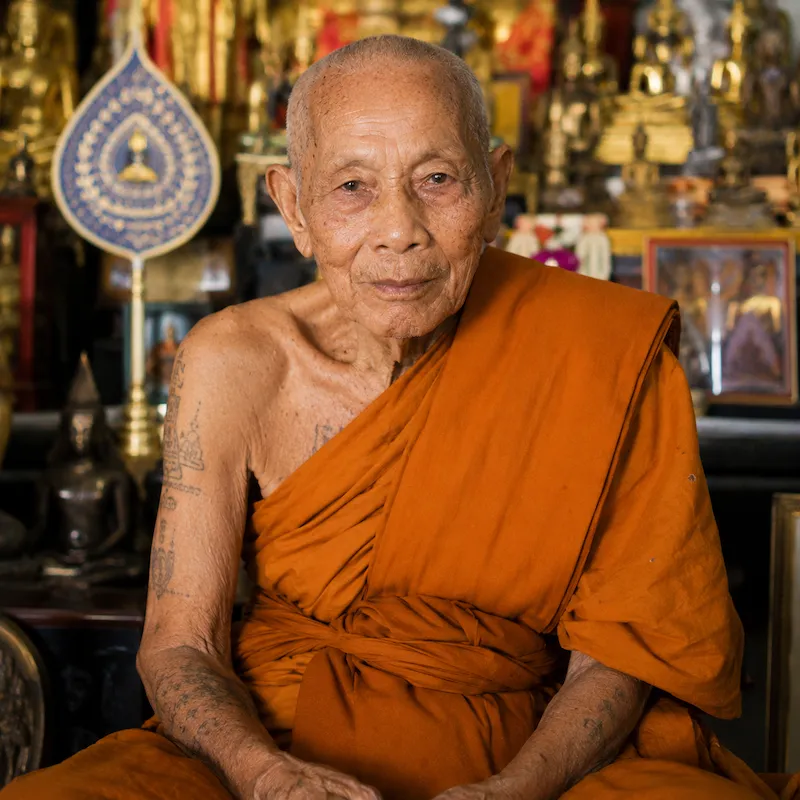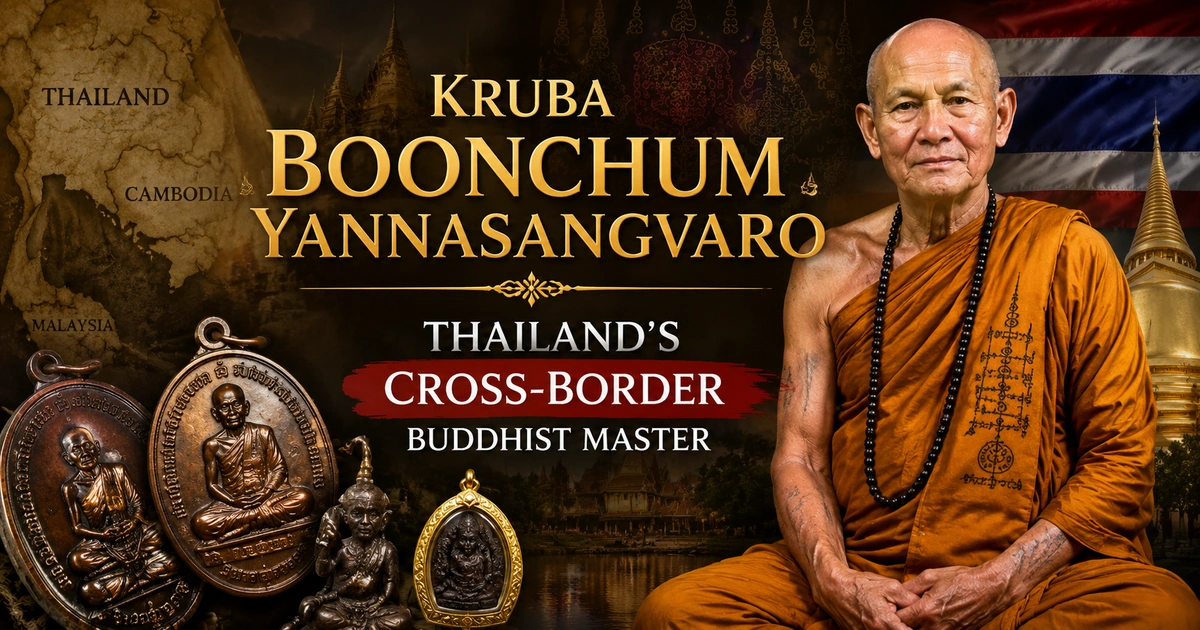
Who Was Kruba BoonChum Yannasangvaro?
Kruba BoonChum Yannasangvaro (ครูบาบุญชุ่ม ญาณสังวโร) is one of the most revered Buddhist masters of the Thai-Myanmar border region — a monk whose spiritual influence stretches across three countries and whose amulets are collected by devotees from Thailand, Myanmar, Laos, and beyond.
Born in northern Thailand near the Mekong River, Kruba BoonChum ordained as a monk in the Shan Buddhist tradition — a lineage that bridges Theravada Buddhism with ancient local forest meditation practices. He resided primarily at Wat Phra That Don Ruang in Myanmar's Shan State, giving him an unusual position: revered by both Thai and Burmese Buddhist communities simultaneously, with access to sacred sites and traditions from both traditions.
Why His Amulets Are Exceptional
Several factors distinguish Kruba BoonChum's amulets from most Thai Buddhist pieces:
Cross-Border Sacred Material Access
Kruba BoonChum's deep connections to sacred sites in both Thailand and Myanmar gave him access to rare materials that most Thai monks cannot obtain. This includes specific sacred earths from revered Burmese pagodas, forest herbs known primarily to Shan Buddhist healers, and relic materials from ancient stupas on both sides of the border. His amulets' sacred powder compositions are considered unusually rich as a result.
Multi-Tradition Consecration Influence
While rooted in Theravada Buddhism, Kruba BoonChum's ceremonies incorporate elements from the broader northern Thai kruba tradition — forest monks known for extraordinarily long uninterrupted meditation practice and specific rituals associated with the northern Buddhist calendar. This gives his pieces a quality that collectors describe as "wilder" or more primordial than standard Bangkok temple consecrations.
Strong Royal and Institutional Recognition
Unusually for a cross-border monk, Kruba BoonChum received recognition from Buddhist institutions in both Thailand and Myanmar. Some of his most significant amulet series were commissioned by royal and noble families — including the Lotus Guru 2546, which relates to a rare Bhutanese royal connection.
The Lotus Guru 2546 — Detail and Analysis
The Kruba BoonChum Lotus Guru 2546 ($450) is the primary Kruba BoonChum piece in the Merit Messenger collection. Consecrated in Buddhist Era 2546 (2003), it represents one of his most significant ceremonies.
The Lotus Guru series takes its name from the lotus posture in which Kruba BoonChum is depicted — the full lotus being a symbol of supreme meditative realization in both Theravada and Mahayana traditions. The piece carries these documented effects:
- Wealth — primary financial attraction energy
- Danger prevention — physical protection for travel and high-risk situations
- Evil ward-off — strong defense against supernatural negative energy
- Noble support — attraction of powerful benefactors and mentors
- Obstacle removal — clearing of bureaucratic and karmic blockages
- Relations — improved social harmony
- Collection value — recognized collector's piece with documented provenance
The obstacle removal effect is what most distinguishes this piece from standard wealth amulets — it addresses situations where progress is blocked, opportunities are consistently missed, or bureaucratic systems create repeated delays. This makes it particularly popular among entrepreneurs working in Southeast Asian markets where navigating complex regulatory or relationship-based systems is a constant challenge.
Who Should Wear a Kruba BoonChum Amulet?
Based on the documented effects and collector feedback, the Lotus Guru 2546 is best suited for:
- Business owners and entrepreneurs operating in Thailand, Myanmar, or Laos who need both wealth energy and obstacle removal
- Expats navigating unfamiliar bureaucratic systems where having "noble support" (the right connections) is essential
- Collectors seeking documented cross-border pieces with unusual provenance
- Anyone who has experienced repeated obstacles or a pattern of bad luck — the obstacle removal effect is specifically consecrated to address karmic blockages
- Practitioners interested in northern Thai and Shan Buddhist traditions
Kruba BoonChum in Thai Buddhist Culture
The kruba title itself is worth understanding. In northern Thai Buddhism, kruba designates a forest monk of exceptional attainment — specifically one who has demonstrated mastery of both meditation and tantric Buddhist ritual arts. The title is conferred by the community, not by institutional appointment, which gives it particular weight among practitioners who distrust official religious hierarchies.
Kruba BoonChum is known to have observed extraordinarily strict vinaya (monastic code) throughout his life, taking specific vows that limited his physical travel and possessions. This austerity is considered by followers to be evidence of his exceptional spiritual discipline — the kind of accumulated merit that makes his blessings particularly potent.
Frequently Asked Questions
How does Kruba BoonChum compare to other famous monks' amulets?
Comparing across masters is subjective and somewhat inappropriate in Thai Buddhist culture — each master has different strengths and lineage focus. Kruba BoonChum's pieces stand out for their cross-border sacred materials and the unusual obstacle-removal effect, which is less commonly the primary focus of Bangkok-based masters. Think of him as a specialist in different terrain than LP Tim or LP Sodh.
Are there smaller or more affordable Kruba BoonChum pieces?
The Lotus Guru 2546 is currently the only Kruba BoonChum piece in our collection. Its $450 price reflects both the rarity of documented 2003 consecrations and the cross-border materials involved. We periodically source additional Kruba BoonChum pieces — contact us if you'd like to be notified when new pieces become available.
Is Kruba BoonChum still alive?
As of our last information, Kruba BoonChum continues his practice at Wat Phra That Don Ruang. However, pieces from recent decades carry special significance because they represent consecrations from his mature meditative practice — decades of accumulated spiritual depth poured into the amulets.