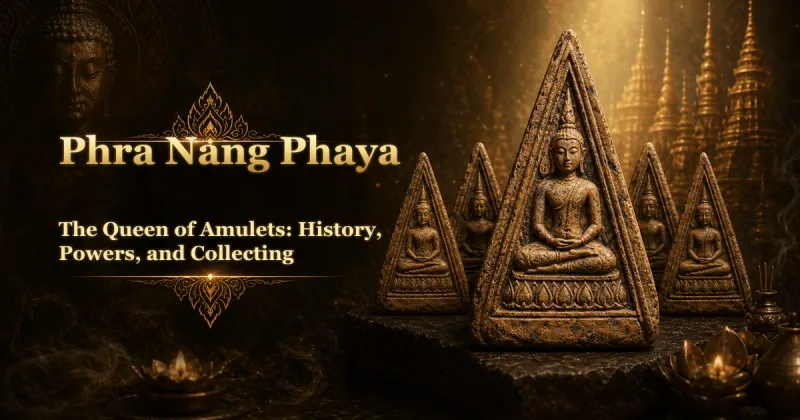
Phra Nang Phaya (Thai: พระนางพญา) is one of Thailand's five Benjapakee amulets, revered as the "Queen of Amulets" — the gentle counterpart to the Phra Somdej "King" at the very top of classical Thai amulet collecting. It comes from Wat Nang Phaya in Phitsanulok, was commissioned in the Ayutthaya era, and became famous across Thailand after a large excavation in B.E. 2444 (1901). Its powers center on charm, prestige, and gentle protection.
The name and origin: why "Queen"?
"Nang Phaya" means "queen" in Thai. The amulet shares its name with Wat Nang Phaya, the temple where it was unearthed, and tradition links it to a royal commission during the Ayutthaya period. In the Benjapakee ranking, Phra Somdej is the "King of Amulets" and Phra Nang Phaya the "Queen" — not because it is only for women, but because its character is soft, dignified, and quietly commanding, forming a natural pair with the Somdej's masculine authority.
Artistic marks: recognizing a Phra Nang Phaya
The defining feature is its triangular shape — a Buddha seated in meditation within a triangular clay tablet, with broad shoulders, a tapered waist, and extremely spare, gentle lines free of elaborate halos or ornament. Stylistically it sits in the transition from late Sukhothai to Ayutthaya art. Authentic kiln-site pieces are judged by fine clay texture, natural firing variation, and patina, and different excavation batches and molds yield the "pim" variants that connoisseurs study closely.
Powers: charm, prestige, and gentle protection
Phra Nang Phaya's traditional powers are "strength within softness":
- Charm and helpful people: raising likability and goodwill, drawing supporters and benefactors.
- Prestige and presence: the "queen" character symbolizes calm, unforced authority — long favored by those in politics, business, and leadership.
- Resolution and protection: using gentle force to dissolve gossip and conflict and to steady the home and the emotions.
Because of this charm-plus-prestige combination, it is not women-only, though it has long been especially loved by women and by anyone who leads "by winning people over."
The collecting reality
- Original kiln-site pieces are museum-grade relics: genuine Wat Nang Phaya originals are extremely scarce, with top examples trading in the millions of baht, and authentication is expert-level. Any "ancient piece" without reliable certification and provenance should be treated as a reproduction.
- The realistic entry point is later temple batches: re-cast and commemorative editions made by the origin temple and later masters offer the same lineage blessing with honest provenance at accessible prices.
- Judge value by three things: a verifiable temple and year, a documented consecration, and a grading card or competition certificate. Steer clear of "family-heirloom original" pieces sold cheap.
Phra Nang Phaya's place in the Benjapakee
The Benjapakee is the supreme grouping of amulets: Phra Somdej (Bangkok), Phra Rod (Lamphun), Phra Nang Phaya (Phitsanulok), Phra Phong Suphan (Suphan Buri), and Phra Sum Kor (Kamphaeng Phet). Phra Nang Phaya is the only one built around the "queen" image and the most distinctly feminine of the five. Assembling all five genuine originals is practically impossible, but understanding each one's origin and character is exactly how the whole Thai amulet value system comes into focus.
FAQ
Is Phra Nang Phaya only for women?
No. "Queen" refers to its soft-yet-commanding character and its place in the Benjapakee; both men and women wear it. It suits anyone who needs charm, prestige, and team cohesion.
Phra Nang Phaya or Phra Somdej — how to choose?
Somdej leans toward all-round fortune and masculine protection; Nang Phaya toward charm, prestige, and gentle resolution. Choose by whether you need to "command the room" or "win people over." For beginners, Somdej remains the best-documented entry point.
Can an ordinary buyer get a genuine Phra Nang Phaya?
Original kiln pieces are essentially unavailable and unaffordable. Ordinary buyers get the same lineage blessing through later temple batches for a few hundred to a few thousand dollars — provenance, consecration, and certification are what matter.
How do I spot a fake?
Judging kiln-site pieces by clay, triangular molding, patina, and provenance is expert work. The safe strategy for ordinary buyers: only buy pieces with a competition certificate or authoritative grading card, from trusted channels, and never anything priced far below market.
Last updated: July 2026 | Author: The Merit Messenger Team (based in Bangkok)
Looking for a classical piece with clear provenance? Browse our pieces or contact us. For terminology, see the Thai amulet glossary.