Thailand's Most Famous Deity
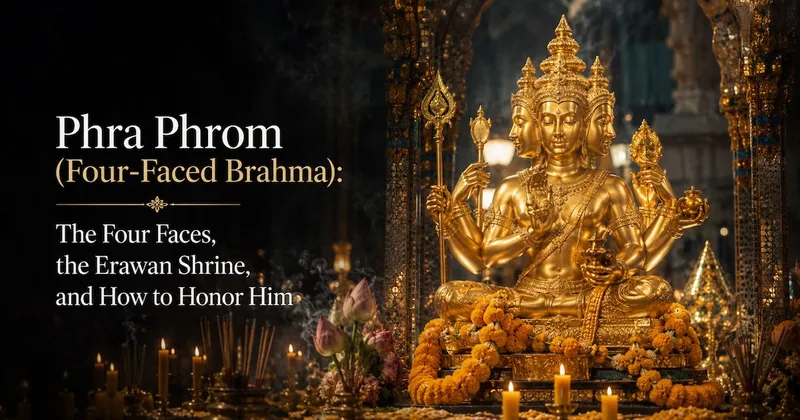
Phra Phrom (พระพรหม) — the Four-Faced Brahma — is arguably the most visible and widely petitioned deity in Thailand. His image presides over the Erawan Shrine in central Bangkok, one of the busiest shrines in the world, where a constant stream of devotees from across Asia comes to ask for blessings on every area of life. Brahma is the creator god of Hinduism, and in Thailand he has become the deity people turn to for all-round life fortune: career, love, wealth, and health, all in one.
This guide explains the meaning of his four faces, how he is honored, and who benefits from his blessings. See also our Phra Phrom deity page and, for the wider picture, our guide to Hindu gods in Thai Buddhism.
The Meaning of the Four Faces
Phra Phrom's four faces gaze in the four cardinal directions, and in Thai devotion each face governs a distinct domain of life. While traditions vary slightly, the common understanding is:
- Front face — career, work, and achievement
- Left face — relationships, love, and social harmony
- Right face — wealth and property
- Back face — health, protection, and stability
This is why Phra Phrom is considered an "all-rounder": rather than specializing in one effect, he covers the full span of worldly wellbeing. On a deeper level, the four faces are also linked to the four Brahmaviharas — loving-kindness, compassion, sympathetic joy, and equanimity — the sublime states of an enlightened mind.
How to Recognize Him
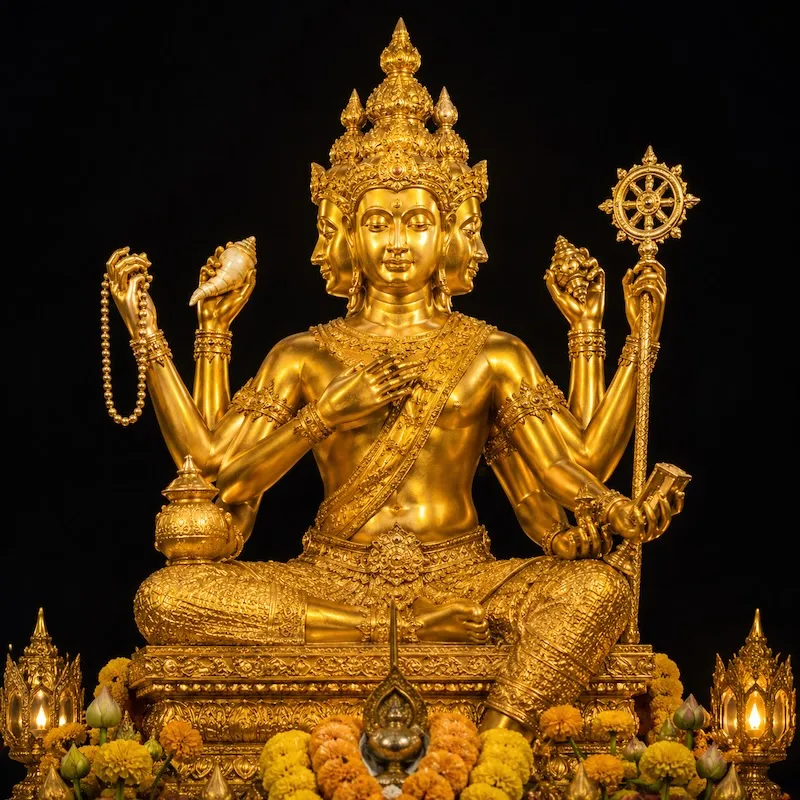
Phra Phrom is depicted with four faces and typically eight arms, seated or standing in golden splendor, holding emblems that may include a sacred text (the Vedas), a rosary, a water vessel, a scepter, a wheel, and a conch. He is usually shown in serene, benevolent majesty — the creator surveying all directions of his creation.
The Erawan Shrine Phenomenon
No account of Phra Phrom is complete without the Erawan Shrine (Thao Maha Phrom Shrine) at the Ratchaprasong intersection in Bangkok. Erected in the 1950s, it became famous for the striking results devotees reported, and today it draws worshippers from Thailand, China, Singapore, Malaysia, and beyond. A tradition of commissioning temple dancers to perform in thanks for answered prayers gives the shrine its distinctive atmosphere. Its fame is a large part of why Phra Phrom veneration spread so widely across Asia.
How He Is Honored
The classic way to honor Phra Phrom is to pay respects to all four faces in turn — moving clockwise, offering incense, candles, flower garlands (especially yellow marigolds), and sometimes a small offering at each face. Devotees often present offerings to the face governing whatever they most need. Sincerity, gratitude for prayers answered, and following through on any vow made are considered essential. Thursday is associated with Brahma.
Who Should Honor Phra Phrom?
- Anyone wanting broad life fortune across career, love, wealth, and health at once
- People at a crossroads who are not sure which single area to focus on
- Those seeking career advancement and recognition
- Anyone drawn to a benevolent, all-round protective deity
Related Sacred Pieces in Our Collection
Our collection includes several fine Phra Phrom amulets. The LP Namfon Phra Phrom in copper is an accessible, ready-to-wear piece covering the deity's full four-domain fortune. The gold-plated standing Phra Phrom by Luang Pho Charan is a certified one-of-a-kind piece from Wat Amphawan, and the Luang Pho Jaran self-image coin with a four-faced Brahma reverse pairs a revered master with the deity.
Frequently Asked Questions
Is Phra Phrom the same as the Buddha?
No. Phra Phrom is Brahma, the Hindu creator god, venerated within Thai culture as a benevolent worldly deity. He is not a Buddha. Thai Buddhists take refuge in the Buddha for liberation and honor devas like Phra Phrom for help in worldly matters.
Do I really need to worship all four faces?
Traditionally yes — honoring all four faces reflects Phra Phrom's all-encompassing nature. Many devotees emphasize the face governing their most pressing need, but paying respects to all four is the complete practice.
What should I offer at the Erawan Shrine or a Phra Phrom altar?
Incense, candles, and flower garlands (yellow marigolds are traditional) are standard. If you make a vow in exchange for a blessing, following through once your wish is granted is considered very important.
Questions about choosing a Phra Phrom amulet? Contact us on WhatsApp.