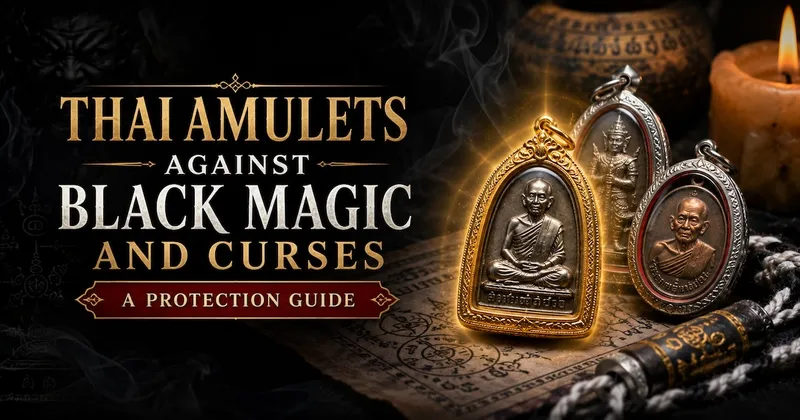
What people mean by black magic in Southeast Asia
Across Thailand, Malaysia, Indonesia, and the Chinese diaspora, belief in curses, hexes, and spirit interference runs deep. The Thai term often translated as black magic covers a range of ideas: a deliberately cast curse, a manipulative love spell, a lingering hungry ghost, or simply a run of misfortune that feels engineered rather than accidental. Whatever your own view, people who feel targeted describe the same symptoms, sudden unexplained illness, ruined relationships, business that collapses for no clear reason, nightmares, and a sense of being watched.
Thai Buddhist amulets are one of the oldest and most trusted defenses in this worldview. This guide explains which amulets are traditionally worn against curses and dark forces, and how the protection is understood.
How Thai amulets are believed to protect
Protective Thai amulets work, in the tradition, on two levels. The first is a spiritual barrier, a consecrated field around the wearer that unwanted forces cannot easily cross. The second is deterrence: certain guardian figures are considered so powerful that lesser spirits and the magic that commands them simply will not approach. A well-chosen defensive set combines a barrier piece with a guardian piece.
Thao Wessuwan: the giant that spirits obey
No figure is more associated with defense against dark magic than Thao Wessuwan, the guardian king who rules over the yaksha and the spirit world. Because he commands these beings, malevolent spirits and the sorcery that directs them are believed to retreat before him. Homes plagued by disturbances often keep a Thao Wessuwan bucha at the entrance, while a worn version travels with the person who feels personally targeted. He is the first name most Thai practitioners mention for curse protection.
Phra Pidta: sealing yourself off
Phra Pidta covers his eyes, and by extension seals the wearer from what should not enter. Against black magic this is read literally: the channels a curse might use, the eyes, the openings, the attention of hostile forces, are shut. Phra Pidta is favored by people who suspect they have been specifically named in a spell and want to close the door on it.
Takrut: the inscribed scroll of protection
A takrut is a thin metal sheet inscribed with sacred yantra and Pali syllables, then rolled tight and blessed. Historically soldiers and travelers wore them against weapons and ambush; the same logic extends to unseen attack. A takrut consecrated for anti-curse purposes is treated as a portable ward, often worn at the waist or layered with other amulets for constant coverage.
Hoon Payon: a guardian on watch
Hoon Payon, the spirit-soldier effigy, is animated by its maker to patrol and defend. In a household that feels spiritually besieged, it is treated as a sentry that intercepts intrusion and warns the owner of danger. It pairs naturally with Thao Wessuwan, one commanding, one patrolling.
Building a defensive set
| Layer | Role | Amulet |
|---|---|---|
| Deterrence | Commands and repels spirits | Thao Wessuwan |
| Barrier | Seals the wearer | Phra Pidta |
| Portable ward | Constant inscribed protection | Takrut |
| Sentry | Patrols the home | Hoon Payon |
You do not need all four. A single strong Thao Wessuwan or Phra Pidta is the traditional starting point; the layered set is for those who feel under sustained pressure.
Living with the protection
- Keep the amulet on your body, not in a drawer, if you believe you are actively targeted.
- Maintain simple offerings and recite the homage to the Buddha, which the tradition considers the foundation beneath any guardian's power.
- Keep your own conduct clean. Merit, honesty, and generosity are held to strengthen protection; malice weakens it.
- Do not use these amulets to send harm back at someone. Defensive tradition is about closing your own door, not opening theirs.
An honest word
Belief in curses is real and culturally serious, but symptoms like persistent illness, exhaustion, or business failure deserve practical attention too. See a doctor for health, get advice for money troubles, and treat the amulet as spiritual reinforcement alongside, not instead of, real-world care. Worn that way, these guardians do what generations of Thai wearers have trusted them to do: they let you sleep, and they make you feel that the door is finally shut.