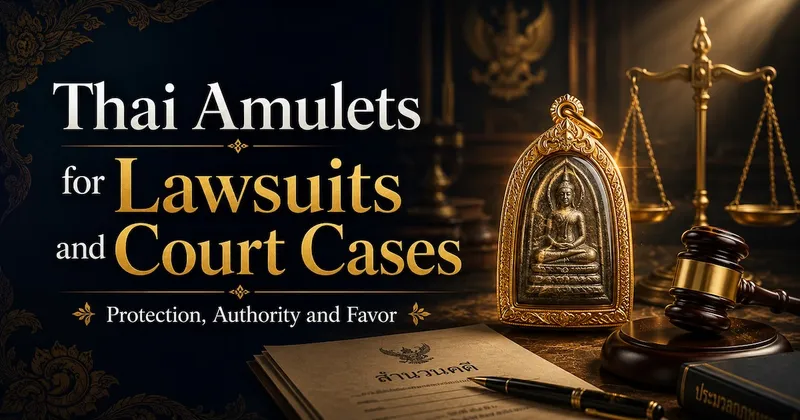
When a legal battle feels bigger than you
Few situations drain a person the way a lawsuit does. Whether you are defending yourself against a false accusation, fighting a contract dispute, or waiting on a verdict that could reshape your finances, the stress is constant and the outcome feels out of your hands. In Thai Buddhist culture, many people turn to amulets during exactly these moments, not as a substitute for a good lawyer but as a way to steady the mind, invite goodwill from the people deciding their fate, and keep hidden enemies from gaining the upper hand.
This guide explains which Thai amulets are traditionally associated with legal disputes, court cases, and winning the favor of authority figures, and how to think about them honestly.
How Thai tradition frames legal trouble
Thai amulet lore does not promise that a piece of consecrated metal will change a judge's ruling. What the tradition addresses is subtler and, in practice, more useful. A court case is won or lost on three human factors that amulets are believed to influence:
- Kong grapan and klaew klaad — protection from harm and the ability to slip past danger, understood here as avoiding traps, ambushes, and worst-case outcomes.
- Metta maha niyom — loving-kindness and likability, believed to soften how officials, opposing parties, and witnesses respond to you.
- Maha amnat — commanding presence and authority, so that your words carry weight in front of people with power over the case.
A good legal amulet is chosen to balance these three: enough authority to be taken seriously, enough metta to avoid making enemies, and enough protection to survive the process intact.
Phra Pidta: closing the door on enemies
Phra Pidta, the Buddha covering his eyes, is the classic choice for anyone caught in conflict. The gesture of shutting out the external world is read as sealing yourself off from ill intent, gossip, and the schemes of opponents. Collectors favor Phra Pidta specifically for situations with hidden adversaries, which describes most lawsuits well. Editions carrying strong kong grapan properties are the traditional pick when you feel outnumbered.
Thao Wessuwan: authority that outranks your opponent
Thao Wessuwan, the guardian giant who commands the spirit world, represents raw authority and the power to overrule lesser forces. In a legal context he is worn to project seriousness and to keep malicious spiritual interference, curses, or dirty tactics from affecting the case. People facing an intimidating or well-connected opponent often choose Thao Wessuwan for the sense of standing on equal footing.
Hoon Payon: a guardian that stands watch
Hoon Payon, the spirit-soldier effigy, is traditionally created to defend its owner and warn of danger. During a drawn-out dispute, it is treated as a sentinel that guards the household and the case, deflecting sabotage and keeping the owner alert to bad-faith moves before they land.
Choosing the right combination
| Your situation | Traditional emphasis | Amulet to consider |
|---|---|---|
| Falsely accused, hidden enemies | Sealing off ill intent | Phra Pidta |
| Facing a powerful or connected opponent | Authority, presence | Thao Wessuwan |
| Fear of sabotage or foul play | Guarding, early warning | Hoon Payon |
| Need officials and witnesses on your side | Metta, likability | Phra Pidta with metta properties |
Many wearers pair a Phra Pidta for protection with a metta-focused piece so that they are shielded without becoming cold or combative in negotiations.
How to wear and treat it during a case
- Wear the amulet consistently from the start of the dispute rather than only on hearing days, so it becomes part of your daily composure.
- Recite the homage to the Buddha before entering court, using it as a moment to calm your breathing and focus.
- Keep your conduct clean. Thai tradition holds that amulets protect those who act with honesty and merit, and lose their goodwill toward those who lie or cheat.
- Do not let the amulet make you reckless. It is meant to support sound decisions, not replace your lawyer, your evidence, or your patience.
An honest word
An amulet is a spiritual and cultural support, not legal advice and not a guarantee of any verdict. Hire competent counsel, prepare your evidence, and tell the truth. Worn with that mindset, a legal amulet does what the tradition intends: it keeps you calm, keeps you likable, and keeps you protected while the real work is done in the courtroom.