Two Traditions, Similar Goals
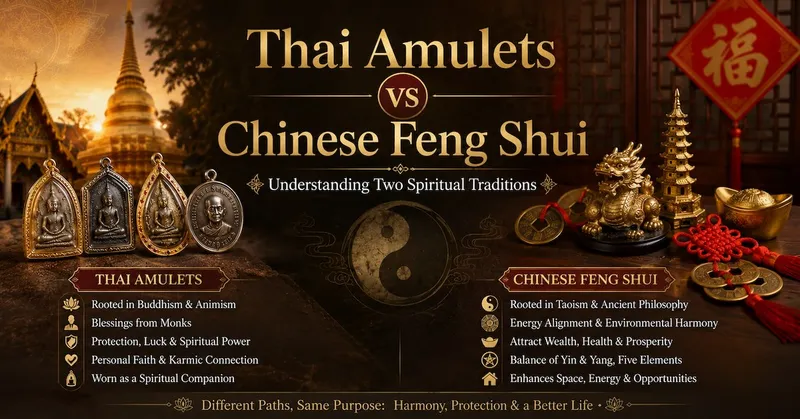
Thai amulets and Chinese Feng Shui are two of Asia's most widely practiced spiritual traditions for attracting prosperity, protection, and good fortune. Both have millions of practitioners worldwide, both have deep historical roots, and both address the same fundamental human desires: safety, wealth, love, and a smooth path through life. But they operate through entirely different spiritual mechanisms, and understanding these differences helps practitioners from either tradition — or both — make informed choices.
Core Philosophical Differences
Source of Power
Thai amulets derive their power from the spiritual attainment of the consecrating monk and the specific blessing ceremony (Puttapisek). The power source is personal — it comes from a specific human being's spiritual cultivation, channeled into a physical object through ritual. Each amulet is essentially a container for a specific monk's spiritual energy.
Feng Shui works with Qi (vital energy) — an impersonal cosmic force that flows through environments and can be directed through the placement and arrangement of objects, structures, and spaces. The power source is the universe itself, channeled through spatial relationships rather than personal spiritual transmission.
How They Work
Thai amulets are portable and personal. You wear them on your body, and their spiritual energy accompanies you wherever you go. The protection and blessings are tied to you as an individual, regardless of your physical location.
Feng Shui is fixed and environmental. It optimizes the energy of specific spaces — your home, office, or business premises. The benefits are tied to the space, and anyone who occupies that space is affected. You cannot carry Feng Shui with you when you leave the building.
Customization
Thai amulets are customized to the individual's needs through the choice of amulet type and its associated power. You select a Phra Pidta for protection, a Khun Paen for charm, a Mae Nang Kwak for business — each piece addresses your specific situation.
Feng Shui is customized to the space through analysis of compass directions, the building's orientation, the layout of rooms, and the placement of elements (water, wood, fire, earth, metal). The practitioner reads the space and adjusts it to optimize energy flow for the occupants.
Key Similarities
Despite the philosophical differences, significant overlaps exist:
- Wealth focus — Both traditions devote substantial attention to attracting financial prosperity. Feng Shui has its wealth corner and water features; Thai amulets have Maha Pokasap power and wealth-specific pieces.
- Protection — Both address safety concerns. Feng Shui uses mirrors, guardians, and elemental placements to deflect negative energy; Thai amulets provide personal protective shields.
- Practitioner expertise matters — In both traditions, the quality of the practitioner determines the quality of the outcome. A skilled Feng Shui master's analysis is worth more than a generic guidebook, just as a renowned monk's consecration carries more weight than a factory-produced charm.
- Integration with daily life — Neither tradition requires dramatic lifestyle changes. Thai amulets are simply worn; Feng Shui adjustments are often subtle changes to existing spaces.
Can You Practice Both?
Yes — and many people do. In Thailand itself, Thai-Chinese families commonly blend both traditions: Feng Shui principles guide the layout of their homes and businesses, while Thai amulets provide personal spiritual protection for individual family members. There is no conflict between the two systems.
The traditions complement each other logically: Feng Shui optimizes your environment (where you live and work), while Thai amulets optimize your personal energy field (wherever you go). Together, they cover both the fixed and portable dimensions of spiritual support.
Practical Comparison
| Aspect | Thai Amulets | Feng Shui |
|---|---|---|
| Portability | Fully portable — travels with you | Fixed to specific locations |
| Cost entry point | $10-50 for a genuine consecrated piece | $200+ for a proper consultation |
| Setup complexity | Minimal — just wear it | Requires expert analysis and adjustments |
| Maintenance | Treat with respect, minimal physical care | Periodic review as circumstances change |
| Personalization | Choose by spiritual power needed | Tailored to the specific space and occupants |
| Cultural origin | Thai Theravada Buddhism + Brahmanical elements | Chinese Taoist cosmology |
Which Should You Choose?
If you want personal, portable spiritual support — especially for protection, charm, or specific life challenges — Thai amulets are the natural choice. If you want to optimize the energy of your physical spaces for everyone who uses them, Feng Shui is the relevant discipline. For comprehensive coverage, use both.
Explore our Thai amulet collection to find pieces that address your specific needs, or start with our beginner's guide to understand the tradition.