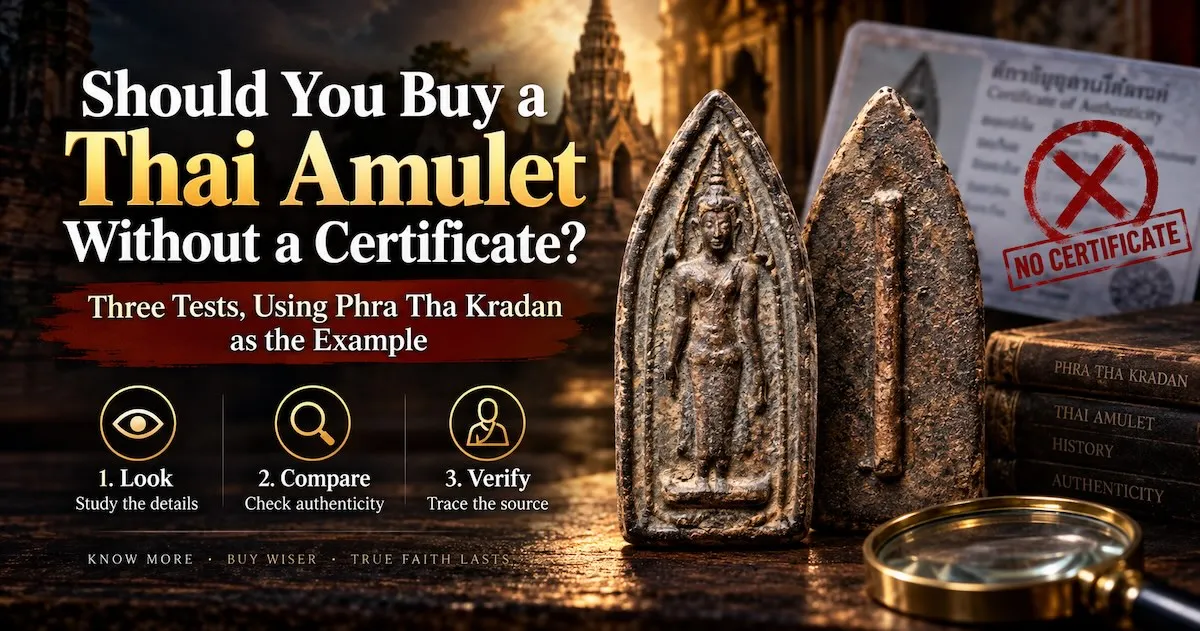
TL;DR: An amulet without a certificate is not automatically fake, but its price must sit in the uncertified band rather than at antique levels. Three things decide whether it is safe to buy: whether the seller states plainly that there is no card, whether they refuse to assert an age, and whether the price matches the uncertainty. Phra Tha Kradan, one of the most over-described categories in Thailand, makes a good worked example.
1. Why the absence of a certificate is not itself the problem
A Thai authentication card is issued by a third-party body after examining the piece in person, and carries a number, the amulet name, the temple, the province, the issue date, two signatures and a scannable QR code. What it answers is one narrow question: is this piece what it claims to be?
Plenty of amulets in circulation were never submitted. Some were taken at the temple by someone who never intended to resell. Some belong to categories so contested that submission is expensive and uncertain. Some are old enough that the mould evidence is too thin for a body to certify at all. No card means no third-party backing. It does not mean the object is wrong.
The risk lives in the next step: how the seller describes it.
2. Phra Tha Kradan: the category most often over-described
Phra Tha Kradan is among the most recognisable forms in Thai amulets, named after the Tha Kradan area of Kanchanaburi and belonging to the U Thong tradition: the Buddha seated in meditation, the ushnisha tall and bent to one side (geis kod in Thai), the face square and deep-set without a softening smile, the body thick, the material lead.
Tradition holds the first pieces were commissioned by a forest-dwelling hermit, a ruesi, together with the local ruler, for soldiers going to war. That is why Thais place it at the martial end of the tradition: protection and escape from harm (Kong Kraphan, Klaew Klaad) and commanding authority (Amnaj). Old collectors call it the warrior of the Mae Klong basin.
The difficulty is that two very different things circulate under the name, and they can look close:
- Antiques — authentic pieces recovered from old caches in Kanchanaburi, reaching back to the U Thong period. Rare and expensive.
- Later re-castings — because the antiques are so scarce, temples and masters have repeatedly re-melted old lead to issue their own versions, anywhere from decades to a century old.
Telling them apart means examining the oxide layers, the state of the lead and the mould detail in hand — expert work. Which is exactly why an uncertified piece described as a six-hundred-year-old antique is a high-risk purchase.
3. Three tests before you buy an uncertified amulet
- Does the seller say plainly that there is no card? In the title or the opening lines, not buried at the end of the description or omitted entirely. Deliberate vagueness is your cue to walk away.
- Do they refuse to assert an age? The responsible position is "we do not state a period and do not claim excavation", with an explanation that dating requires expert examination. A confident, specific age claim with no card behind it is the clearest warning sign there is.
- Does the price match the uncertainty? Genuine antiques of this kind run into six figures in Thai baht. If an "excavated antique" is offered for a few thousand baht while the seller insists it is genuine, the price is already telling you the answer: either they do not believe it themselves, or they are betting that you cannot tell.
One practical addition: the description of an uncertified piece should contain only observable facts — material, form, oxidation, finishing marks, whether there is a loop. Anything beyond what can be seen (period, find site, consecration by a named master) has no basis without a card.
4. Caring for lead amulets: do not polish
Lead is soft and dents easily, and more importantly the oxide surface is the core of its condition. Removing it is irreversible.
- Wear it in a case or frame and keep it away from knocks
- Keep it away from acids
- Clean with a dry cloth only — no polishing, no cleaning agents
- Many old lead pieces have no original loop and need a case or frame before they can be worn
5. Who this form suits
The expression on a Phra Tha Kradan carries authority and deterrence rather than serenity. In Thailand its wearers are typically police and military, security professionals, managers, and people working under sustained pressure or risk. Popular reading adds a layer to the bent ushnisha: bent, but not broken — a symbol of staying upright through adversity.
If what you want is charm, attraction and warmth in business, a Phra Khun Paen fits better; for steady wealth accumulation, look at Luang Pu Liew turtle amulets. Choosing the right direction matters more than choosing the expensive option.
FAQ
Q: Can an uncertified amulet be worn?
A: Yes. Certification addresses resale and provenance, not wearing. It should simply be priced in the uncertified band.
Q: Can I submit one for certification myself?
A: Yes. Thailand has several authentication bodies and regular amulet competitions. Note that submission costs money and contested categories may not receive a card at all — one reason many genuinely old pieces still have none.
Q: Why does the face look stern rather than serene?
A: That is the type, not a flaw. It was made for protection in war, so the expression carries authority.
Q: Is a lead amulet safe to wear?
A: Worn normally — cased, not held to the mouth, hands washed after handling — it is not a cause for alarm. Keep it cased and away from young children.
Q: What do you guarantee on uncertified pieces?
A: Certified items carry our ten-times refund guarantee. For uncertified pieces we guarantee that the description is accurate and the item is as photographed — the page states only what can be seen, with no claim about age or excavation. Our current Phra Tha Kradan is described to exactly that standard.
Note: Thai amulets are objects of faith and cultural collection. Their purpose is to remind the wearer to keep precepts and act well. The associations described here reflect Thai devotional tradition and are not a guarantee of personal safety or any other outcome. Never take a risk because you are wearing a sacred object.
Last updated: September 2026 | Merit Messenger team, based in Bangkok
Questions about the condition of a specific piece are welcome before you order — contact us and we will answer straight. You can also browse the shop to compare how we price certified against uncertified pieces.