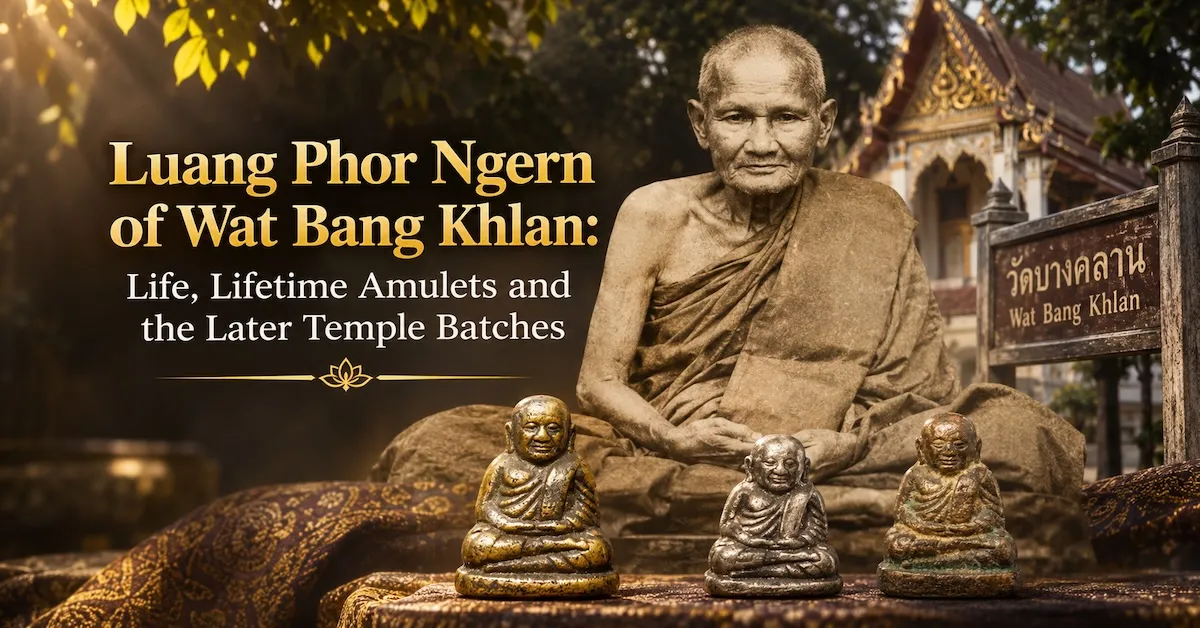
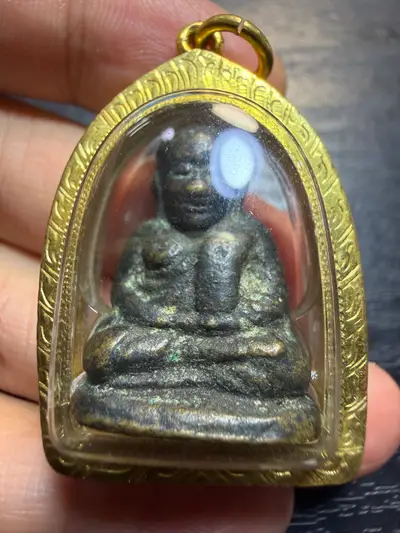
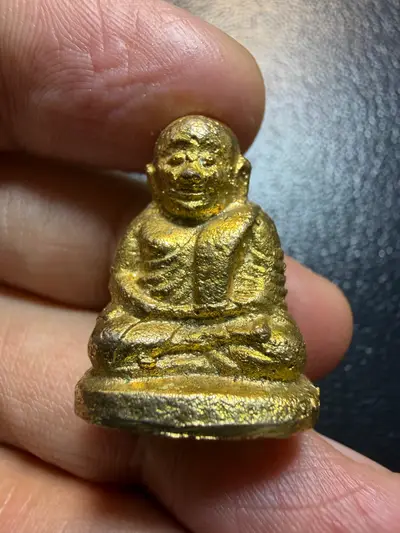
Luang Phor Ngern Phutthachot (หลวงพ่อเงิน พุทธโชติ) was the founding abbot of Wat Bang Khlan in Pho Thale district, Phichit province, a temple also known by its formal name Wat Hiranyaram and its older name Wat Wang Tako. He died in 1919, yet he remains one of the most widely venerated monks in Thailand, and the small cast images made in his lifetime are among the most expensive amulets in the country. His name, Ngern, means "silver" or "money" in Thai, which is one reason devotees associate him with wealth.
This guide separates three things that are often blurred together: what the Thai sources agree on about his life, what is tradition and belief, and how the amulets made during his lifetime differ from the memorial batches issued decades later. That last distinction matters most to buyers, because almost every Luang Phor Ngern piece a normal collector can afford belongs to the later group.
His Life: What the Sources Say
Thai sources agree on the outline and disagree on the birth year. He was born on 16 September; the year is given as BE 2351 (1808) by Thai Wikipedia, Kom Chad Luek and the Thai amulet association's listing, as BE 2353 (1810) by Thairath and others, and Thairath notes that the life-size statue inside the temple's own wihan gives BE 2348 (1805). His father is recorded as coming from Bang Khlan, and his mother from Kamphaeng Phet.
As a small child he was taken to Bangkok by an uncle and educated at Wat Tong Pu, today's Wat Chana Songkhram. He became a novice there at about twelve and took full ordination there at around twenty, receiving the monastic name Phutthachot. Thai Wikipedia dates the ordination to BE 2373 (1830). After roughly three rains retreats in Bangkok he returned to Phichit and stayed at Wat Khongkharam, also called Wat Bang Khlan Tai.
From there he moved a short distance to the village of Wang Tako and established a new monastery. The accounts say he planted a bodhi tree brought from Wat Khongkharam on the site. That monastery became Wat Wang Tako, later Wat Bang Khlan or Wat Hiranyaram, and he remained its abbot for life. The founding year is not secure: MGR Online gives BE 2377 (1834), while two other Thai pages print years that fall after his death and are clearly errors.
He was known locally as a healer who used herbal medicine and holy water, and the temple still keeps his medical manuscript, according to Thai Wikipedia. He died before dawn on 20 September BE 2462 (1919). The age usually quoted is 111, which matches the 1808 birth year; sources that use a later birth year give a lower figure.
Teachers and famous connections
Luang Phor Ngern is often described online as a student of Luang Pu Suk of Wat Pak Khlong Makham Thao. The Thai sources we checked put it differently. Thairath and Thai Wikipedia describe the two as fellow disciples of the same lineage, with Luang Phor Ngern the senior. They report that Luang Pu Suk advised his own royal pupil, Prince Chumphon (Krom Luang Chumphon Khet Udomsak), to go and study with Luang Phor Ngern. Separately, the Thai amulet association's page and a Khaosod column name Somdej Toh of Wat Rakhang as one of his teachers during the Bangkok years. These teacher lists are traditional accounts rather than documented records, and should be read that way.
The Lifetime Amulets and Why They Cost So Much
Four types made in his lifetime are treated as the standard set by Thai collectors:
| Type | Thai name | What the sources say |
|---|
| Cast image, Phim Niyom | รูปหล่อพิมพ์นิยม | The "popular mould". Post Today's amulet columnist describes it as designed and cast by a hired craftswoman from the Ban Chang Lo foundry community, using wax models poured in clusters. Two versions are recognised, with and without a raised line under the hands. |
| Cast image, Phim Khi Ta | รูปหล่อพิมพ์ขี้ตา | The "eye-crust mould", named for a lump of excess metal near the eye. Described as the work of village craftsmen using two-part moulds, cast one at a time. Sub-types are named by the number of robe folds. |
| Large hoe coin | เหรียญหล่อพิมพ์จอบใหญ่ | A cast medal whose outline resembles a hoe blade, with a beaded border. |
| Small hoe coin | เหรียญหล่อพิมพ์จอบเล็ก | The smaller cast medal of the same family. |
The casting date is approximate. Post Today and Daily News both place the Phim Niyom images and the hoe coins at roughly BE 2451 to 2459 (1908 to 1916). The order is disputed: Kom Chad Luek and ThaiNews say the rougher Khi Ta images came first and the refined Phim Niyom later. The base metal is a brass alloy; Kom Chad Luek adds that villagers donated gold to the melt, and that the first images were originally offered at one baht each.
As for price, the only figures worth repeating are those in Thai media reports. Post Today wrote in 2018 that Phim Niyom images in fine condition were valued from the high millions of baht up to eight figures, and called it the most expensive cast-image amulet. Daily News wrote in October 2025 that fine examples change hands for well over a million baht. A Thairath feature in March 2025 showed a large hoe coin with a quoted figure of 9.5 million baht. These are press reports and asking levels, not audited sale records.
You will also see the hoe coin described as a member of the "Benjapakee of cast coins", a collectors' top-five grouping. We found this only on informal pages, not in a mainstream Thai source, so treat it as trade usage rather than an official ranking.
Later Temple Batches: BE 2515, 2516 and 2528
Because lifetime pieces are out of reach, the collecting market for Luang Phor Ngern is mostly about memorial batches made long after his death. They carry his image and the temple's consecration, but he did not make or bless them himself.
BE 2515 (1972)
This is the benchmark later batch. Collector references agree on a two-stage consecration: a ceremony at Wat Suthat in Bangkok on Sunday 5 December BE 2514, attended by 127 monks, followed by a second ceremony at Wat Bang Khlan at the end of January BE 2515, where the figure usually given is 96 monks. Kom Chad Luek states that the temple's 1972 programme ran in three rounds and that the batch's popularity rose quickly afterwards. Collector pages add that it was made to fund the temple's new ordination hall; we could not confirm that in a mainstream source.
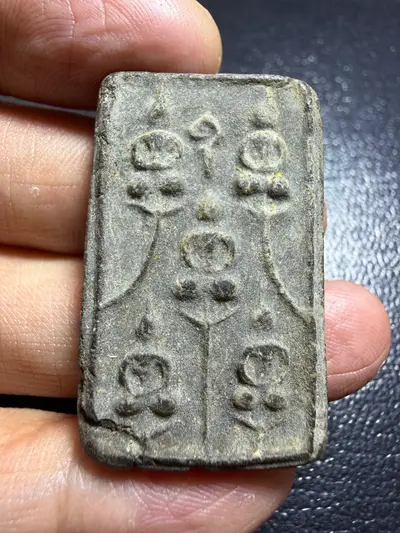
The best-known item is a machine-stamped image with a rattle bead sealed in the base, made in alpaca and in brass. Collectors divide it into three moulds, of which Phim Kho Ael (the "L-neck") is the most sought after. The same year's range also included revival versions of the hoe coins and a Five Buddhas (Phra Chao Ha Phra Ong) design. Thai listings date the Five Buddhas piece to either 2515 or 2516.
BE 2516 (1973)
Documentation is thin. Thai dealer listings describe a brass cast image marked with the Thai numeral two on the back, issued by Wat Bang Khlan in 2516, and explain it as a follow-up after the 1972 pieces were quickly taken up. We found no temple or press record of the ceremony.
BE 2528 (1985) and the "Puen Taek" name
Puen Taek (ปืนแตก) means "the gun burst". According to Thai trade accounts, the batch did not carry that name at first; the story is that someone test-fired a gun at one of the images and the gun burst, and the nickname stuck. This is a market legend, not a documented event.
The same accounts say the metal came from damaged old images and bells found under the principal Buddha's base in an old ordination hall, melted down under an abbot named Luang Phor Chuea, and that there are more than ten moulds, including big-head (Sian To) and small-head (Sian Lek). Note that many Thai listings attribute Puen Taek to Wat Khongkharam (Bang Khlan Tai), the neighbouring temple where Luang Phor Ngern first stayed, rather than to Wat Bang Khlan itself.
A separate 1985 issue, Ruam Jai Sang Saphan ("united to build the bridge"), is tied by listings to a consecration on 23 March BE 2528 commemorating a bridge to the temple. Listings again differ on whether Wat Bang Khlan or Wat Khongkharam issued it.
What Devotees Believe
Devotees associate Luang Phor Ngern above all with wealth and steady income, an association helped by his name. Thai amulet columns also list protection from danger and, in the older tradition, invulnerability; many wearers add goodwill from others. These are matters of faith. No amulet guarantees an outcome, and we make no such promise for any piece we sell.
Authenticity and Buying Advice
- Assume any "lifetime" Luang Phor Ngern offered casually is a copy. A Thai antiquities institute director quoted by Kom Chad Luek said that fakes exist for every Luang Phor Ngern batch, later ones included.
- For most buyers the realistic target is a later temple batch such as 2515, 2516 or 2528, bought with third-party authentication.
- Check which temple and which year a piece is attributed to, and whether the authentication card says the same thing.
- Learn what the paperwork means. Our explainer on the Samakom yellow receipt card versus the formal certificate covers the difference.
- Be wary of prices far below the going level for a named batch.
Luang Phor Ngern Amulets Currently in Stock
Every piece below is a later memorial batch, not an amulet made by Luang Phor Ngern in his lifetime. Prices are in Thai baht.
- Luang Phor Ngern Five Buddhas (Phra 5 Ong), BE 2515, ฿10,000
- Luang Phor Ngern small cast image, numeral two on the back, brass, BE 2516, ฿20,000
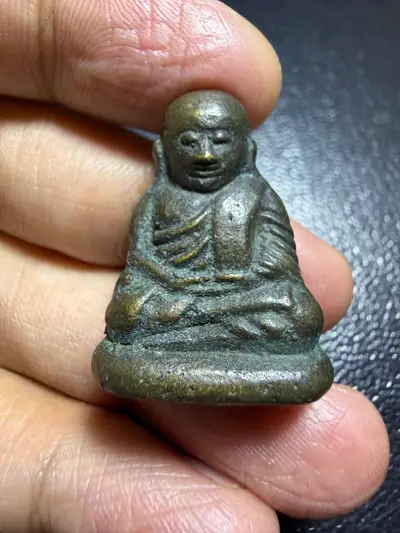
- Luang Phor Ngern cast image, Puen Taek, small-head mould, BE 2528, ฿14,000
- Luang Phor Ngern cast image, Puen Taek, big-head mould, BE 2528, ฿16,000
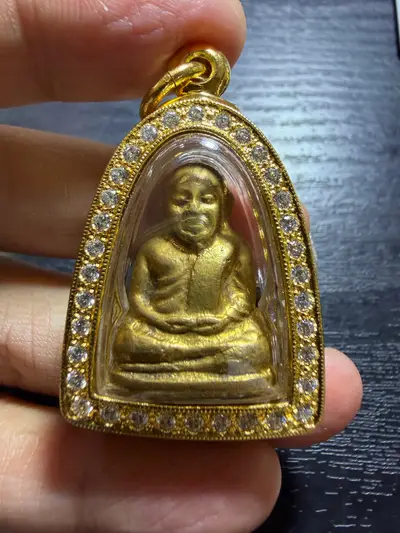
- Luang Phor Ngern cast image, Ruam Jai Sang Saphan batch, gilded brass, BE 2528, ฿12,000
See each product page for photographs and authentication details, or browse all amulets.
Frequently Asked Questions
When did Luang Phor Ngern live?
He died on 20 September 1919 (BE 2462). His birth is given as 16 September in 1808 by several Thai sources and 1810 by others, with 1805 shown at the temple itself. The traditional age at death is 111.
Are Wat Bang Khlan and Wat Hiranyaram the same temple?
Yes. Wat Hiranyaram is the formal name of Wat Bang Khlan in Pho Thale district, Phichit, formerly Wat Wang Tako. Wat Khongkharam, or Wat Bang Khlan Tai, is a different, neighbouring temple where he stayed earlier.
Why are lifetime Luang Phor Ngern amulets so expensive?
They are over a century old, were cast in small workshops, and are sought by a very large following. Thai press reports put fine Phim Niyom images in the millions of baht.
Is a BE 2515 amulet made by Luang Phor Ngern himself?
No. He died in 1919. The 2515 batch was issued by Wat Bang Khlan in 1972 and consecrated by invited monks at Wat Suthat and at the temple.
What does Puen Taek mean?
It means "the gun burst". The trade story is that a gun burst when someone test-fired at one of the 1985 images. It is a legend attached to the batch, not a verified event.
How can I reduce the risk of buying a fake?
Buy later temple batches rather than supposed lifetime pieces, insist on recognised third-party authentication, and confirm that the temple, year and mould on the card match the listing.