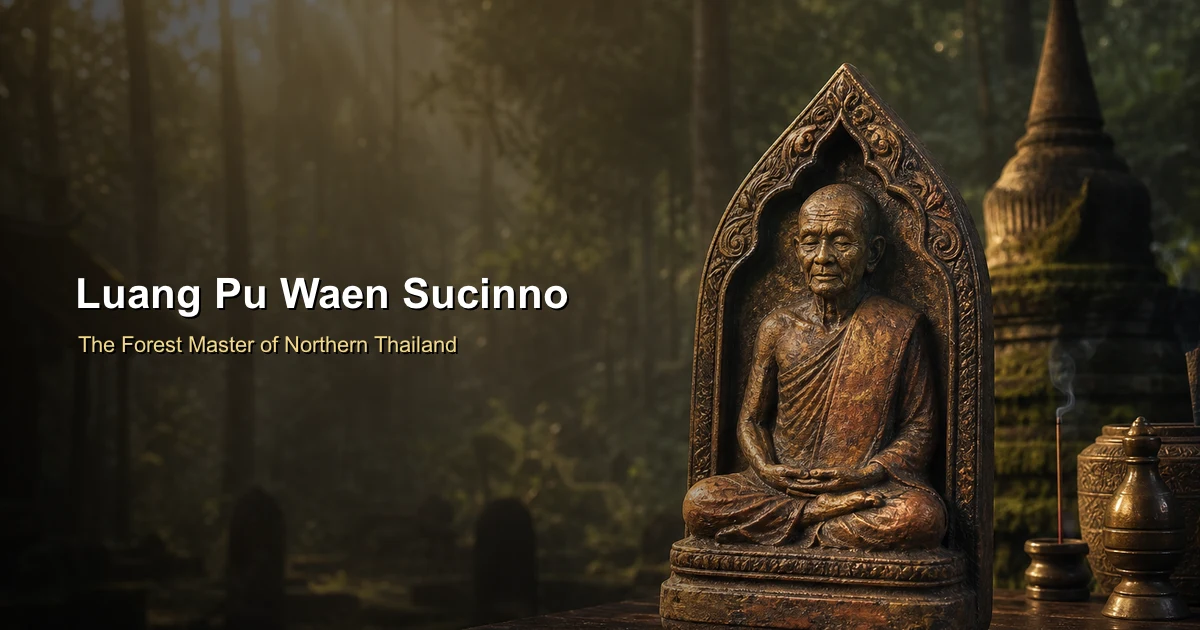
A forest master even kings came to see. Luang Pu Waen's place in the lineage of Ajahn Mun, why his amulets are trusted, and a golden-period sacred clay piece from Wat Doi Mae Pang.
A Forest Master Even Kings Came to See
In the mountains of northern Thailand, few monks are remembered with the reverence given to Luang Pu Waen Sucinno (หลวงปู่แหวน สุจิณโณ, 1887–1985). A meditation master of the Thai Forest Tradition, he lived to nearly a hundred, spent much of his life in remote practice, and became so widely venerated that the royal family made repeated visits to pay their respects at his mountain monastery. His amulets remain among the most trusted in the north — quietly powerful pieces associated with loving-kindness, safety, and steady fortune.
The Forest Tradition and the Lineage of Ajahn Mun
Luang Pu Waen was a direct disciple within the lineage of Ajahn Mun Bhuridatta, the founding teacher of the modern Thai Forest Tradition (kammatthana). This lineage prized strict discipline, long solitary meditation, and realization over ritual and title — the same tradition that produced masters like Luang Ta Maha Bua. For readers new to it, our overview of Ajahn Mun and the Thai Forest Tradition gives the wider context.
What set Luang Pu Waen apart even within this austere company was the depth of his seclusion and the calm authority of his presence. He wandered and practiced across the northern highlands for decades before settling at Wat Doi Mae Pang in Chiang Mai's Phrao district, where he remained until his death in 1985.
Why His Amulets Are Trusted
Amulets consecrated by a forest master carry a particular reputation. Because these monks are understood to have spent their lives cultivating genuine meditative attainment rather than producing objects for sale, their blessings are considered unusually pure and potent. Luang Pu Waen's pieces are associated above all with:
- Loving-kindness and charisma (metta) — the warm, trustworthy presence a forest master embodies
- Protection from danger — safety on the road and in daily life
- Steady fortune and career — solid, grounded prosperity rather than speculative luck
- Noble support and peace — attracting good people and a settled mind
Collectors generally regard the years B.E. 2513–2521 (1970–1978) as the golden period of his amulet production, when many of his most sought-after pieces were made.
The Piece in Our Collection
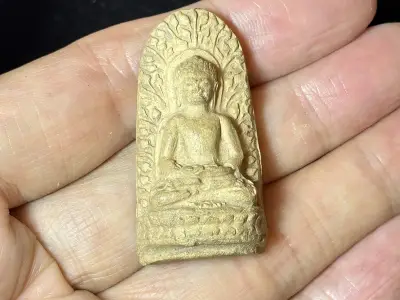
The Luang Pu Waen Phra Lue Chai Sacred Clay Amulet, B.E. 2516 (฿4,600) sits squarely in that golden period. Consecrated in 1973 at Wat Doi Mae Pang, it is a clay-bodied piece (traditionally mixed with sacred powder) showing a Lanna-style Phra Lue image crowned by a ring of Bodhi-leaf motifs.
As a half-century-old clay amulet from a master who passed in 1985, well-preserved examples grow harder to find each year. This one comes with an authenticity card and a full guarantee. One of a kind in our inventory — a quietly serious piece for someone who values grounded, forest-tradition provenance over flash.
Who Should Wear a Luang Pu Waen Amulet?
- Those seeking safety and peace of mind in daily life and travel
- People in solid, long-horizon work — trades, industry, family business — who value steady fortune
- Admirers of the Forest Tradition and the lineage of Ajahn Mun
- Collectors of northern Thai vintage amulets who prize authenticity and restraint
Frequently Asked Questions
What is the "Forest Tradition" and why does it matter for amulets?
The Thai Forest Tradition is a lineage of meditation monks who emphasize strict discipline and deep practice in remote settings. Its masters are trusted amulet-makers precisely because their blessings are seen as the fruit of genuine attainment rather than commercial production.
Is a clay amulet durable enough for daily wear?
Yes, with care. Sacred clay is sturdier than pressed powder, but it is still best protected in a case for everyday wear and kept from hard knocks and prolonged moisture.
Why is the B.E. 2513–2521 period considered special?
Collectors regard those years as the golden era of Luang Pu Waen's amulet production, when many of his most revered and sought-after pieces were consecrated. The 2516 (1973) date of our piece falls right in the middle of it.
Interested in this piece? Contact us on WhatsApp for more photos and details.