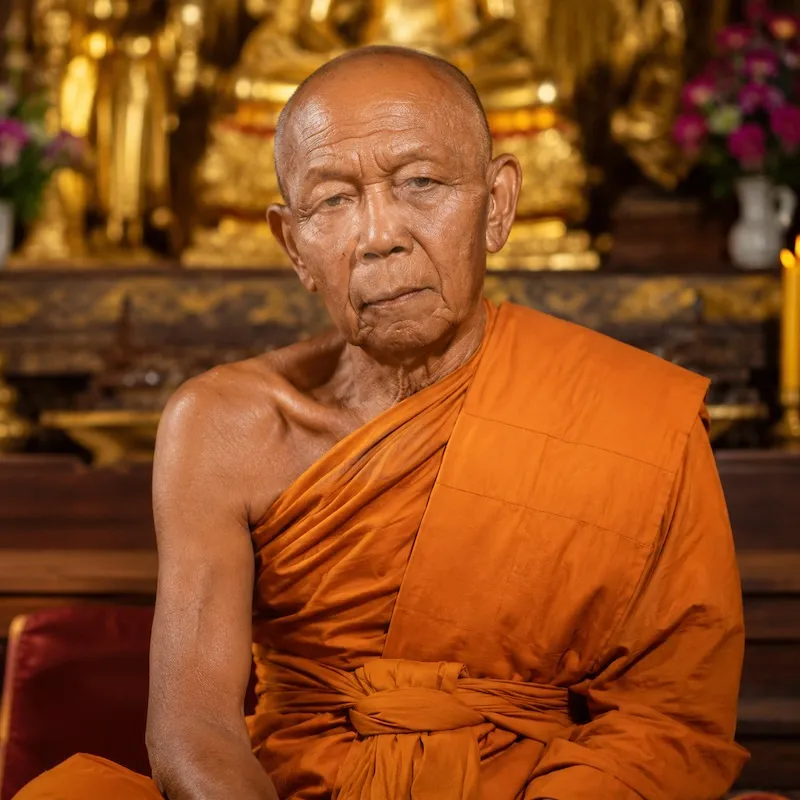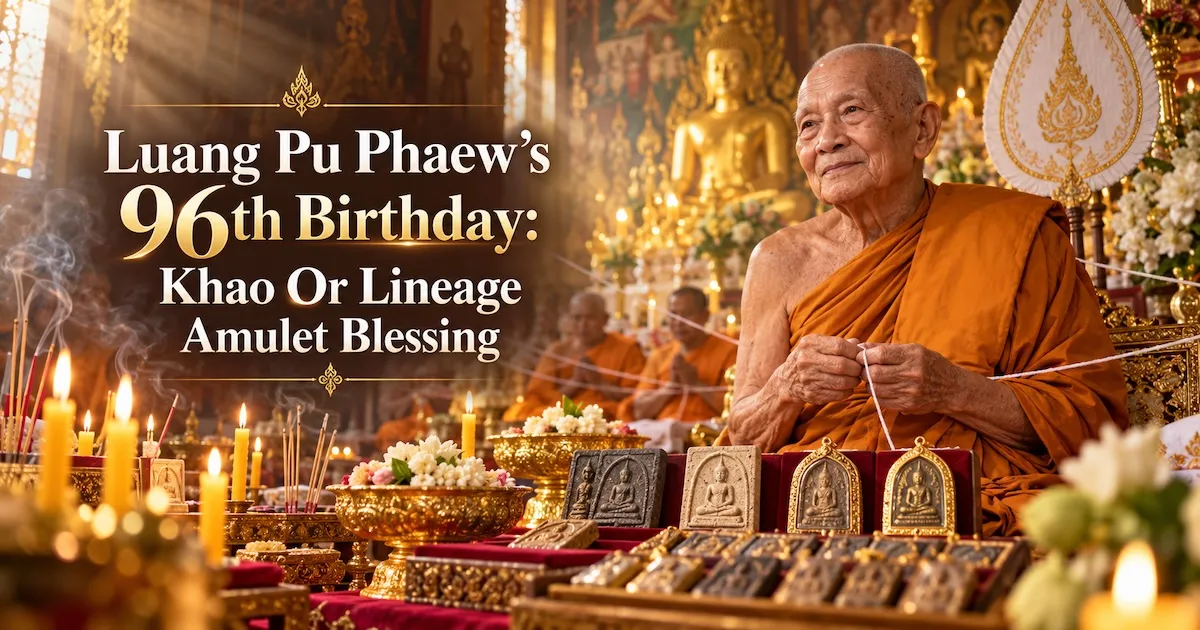
On September 25, 2026, a grand Buddha-Deva consecration ceremony (Phutthaphisek) was held at Wat Ban Sai Luang Meditation Center in Khuan Khanun district, Phatthalung province, southern Thailand, to bless a new "Sema Coin, 8th Cycle Edition" (Rian Sema 8 Rob) commemorating the 96th birthday of Luang Pu Phaew Phonpanyo, a senior monk of the celebrated Khao Or (เขาอ้อ) magical lineage. A preliminary offering rite began at 11:09 a.m., followed by the main consecration at 1:09 p.m., during which Luang Pu Phaew himself lit the ceremonial candle. Luang Phor Prasoot Piyathammo, abbot of Wat Tham Phra Phutthakosi in Trang province, extinguished it to close the rite. Devotees and disciples in attendance received the newly consecrated coins free of charge.
What Is the Khao Or Lineage, and What Is a "Sema" Coin
Khao Or refers to Wat Khao Or in Phatthalung province, one of the two most storied centers of Thai esoteric Buddhist magic (Wicha Saiyasat), historically ranked alongside Wat Prasat Bun in Suphanburi as one of Thailand's two "schools" of sacred arts. The lineage specializes in protective, invulnerability, and warding magic, and — unlike most temple traditions — its knowledge has historically been passed to lay masters (Ajarns) as well as ordained monks. Luang Pu Phaew is a grand-nephew of the late Phra Ajarn Nam Chinnaworo of Wat Don Sala, one of the 20th century's most revered Khao Or grandmasters, whose own protective charms were sought by soldiers and even senior Thai statesmen. A "Sema" is the boundary stone that marks a temple's ordination hall, one of the most recognizable religious markers in Thai temple architecture; casting an amulet in that shape to mark a monk's milestone birthday is a established convention, and "8 Rob" denotes the eighth twelve-year zodiac cycle — 96 years.
Fifteen Monks From Six Provinces
The ceremony was organized by Patcharapon Kaewmanee, known as "Phat Nakhon Si," a well-known southern Thai amulet maker, who brought together fifteen senior monks from the Khao Or tradition and related southern lineages across Phatthalung, Trang, Nakhon Si Thammarat, Surat Thani, Ranong, and Chumphon provinces, plus four additional chanting monks from Nakhon Si Thammarat for the Maha Nak invocation. Large multi-master consecrations of this kind carry weight in Thai amulet culture: the more senior monks who jointly chant over an item, the stronger its claim to lineage authenticity once it reaches the collector market, a pattern explored in our guide on what happens at a Thai amulet consecration ceremony.
What This Means for Collectors
For overseas collectors, three points are worth noting. First, as a direct descendant of Ajarn Nam Chinnaworo, Luang Pu Phaew's amulets carry an authentic claim to Khao Or's warding and anti-black-magic specialty, placing this release closer to the tradition covered in our guide to Thai amulets against black magic and curses than to purely wealth-focused pieces. Second, this is a brand-new release with no third-party certification history yet; buyers considering it on the secondary market should treat the organizer's name and ceremony footage as the primary provenance trail, following the verification habits outlined in our 2026 buyer's guide to protection amulets. Third, the Khao Or lineage remains far less recognized among English- and Chinese-speaking collectors than central and eastern masters such as Luang Phor Koon or Luang Phor Tim, even though its southern magical tradition, profiled in our overview of Thailand's great amulet lineage masters, is just as historically deep. As the senior generation of Khao Or teachers reaches advanced age, ceremonies like this one are becoming an important record of a living but aging lineage.
Source: TOPNEWS