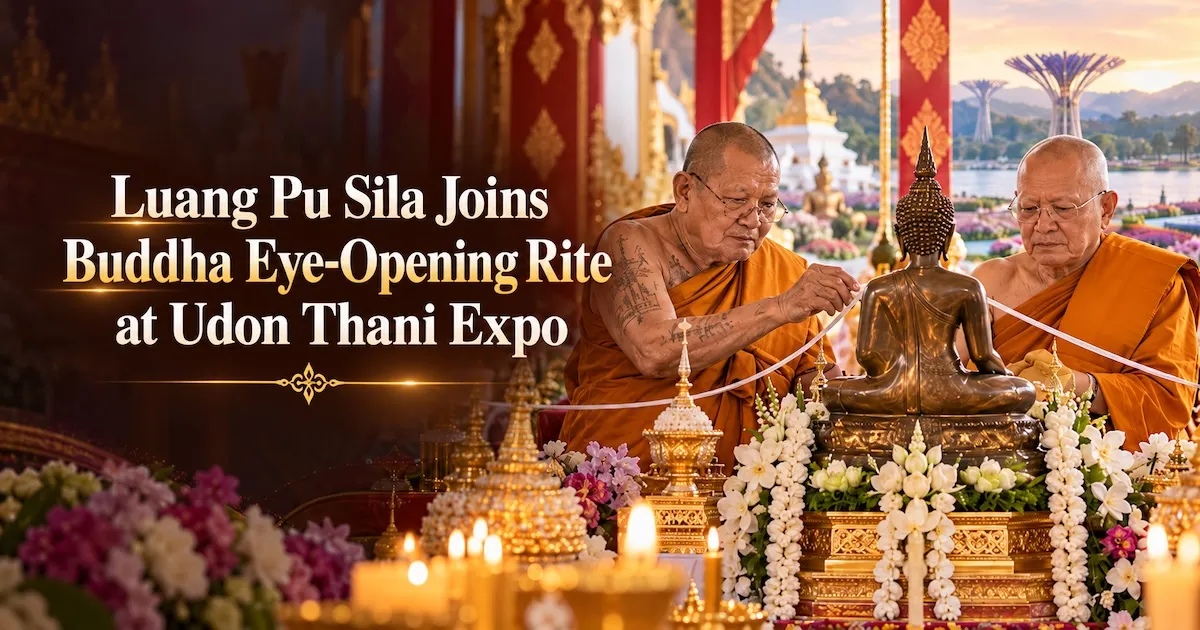
On October 5, 2026, prominent northeastern Thai monk Luang Pu Sila Sirichantho (หลวงปู่ศิลา สิริจันโท) appeared at the Udon Thani World Horticultural Expo site in northeastern Thailand to join Somdet Phra Maha Theerachan, abbot of Bangkok's Wat Pho (Wat Phra Chetuphon Vimolmangklararam) and head of the Sangha's Northern Ecclesiastical Region, in presiding over a "bhoek net" (เบิกเนตร) eye-opening consecration for a statue of Phra Sri Ariyamettrai Buddhabhattaramsuk — a future-Buddha (Maitreya) image installed on the expo grounds. The eye-opening rite is the ritual moment in Thai Buddhist tradition when a newly cast Buddha image is considered to receive its spiritual presence. The ceremony was one of several religious blessings arranged by Thailand's Ministry of Agriculture and Cooperatives ahead of the expo's opening on November 1, 2026, with overall site construction now reported at 96.31 percent complete.
Two Ceremonies, One Day
According to Thai news outlets and a statement from the Department of Sericulture, Deputy Agriculture Minister Watcharapol Khaokham presided over the proceedings, joined by Permanent Secretary Rapeepat Chantornsrivong and Udon Thani Governor Chaiwat Chuenkosum. The main eye-opening rite for the expo's centerpiece Maitreya statue was led by Somdet Phra Maha Theerachan. Separately, Luang Pu Sila conducted his own eye-opening ceremony for a second Buddha image inside the expo's "Buddhist History Garden" (สวนไม้พุทธประวัติ), adding a further layer of ritual blessing to the site. Thai officials have emphasized the event's significance as the first World Horticultural Expo hosted in Thailand's Isan region, which is why the religious program drew monks of this seniority.
Who Is Luang Pu Sila?
Born Sila Nilchan on October 14, 1945, Luang Pu Sila ordained at age 15 and now serves as abbot of Wat Phra That Muen Hin in Kao Wong district, Kalasin province. He holds a sixth-level Pali degree, received a royal fan rank from King Rama IX in 1972, and has donated more than 100 million baht to hospitals, schools, and temples over his career — building a reputation across Isan as both a serious scholar-monk and a master whose blessed objects are believed to carry unusual protective power. We previously covered how Luang Pu Sila consecrated lek lai amulets to fund a temple hall for cross-border Thai-Lao devotees, and how a retired army general turned monk asked him to contribute roughly 16 baht-weight of gold toward a first-edition memorial coin earlier this year. Each of these appearances has reinforced his standing as one of the most actively sought-after living consecrators in the northeast.
What This Means for Amulet Collectors
For collectors holding or tracking objects blessed by Luang Pu Sila — lek lai talismans, Phra Pidta pieces, or memorial coins carrying his consecration — sharing a dais with one of the Thai Sangha's most senior abbots at a government-organized national event is a meaningful signal. It shows that his standing within the formal monastic hierarchy, not just his folk reputation, continues to rise. Public appearances and consecration invitations at this scale are one of the clearer proxies collectors use to judge whether a living master's blessing power, and by extension resale interest in objects he has consecrated, is holding steady or still growing. Readers unfamiliar with Thailand's monk lineages can cross-reference Luang Pu Sila against other master consecrators in our guide to Thailand's Nine Great Monks, and explore protection-focused amulets more broadly in our guide to the best Thai protection amulets for 2026.
Source: Talk News Online and Department of Sericulture (QSDS)