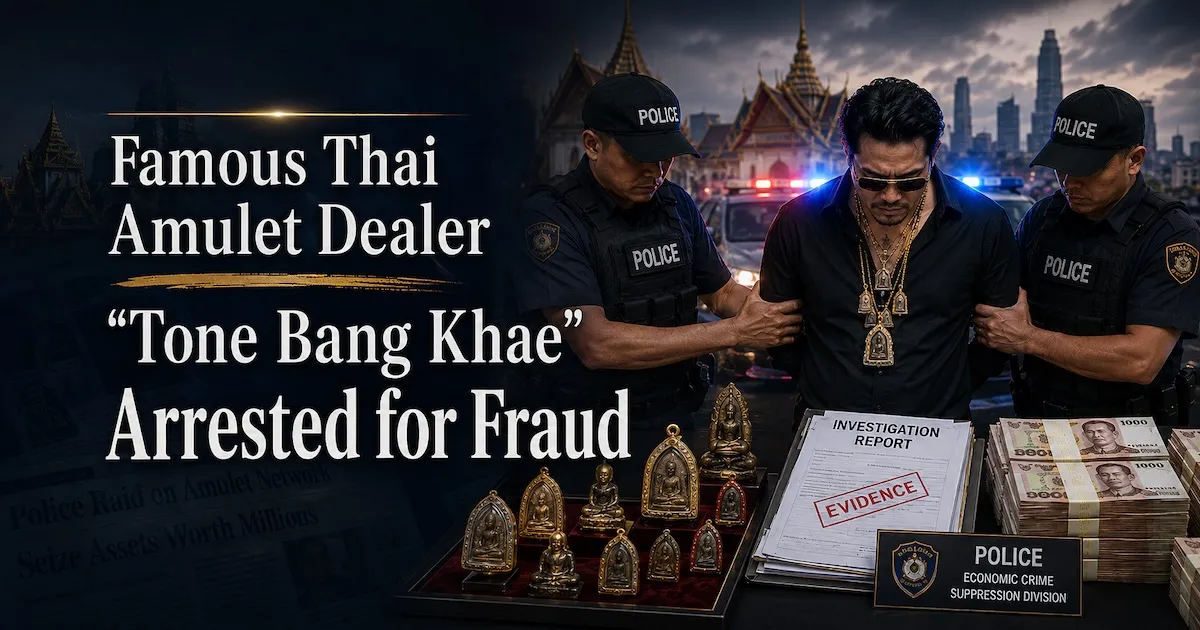
On Thursday, August 6, 2026, Thailand's Economic Crime Suppression Division (ECD) arrested Tone Bang Khae (โทน บางแค), legal name Tonthong Sukkaen, at his residence in Bang Yai district, Nonthaburi province, and searched his business premises in Bangkok's Bang Khae district. Police executed a court warrant on charges of fraud and issuing bounced checks, in a case investigators say involves damages exceeding 300 million baht.
From Slum Amulet Trader to Accused Fraud Investment Promoter
Tone Bang Khae built his reputation over decades as one of Thailand's most recognized "sien phra" — amulet connoisseurs and dealers who authenticate and broker high-value pieces for collectors. Raised in poverty in a Bangkok slum near the Bang Khae district, from which he took his trade name, he became a fixture of Thai amulet media, frequently profiled for turning humble origins into a fortune built on amulet trading. Recent investigative reporting by Thai outlets Thansettakij, Komchadluek, and Posttoday, however, found that four companies registered under his name have posted ongoing losses on paper despite his lavish public image. Police allege that Tone raised investment capital by promising high returns for expanding a business manufacturing "kong song phra" — magnifying loupes collectors use to inspect an amulet's surface texture and patina for authenticity — then failed to deliver returns and issued checks that bounced when investors sought repayment.
A Debt Dispute With a Senior Police Officer Preceded the Case
The arrest follows weeks of public sparring between Tone and a senior Royal Thai Police officer over a separate debt of several hundred million baht spanning two contracts. Tone had publicly accused the officer of using his rank to intimidate him over the debt; the officer countered that he had merely advised Tone to negotiate directly with the aggrieved investors. That dispute drew heavy media attention to Tone's finances well before the fraud case was filed. Following his arrest, Tone posted on social media insisting he "never fled" and would "fully cooperate" with investigators.
What This Means for Amulet Collectors
The case is a reminder that fame within the amulet trade is not a proxy for financial trustworthiness. A magnifying loupe is a legitimate and widely recommended tool — collectors use one exactly the way our guide on buying Thai amulets online and spotting fakes describes — but the credibility of any inspection tool or dealer depends on independent verification, not a seller's public profile or apparent wealth. As we outlined when covering a separate case in which a retiree lost $110,000 in a fake amulet and gold scam, the safest path for buyers is to rely on certificates from recognized bodies such as the Samakom Phra authentication society — see our guide on what a Samakom Phra certificate is — rather than any individual trader's reputation. Overseas collectors should treat any offer involving upfront investment, promised returns, or bulk pre-orders from a "celebrity" dealer with the same skepticism they would apply to an unlicensed online seller, no matter how many magazine profiles that dealer has received.
Source: Bangkok Biz News, Thairath