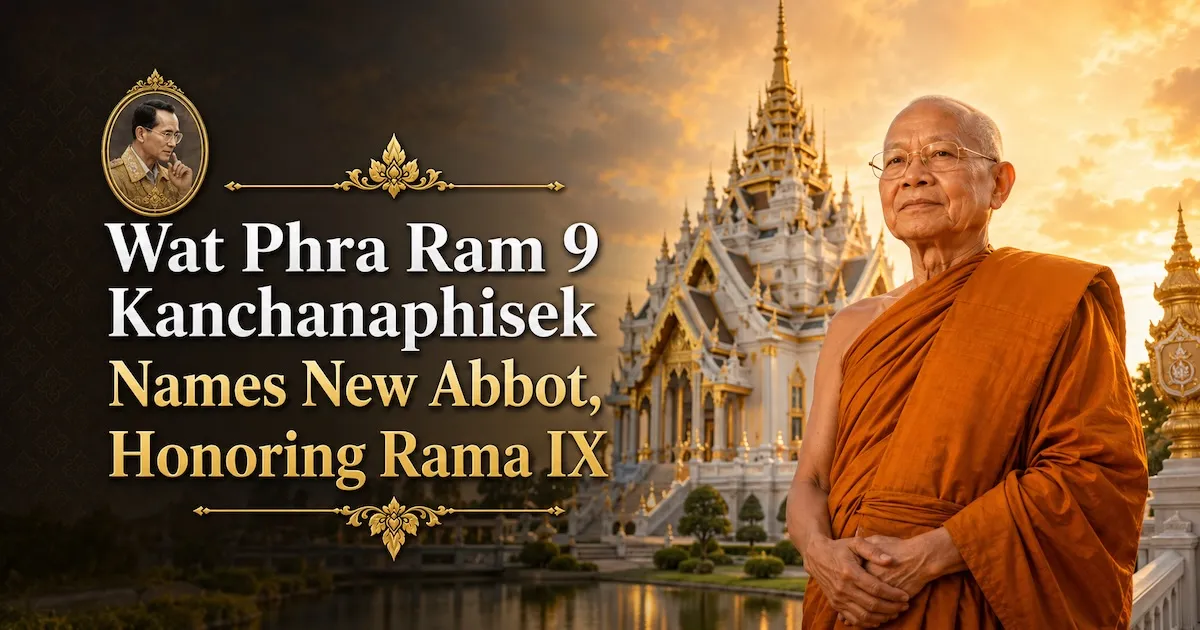
Thailand's Sangha Supreme Council approved the appointment of Phra Thep Vachirasuntorn (พระเทพวชิรสุนทร, secular name Thongchai Thammathacho) as the new abbot of Wat Phra Ram 9 Kanchanaphisek in Bangkok, at its 19th session of 2026 held on August 31 at Wat Bowonniwet Vihara. The appointment, endorsed by the Supreme Patriarch Somdet Phra Ariyavongsagatayana, fills a vacancy left by the temple's founding abbot, Phra Phrom Vachirasuthi (secular name Aphiphon Aphipalo), who died on April 2, 2026 at age 89.
Who Is the New Abbot
Before his elevation, Phra Thep Vachirasuntorn served for years as the temple's assistant and acting abbot, and holds the rank of upachaya (พระอุปัชฌาย์), the senior monk authorized to preside over ordination ceremonies. He has been a visible presence at the temple's merit-making events honoring the late King Rama IX, including chanting ceremonies and blood-donation drives held in the king's memory. His promotion from acting to permanent abbot follows the Thai Sangha's standard practice for filling a vacancy at a major temple: elevating the most senior, already-familiar deputy rather than bringing in an outsider, which keeps day-to-day administration and the temple's lineage uninterrupted.
Why This Temple Is Unusual
Wat Phra Ram 9 Kanchanaphisek did not begin as a religious project. It grew out of a 1988 initiative by the late King Bhumibol Adulyadej (Rama IX) to treat polluted water at the "Rama IX Swamp" in Bangkok's Huai Khwang district using an aeration method he helped design. Once the water treatment showed results, the King ordered on August 15, 1988 that a temple be built on the reclaimed wetland — with an explicit instruction to keep it economical. By 1997, the total construction and operating budget was capped at roughly 3 million baht, and the architecture deliberately avoided the ornate gilding typical of Thai royal temples in favor of simple, modern lines. Thai Buddhists have long referred to it as a model "sufficiency economy" temple, a deliberate contrast to the grand consecration ceremonies and limited-edition sacred objects that fund many other prominent temples.
What This Means for Amulet Collectors
A change of abbot is rarely just an administrative footnote — it determines who will preside over future consecration ceremonies (phutthaphisek) and vouch for the lineage of any commemorative objects a temple later issues. Wat Phra Ram 9 Kanchanaphisek is known for the opposite of amulet-driven fundraising, but that austerity is exactly why its leadership transitions are watched as a benchmark for institutional integrity in Thai Buddhism. The pattern here — a long-serving deputy quietly promoted rather than an outsider brought in — mirrors recent successions our readers may recognize from Wat Suthat's deputy abbot elevation and Wat Ratchanatda's new abbot appointment. For collectors trying to judge whether a temple's lineage and governance are stable enough to trust its future consecrated pieces, this kind of continuity is a useful signal worth watching. Readers wanting the broader monk lineages behind Thailand's most collected amulets can start with our guide to the Nine Great Monks of Thailand.
| Key Fact | Detail |
|---|---|
| Date of appointment | August 31, 2026 |
| Approving body | Sangha Supreme Council, 19th session, Wat Bowonniwet Vihara |
| New abbot | Phra Thep Vachirasuntorn (Thongchai Thammathacho) |
| Previous role | Assistant/acting abbot and upachaya of the same temple |
| Reason for vacancy | Founding abbot Phra Phrom Vachirasuthi died April 2, 2026, age 89 |
| Temple background | Founded 1988 on King Rama IX's initiative, built on a strict "sufficiency economy" budget, in Bangkok's Huai Khwang district |
Source: Dailynews