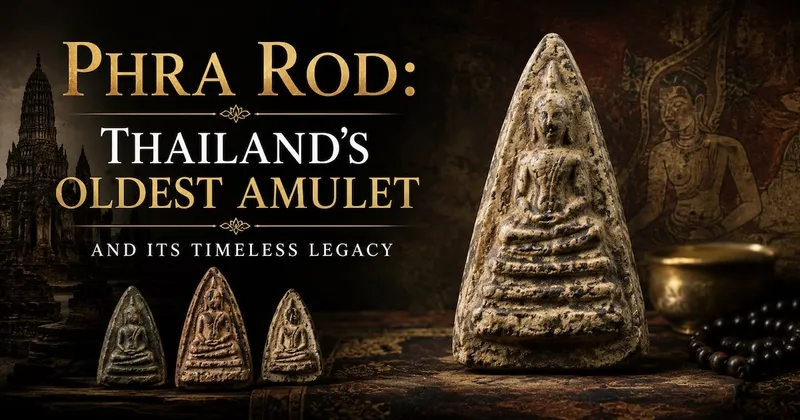
What Is Phra Rod?
Phra Rod is the oldest known type of Thai amulet, dating back approximately 1,300 years to the Haripunchai Kingdom (centered on modern-day Lamphun Province in northern Thailand). These ancient sacred powder tablets are considered one of the five most sacred amulet types in all of Thai Buddhism — the "Benjapakee" — a pantheon so revered that any single member represents the pinnacle of Thai amulet tradition.
While newer amulet types are more commonly worn today, Phra Rod holds a special status as the living proof that Thai amulet practice is not a modern invention but an ancient tradition stretching back to the earliest days of Buddhism in Southeast Asia.
Historical Origins
Phra Rod was created during the Haripunchai period (roughly 7th–13th century CE), one of the earliest Buddhist civilizations in mainland Southeast Asia. The Haripunchai Kingdom was a Mon cultural center that predated the Thai kingdoms of Sukhothai and Ayutthaya, and it was one of the primary channels through which Theravada Buddhism entered what is now Thailand.
The original Phra Rod amulets were created as votive tablets — small sacred objects pressed from clay or sacred powder mixtures and deposited inside stupas (chedi) as acts of merit. They were not originally intended to be worn. Instead, they served as portable representations of Buddhist teachings, created in large numbers so that the merit of their creation could be shared widely.
The primary source of Phra Rod amulets is Wat Mahawan in Lamphun, where they were discovered inside ancient stupas during restoration work. The discovery of hundreds of these tiny, ancient tablets created a sensation in Thai amulet culture, connecting modern practitioners to a tradition over a millennium old.
Appearance and Design
Phra Rod amulets are small, typically oval or rectangular tablets showing a seated Buddha figure in the Maravijaya (earth-touching) posture. Key identifying features:
- Size — Small, usually 2-3 centimeters in height
- Material — Sacred powder/clay mixture that has hardened over centuries
- Design — A seated Buddha figure, often with a pointed or rounded arch behind the head representing a halo or bodhi tree
- Surface texture — Ancient pieces show unmistakable signs of extreme age: deep surface cracking, mineral deposits, and a distinctive patina that develops only over centuries
- Color — Ranges from brown to grey to reddish-brown depending on the specific clay composition and centuries of environmental exposure
Spiritual Significance
Phra Rod carries spiritual significance on multiple levels:
- Accumulated merit — Over 1,300 years, these objects have been venerated by countless devotees, each act of respect adding to the accumulated spiritual energy of the piece.
- Connection to ancient Buddhism — Wearing a Phra Rod connects the wearer to the earliest layer of Buddhist practice in Southeast Asia.
- Klaew Klaad (danger evasion) — Phra Rod is particularly associated with the power to help the wearer escape from dangerous situations.
- Metta Mahaniyom — The loving-kindness energy accumulated over centuries of veneration is considered exceptionally potent.
The Benjapakee: Five Supreme Amulets
Phra Rod belongs to the Benjapakee — the five most sacred amulet types in Thai Buddhism. The complete set is:
- Phra Rod (Lamphun) — The oldest, from the Haripunchai period
- Phra Somdej (Bangkok) — Created by Somdej Toh at Wat Rakang
- Phra Nang Phaya (Phitsanulok) — Ancient tablets from the Sukhothai period
- Phra Phong Suphan (Suphanburi) — Ancient sacred powder tablets
- Phra Soomkor (Kamphaeng Phet) — Sukhothai-era tablets
Owning even one genuine piece from the Benjapakee is considered a lifetime achievement for Thai amulet collectors.
Market Value and Authentication
Genuine Phra Rod from the Haripunchai period are among the most valuable amulets in existence. Prices for authenticated pieces can reach hundreds of thousands of dollars — comparable to fine art or rare archaeological artifacts.
Because of this extreme value, counterfeits are rampant. Authentication requires expert evaluation — the aging patterns, material composition, and specific mold characteristics of genuine Phra Rod are well-documented by Thai amulet competitions but extremely difficult for non-experts to verify. For any purchase claiming to be an ancient Phra Rod, competition certification from a recognized Samakom is essentially mandatory.
Phra Rod for Modern Practitioners
While original Haripunchai-period Phra Rod is museum-grade collectible, modern temples in Lamphun Province create commemorative editions honoring this ancient tradition. These modern pieces are properly consecrated and carry genuine spiritual significance at accessible prices, offering practitioners a connection to the oldest known layer of Thai amulet practice.
Browse our collection or learn more about other historic amulet types in our guide to Phra Somdej. For the complete beginner's overview, see our introductory guide.