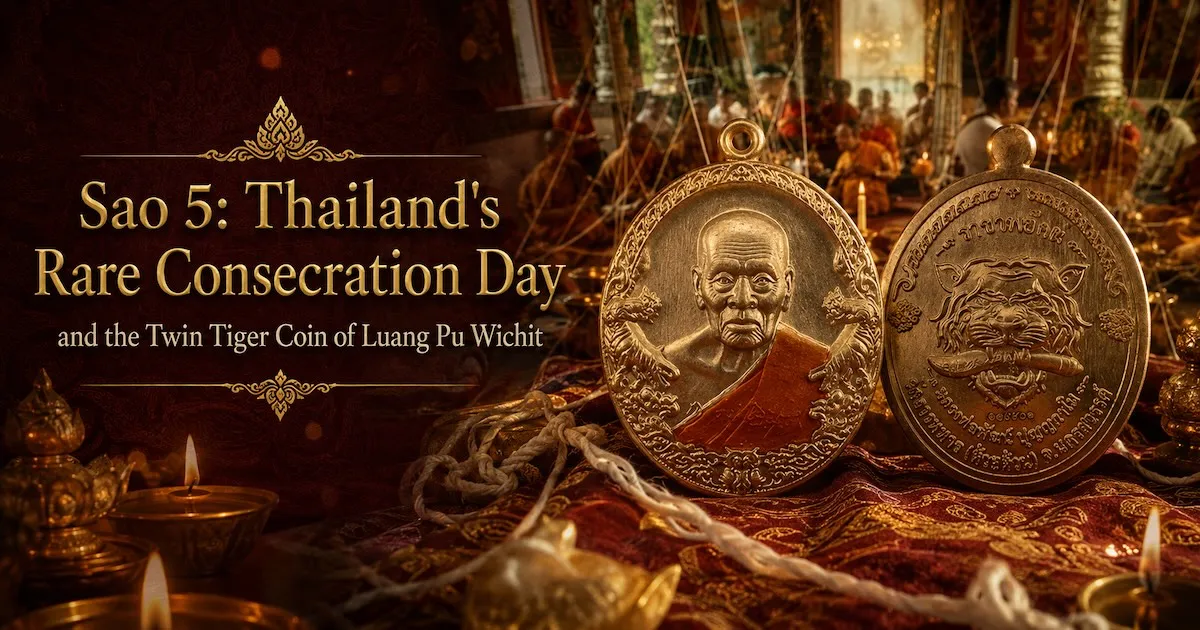
What the rare Sao Ha (Saturday the Fifth) consecration day means in Thai tradition, why tiger amulets dominate it, and a close look at the B.E. 2567 twin tiger coin of Luang Pu Wichit.
Among Thai consecration traditions, few dates carry more weight than Sao Ha — "Saturday the Fifth" — when a Saturday coincides with the fifth day of the fifth lunar month. The alignment happens rarely, sometimes with years between occurrences, and Thai tradition holds that sacred objects empowered on this day are exceptionally potent, particularly for protection, authority, and turning back misfortune. This article explains what Sao 5 means, why tiger imagery dominates it, and looks at a current example: the twin tiger coin of Luang Pu Wichit.
What makes Sao 5 special
Thai Buddhist consecration is calendrical as much as ritual: the day chosen for a ceremony is believed to shape the character of the blessing. Sao Ha combines Saturday — the day of Phra Sao (Saturn), associated with endurance and the power to withstand hardship — with the doubled five of the fifth day of the fifth month. Amulets blessed at a Sao 5 ceremony are traditionally credited with strong kong grapan (invulnerability) and klaew klaad (escape from danger) qualities. Because the date is rare, temples plan major ceremonies around it, and collectors specifically seek out "Sao 5 batch" pieces.
Why tigers
The tiger is Thailand's great emblem of authority and fearlessness. Tiger amulets are worn by people who face confrontation or competition — traditionally soldiers and police, today just as often business owners and negotiators. A twin tiger doubles the symbolism: power paired with vigilance. For the broader tiger tradition, see our profile of Luang Phor Pern, the tiger monk of Wat Bang Phra.
The Luang Pu Wichit twin tiger coin, B.E. 2567
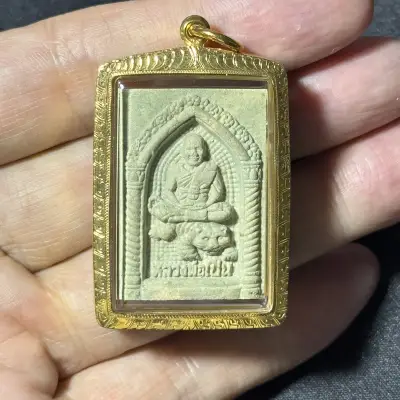
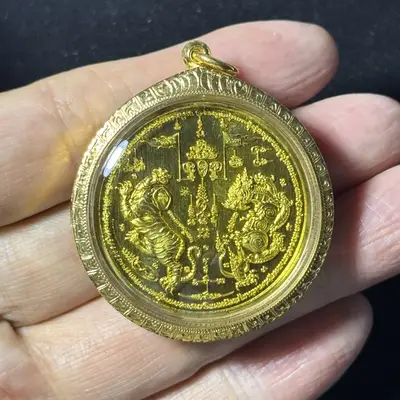
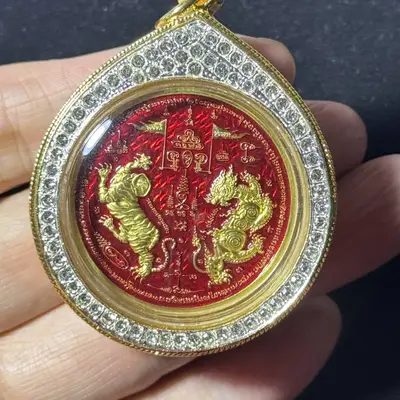
Our collection includes two examples of the Rian Suea Khu (twin tiger coin) by Luang Pu Wichit of Wat Phutthabat Khao Nangnom: this enamel brass piece and a second one-of-a-kind example. Both were consecrated in B.E. 2567 with the master presiding, passed through five consecration ceremonies including the Sao 5 rite, and come cased in Italian gold-plated shells with rhinestone bezels. The enamel work gives the tigers their colour; the five-ceremony history is what collectors of protective amulets look for.
Who should consider a Sao 5 tiger amulet
- People in competitive or confrontational work — sales, litigation, management, security
- Those who feel targeted by hostility, office politics, or ill-wishers
- Travellers and drivers who want the classic protective pairing of power and escape-from-danger
- Collectors who value ceremony provenance: a documented Sao 5 blessing is a datable, checkable fact
Tiger amulets carry a commanding energy, and tradition advises wearing them with restraint and respect — they are not usually recommended as a first amulet for someone seeking gentle, all-round luck. If that is you, start with our first amulet guide or browse the protection collection.
Frequently asked questions
Is Sao 5 only about protection?
Protection and authority are the core associations, but Sao 5 batches span many forms. The date is understood as an amplifier of whatever the ceremony consecrates, which is why temples reserve important batches for it.
Can I wear a tiger amulet together with a Buddha-image amulet?
Yes, and it is common practice. Keep the Buddha image in the senior position (centre or highest) and the tiger as a flanking piece. Details in our wearing rules guide.