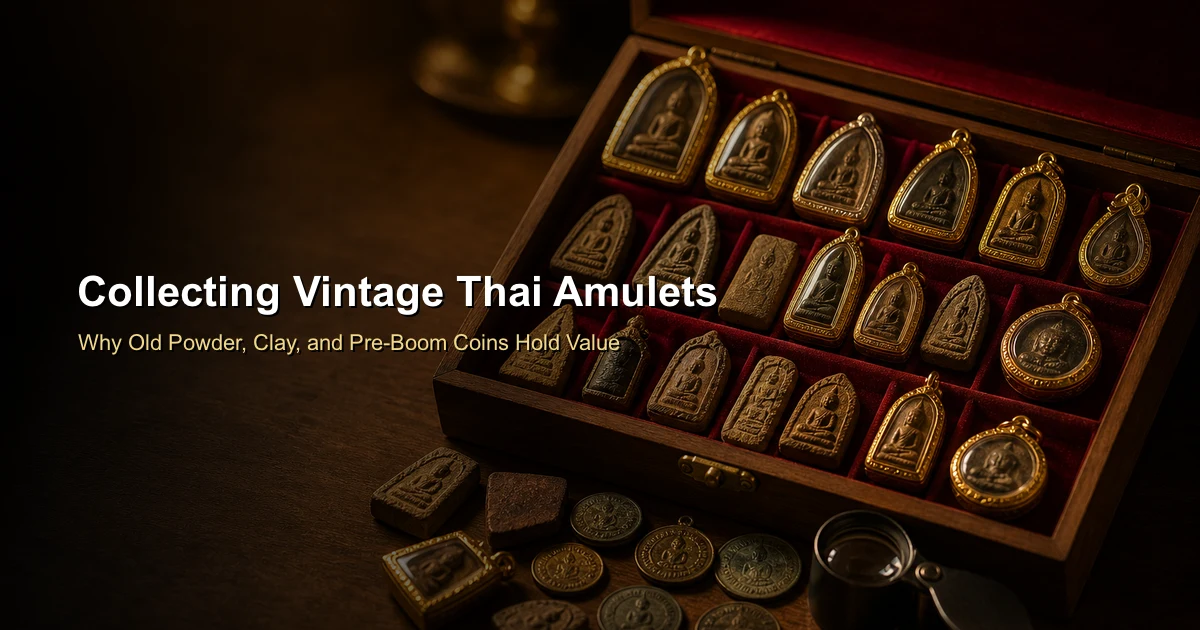
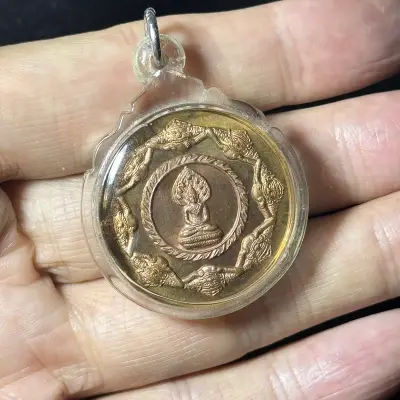
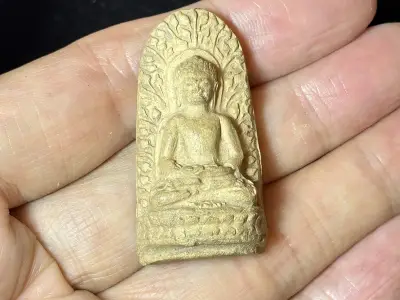
The four pillars of vintage amulet value, the main categories to know, real examples in our collection, and how to buy old pieces without getting burned.
Why Old Amulets Command a Premium
Walk into the world of Thai amulets and you quickly notice a pattern: two pieces of the same type, from the same tradition, can differ in price by a factor of ten — and the older one usually wins. To a newcomer this can seem like mere nostalgia. It is not. Vintage value in Thai amulets rests on concrete, understandable factors, and learning them is the first real step from casual buyer to collector. This guide lays out what makes an old piece worth collecting and how to buy one wisely.
The Four Pillars of Vintage Value
1. A closed and shrinking supply
Once a master dies, the supply of amulets he personally consecrated can never grow. Every genuine piece that survives is part of a fixed pool that only shrinks as amulets are lost, damaged, or locked away in collections. This simple fact underlies almost all vintage value.
2. Irreplaceable materials
Old powder and clay amulets were made with relics, robes, herbs, and sacred earth that no longer exist. A modern tribute batch can copy a mold, but it cannot include a fragment of a robe consumed fifty years ago or powder ground by a master who is long gone.
3. Accumulated reverence
Collectors describe a "resonance" that a piece gathers over decades of being worn, prayed with, and honored. Whatever one makes of it spiritually, it is a real part of how the tradition values age — something a freshly pressed amulet simply has not had time to acquire.
4. Provenance and rarity of type
Pre-boom coins, first editions, final-year issues, small original mold runs — categories defined by history and scarcity carry premiums. A Jatukham coin struck before the 2007 boom, for instance, sits on the valuable side of that market's great divide, while late-boom mass issues do not.
The Main Categories of Vintage Pieces
- Old powder (pong). Pressed sacred powder whose value rests on the formula, the master, and the age. See our guide to Thai sacred powder amulets.
- Old clay (din). Fired sacred clay, sturdier than powder, common in northern and central vintage pieces.
- Pre-boom coins and medals (rian). Metal issues valued for early dates and source-temple provenance.
- Cast images (loi ong / bucha). Metal-cast figures and altar pieces from respected editions.
Vintage Pieces in Our Collection
Several recent additions illustrate these categories well:
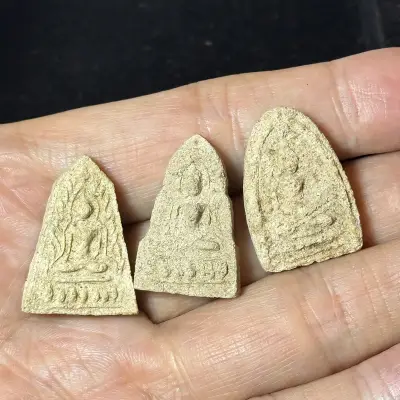
- Luang Pho Chai Success Buddha powder, B.E. 2497 (฿3,300) — a seventy-year-old piece in the legendary Itthije Maha Phut powder.
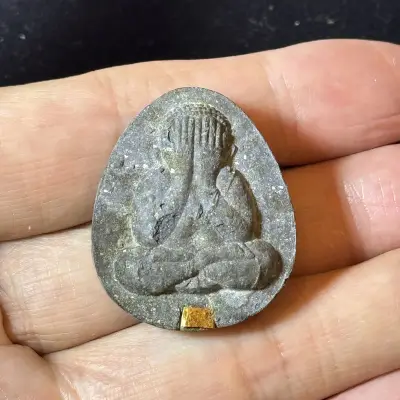
- Luang Pho Pae Phra Pidta with gold leaf, B.E. 2541 (฿5,600) — a final-year issue from a master who passed in 1999.
- Luang Pu Waen sacred clay, B.E. 2516 (฿4,600) — a golden-period clay piece from a forest master.
- Jatukham Rammathep copper coin, B.E. 2547 (฿5,600) — a pre-boom issue from the founding temple.
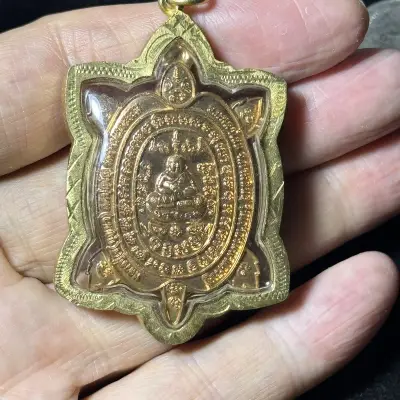
- Luang Pu Je wealth turtle, B.E. 2563 (฿4,200) — a first-edition turtle from a master who passed in 2025.
Each is one of a kind, individually documented, and sold with an authenticity guarantee.
How to Buy Vintage Without Getting Burned
- Demand documentation. An authenticity card and a clear account of origin should be non-negotiable for any piece of real value.
- Understand the market's divides. Learn which years, temples, and editions carry value in a given category — pre-boom versus late-boom, source temple versus opportunistic issue.
- Be wary of "too old, too cheap." Artificial aging is common; a suspiciously cheap "century-old masterpiece" usually is not one.
- Lean on trusted sourcing. Until your own eye is trained, provenance and a reputable seller matter more than your own read of surface wear. Our guide to dating Thai amulets helps you interpret the years involved.
- Buy what you would keep. The best collector's mindset is to buy pieces you genuinely value; devotional worth does not depend on resale.
Frequently Asked Questions
Is an expensive vintage amulet always more powerful than a new one?
Not necessarily. Price reflects rarity, age, and demand, not a spiritual ranking. A well-consecrated modern piece from a respected lineage can be deeply meaningful. Vintage value is about scarcity and history layered on top of devotional worth.
How do I start collecting if I am a beginner?
Begin by choosing one category or master that speaks to you and learn it well. Buy documented pieces from a trustworthy source, read widely, and let your eye develop before spending on high-value rarities.
Do "one of a kind" pieces sell out permanently?
Yes. A one-of-a-kind vintage listing is a single physical object; once sold, it is gone, and an identical replacement cannot be sourced. That is part of what defines the category.
Want guidance on starting or extending a collection? Talk to us on WhatsApp.