TL;DR: The White Dragon King (Bai Long Wang, 白龍王; born Chow Yam-nam, 周欽南; Thai กิมน้ำ จิรรัตนพิเชษฐ์, known to Thais as หลวงปู่มังกรขาว) was born in Pattaya, Chonburi, in 1937 to a family from Chaozhou, Guangdong, and died on 17 August 2013, aged 76. Devotees believed he was the incarnation of a Taoist deity of the same name, and many Hong Kong and Taiwanese stars travelled to see him. Blessing cloths and other sacred objects from his shrine are still collected; for old pieces, check the Association certificate and separate it from seller claims.
Who was he?
Chow Yam-nam was born to Chinese parents on 19 June 1937 in Pattaya. Before he became known he reportedly repaired electronics and bicycles and worked as a hawker. Accounts of his awakening differ: a manifestation at 13, a near-fatal car accident in his twenties, or a dream in his forties. Devotees believed he was the incarnation of the Taoist White Dragon King and regarded him as a living saint.
He taught himself palmistry, feng shui and fortune-telling, and spent his later life receiving devotees at his temple in Pattaya. He died of long-standing bronchitis on 17 August 2013, aged 76.
Why Hong Kong and Taiwanese stars went to him
Much of his fame in the Chinese-speaking world came from show business. According to Wikipedia and Hong Kong press reports, Jackie Chan, Andy Lau, Leon Lai, Carina Lau, Sammi Cheng and Show Lo all met him, while Tony Leung Chiu-wai, Eric Tsang, Wong Jing and Shu Qi were counted among his devotees; Tony Leung and Eric Tsang flew to Thailand to pay their respects after his death. He is also said to have blessed Infernal Affairs before filming. These stories made a visit to the White Dragon King part of many Hong Kong and Taiwanese trips to Thailand.
How visits worked
By contemporary accounts, visitors dressed in white and began queueing from 4am, lighting 17 sticks of incense before being admitted. One-to-one meetings often lasted about five minutes and group blessings about fifteen. He read faces, gave guidance and sometimes chose or changed names for devotees.
His sacred objects: Pha Yant cloths
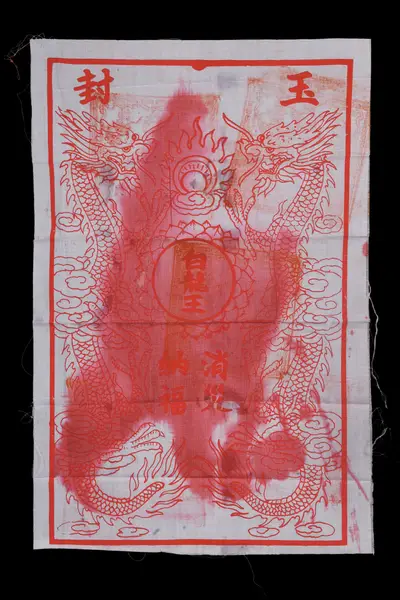
The most common objects from his shrine are Pha Yant (ผ้ายันต์) blessing cloths: red print on white cloth with twin dragons, a flaming eye, the 白龍王 seal and the words 消災納福 ("dispel misfortune, receive blessings"), hung at home, in shops or in cars for safety, helpful patrons and protection of the space. Many also carry hand-applied red marks, so no two are alike.
The Thai Buddha Image Admiration Association classes these cloths as เครื่องราง (talismans) and records them by year, for example ผ้ายันต์หลวงปู่มังกรขาว พ.ศ. 2531 (B.E. 2531, 1988).
How to hang and keep a cloth
- Placement: high up in the main room, behind a shop counter or in an office, kept clean; framing is fine.
- Handling: avoid folding or crushing it, and never keep it low or where it could be stepped on.
- Mindset: a cloth is for blessing and support, not a guaranteed result; see Thai amulet rules and taboos.
What to check on an old piece
- Certificate: it should be searchable on the Association website; see the Samakom Phra certificate guide.
- Certificate vs story: claims such as "the earliest batch" or "marked by his own hand" are usually not on the certificate; an honest seller labels them as the supplier's account.
- Dates: subtract 543 from the Buddhist Era year for the Western year.
In our collection
FAQ
Q: Was the White Dragon King a monk?
A: No. He was a lay Chinese-Thai spiritual figure believed by devotees to embody a Taoist deity. Thais addressed him respectfully as หลวงปู่ (Luang Pu), but he was not an ordained monk.
Q: Is he still alive?
A: He died on 17 August 2013, aged 76. Reports say a daughter succeeded him, but sources for this are thin.
Q: Where is his temple?
A: In the Pattaya area of Chonburi province. Check current opening times and visiting rules before you go.
Q: Who is a White Dragon King cloth for?
A: Anyone seeking helpful patrons, a career breakthrough or a change of luck, business owners, and his devotees.
Last updated: November 2026 | By the Merit Messenger team, based in Bangkok
Looking for certified pieces from figures revered across the Chinese-speaking world? Browse our collection or contact us.